Room layouts follow predictable logic. Beds go against walls. Sofas face entertainment centers. Desks sit near windows. These arrangements make spatial sense, but they consistently place furniture directly in front of the outlets people need several times a day.
The outlet exists, the cable reaches, but the physics of a bed frame or sofa placed against a wall creates a gap that’s just narrow enough to be annoying. Plugging in an iPhone before sleep or charging a MacBook near the couch requires either moving furniture slightly, threading a cable through a small space, or accepting a charging setup that lives awkwardly on top of or beside the obstacle.
This isn’t new. People have dealt with blocked outlets since furniture existed. What changed is how often Apple devices need access to power throughout the day, and how many of those devices someone owns simultaneously. An iPhone charging overnight, an iPad near the couch, AirPods on a desk, a MacBook somewhere in between—each one multiplies the outlet access question.
Some people solved this by adding power strips, but power strips are rigid. They sit in one location, and if that location is behind a sofa, the problem persists. The strip itself becomes another object competing for the same inaccessible space.
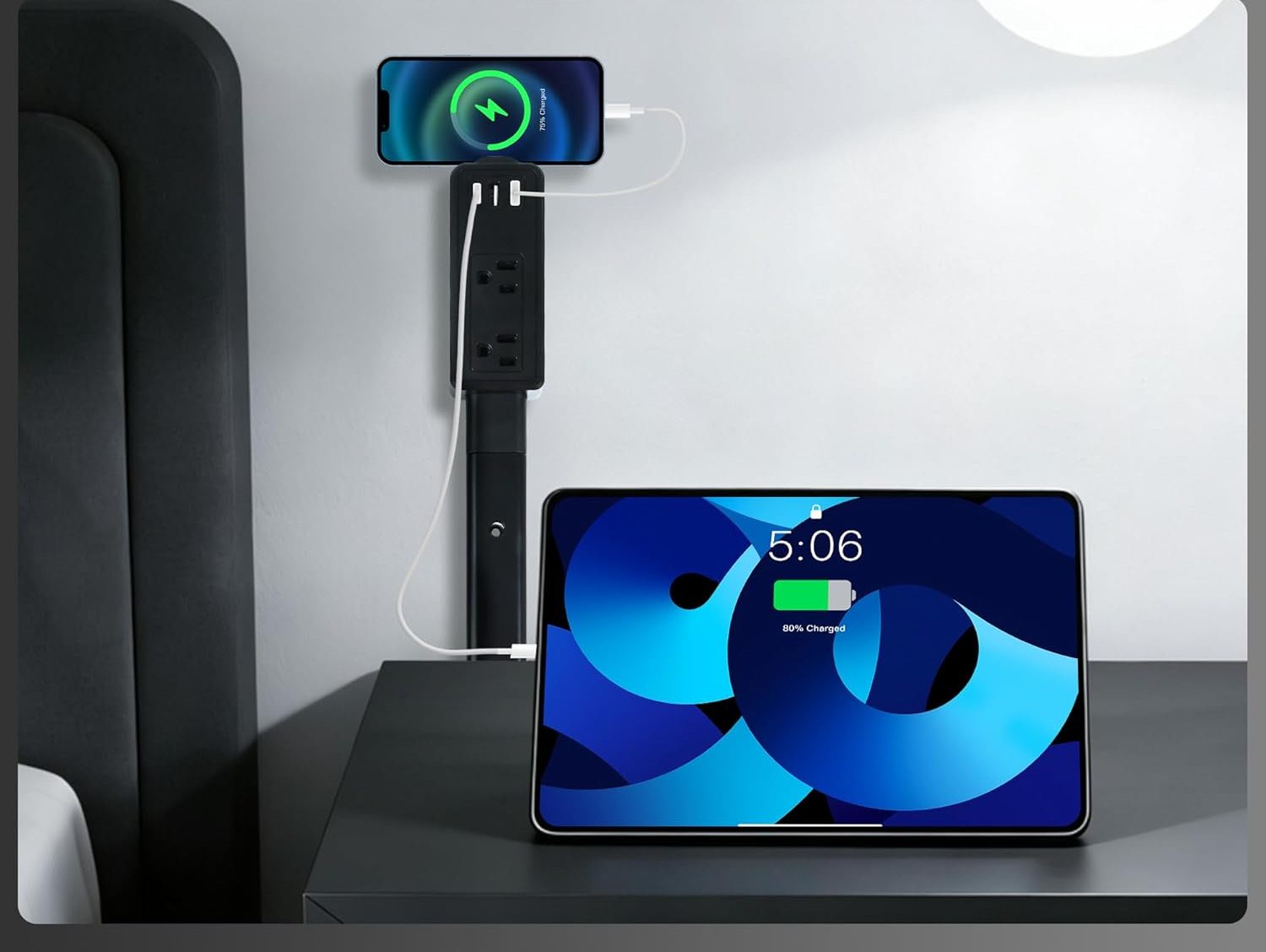
The extension concept isn’t complicated—it just moves the outlet opening away from the wall and into a reachable position. But the gap between “this would be useful” and “I should actually address this” is surprisingly wide. Most people live with the inconvenience until something specific triggers action: rearranging a room, adding a new device, or the low-level irritation of threading a cable behind furniture one too many times.
What’s telling is that this solution addresses a problem Apple’s hardware can’t fix. The iPhone’s battery life improves, charging speeds increase, cable lengths vary—but none of that changes the fact that outlets remain where builders installed them decades ago, often in positions that made sense before rooms contained multiple rechargeable devices.
Some listings currently reflect a reduction of roughly 20 percent compared with earlier availability. But the cost that matters is the cumulative friction of reaching behind a bed frame twice a day for months, or accepting that the couch will never quite sit flush against the wall because a charging cable needs to fit through the gap. Eventually, that adds up.
"Note: Readers like you help support The Apple Tech. We may receive a affiliate commission when you purchase products mentioned on our website."