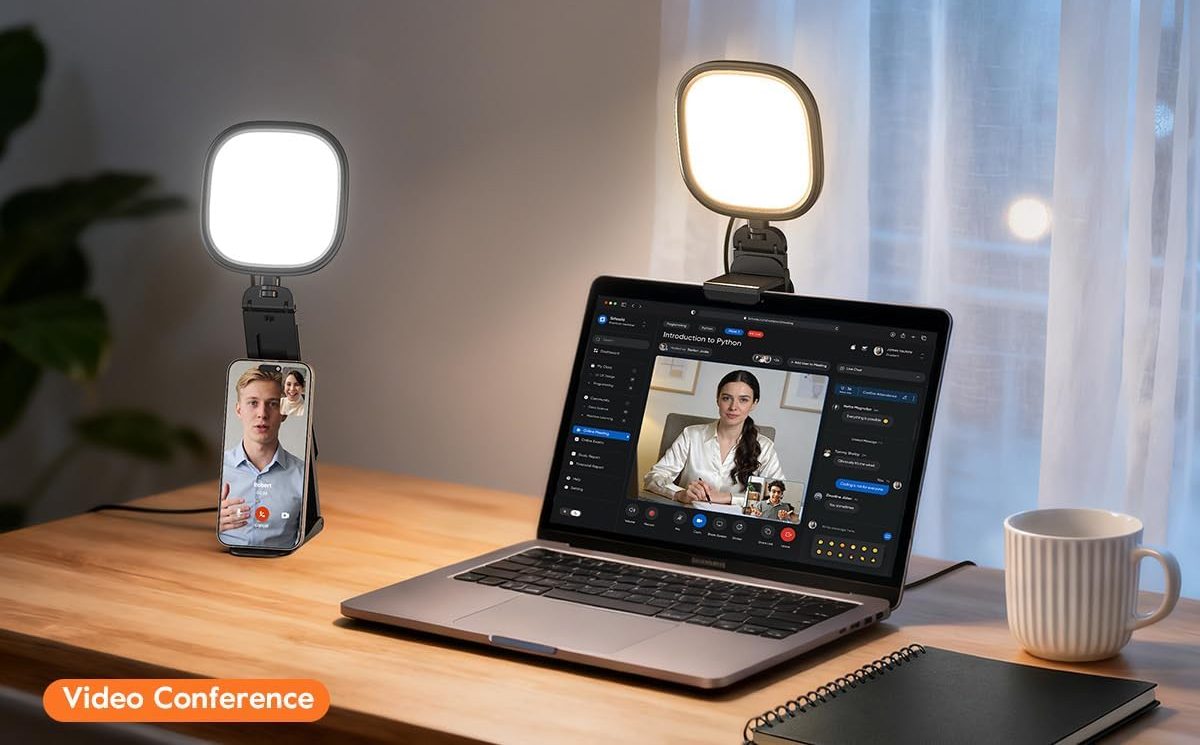
Apple users who transitioned to remote work during the pandemic developed a set of small, repeated adjustments that have since become invisible. One of the most persistent involves lighting. Not room lighting in general, but the specific challenge of appearing clearly on camera while staring at a bright display for extended periods.
The friction isn’t dramatic—it’s the small, repeated gesture of tilting a laptop screen or shifting a chair to catch better light before unmuting. Many Mac users positioned displays near windows, then spent months squinting against glare or appearing shadowed on video calls. The display itself provides some illumination, but it’s designed to be viewed, not to light a face evenly.
This created a quiet workflow disruption. Apple’s ecosystem emphasizes continuity and minimal setup, but desktop video calls introduced a variable the hardware wasn’t designed to address directly. Users adapted by opening blinds at specific angles, positioning lamps awkwardly, or simply accepting that they’d look underlit compared to colleagues who’d invested in dedicated setups.
What’s notable is how long this adaptation persisted without much discussion. Apple users are accustomed to devices that work well out of the box, and video calls technically functioned fine. The issue was ambient, not functional. It didn’t register as a problem requiring a solution—just an accepted condition of remote work.
Over time, some users began adding supplemental lighting that mounts directly to displays or laptop screens. These aren’t ring lights in the traditional influencer sense, but diffused LED panels that clip onto the hardware itself. They integrate into existing desk setups without requiring new furniture or repositioning. For users already managing multiple Apple devices across a single workspace, this approach aligns with existing habits around minimizing cable clutter and preserving desk real estate.
The behavior shift is subtle. Users don’t think of it as upgrading their lighting—they’re reducing a small, recurring irritation that had become part of the daily routine. The adjustment happens almost passively, the way someone might eventually add a laptop stand after months of neck strain.
Listings for display-mounted lighting currently reflect a reduction of roughly 40 percent compared with earlier availability, though pricing remains variable across different configurations and feature sets.
"Note: Readers like you help support The Apple Tech. We may receive a affiliate commission when you purchase products mentioned on our website."