
There’s a specific choreography Apple users perform each night: iPhone plugged into the cable on the left, Apple Watch on the magnetic charger behind the lamp, AirPods case connected to whichever cable isn’t currently occupied—or not, if you’ve run out of accessible outlets. It became automatic. You didn’t think about it. You just developed a system that accounted for having more devices than convenient charging points.
The adaptation happened so gradually that most Apple ecosystem owners couldn’t identify when their nightstand became defined by cable management. You bought longer cables to reach from distant outlets. You installed power strips specifically to accommodate multiple device charging. You developed hierarchies—iPhone always charges, Watch charges most nights, AirPods charge when you remember or when battery anxiety sets in. These weren’t conscious decisions. They were the inevitable mathematics of Apple’s ecosystem expansion meeting residential electrical infrastructure designed decades earlier.
What’s revealing isn’t that multi-device charging stations exist now—it’s how many Apple users had internalized cable sprawl as the natural state of device ownership. The constraint shaped spaces and routines in ways most people never consciously recognized. Nightstands needed to be positioned near outlets. Hotel stays required advance planning about which devices would charge and which would run low. Travel meant carrying multiple cables and a power brick, accepting that the charging solution occupied more bag space than the devices themselves.
Nighttime device management became a case study in normalized friction. You untangled cables that had twisted together overnight. You played spatial Tetris figuring out how to position three devices and three cables in the available nightstand real estate. You woke up to discover that one cable had worked itself loose, leaving a device dead. Apple users treated these small frustrations as inherent to owning nice things rather than symptoms of a design problem that transcended any single device.
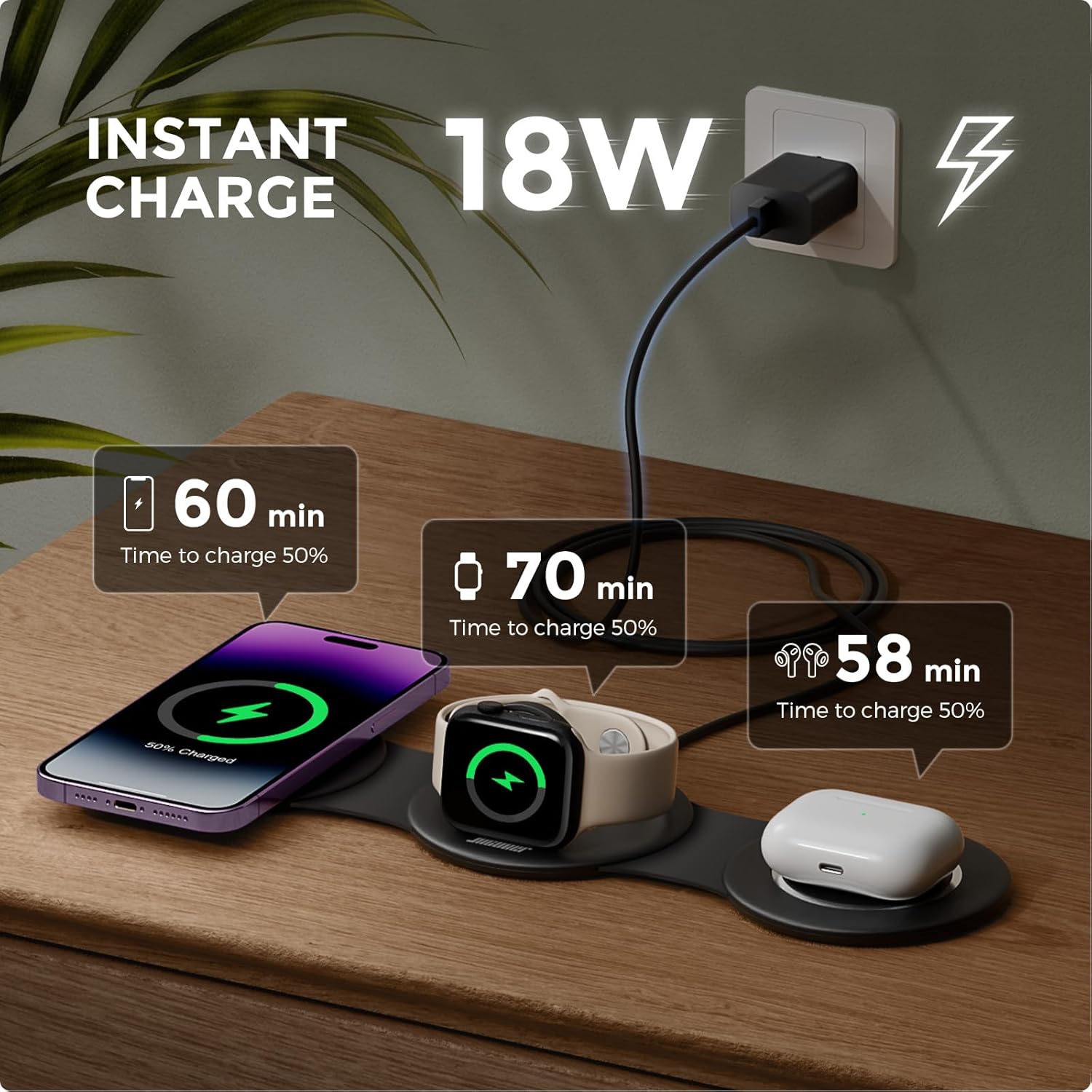
The consolidated charging station didn’t just organize cables—it eliminated the entire category of micro-decisions that had been happening every evening. For Apple users accustomed to performing nightly charging calculus, the absence of that mental load revealed how much cognitive space had been devoted to remembering which device needed priority, which cable went where, and whether you’d actually plugged everything in correctly before getting into bed.
What shifted wasn’t the devices themselves—it was the recognition that an entire ritual of cable management had been mistaken for the inevitable cost of ecosystem participation. Apple users who’d spent years optimizing their charging setup suddenly realized they’d been solving a problem that shouldn’t have existed in the first place. One surface. One connection point. All devices charging simultaneously without negotiation or planning.
The price has quietly dropped since many users first adapted to this habit. It now costs less than when most Apple users learned to work around it. The price shift went largely unnoticed, much like the behavior itself. A link is included solely to document the change.
The charging station didn’t add convenience. It revealed how much mental energy had been devoted to managing which devices would wake up alive. For Apple ecosystem owners who spent years developing elaborate systems to accommodate multiple charging cables in limited space, that simplification feels less like gaining a feature and more like finally questioning why device charging had required so much evening choreography at all.
"Note: Readers like you help support The Apple Tech. We may receive a affiliate commission when you purchase products mentioned on our website."