
There’s a specific nighttime micro-anxiety Apple users know well: wondering whether your iPhone is actually charging or just sitting on the MagSafe puck making contact but not drawing power. You can’t see the screen without picking it up. You can’t verify the connection without breaking it. So you develop faith-based charging—you place the device, you assume it’s working, and you won’t know until morning whether that assumption was correct.
The adaptation happened so thoroughly that most Apple ecosystem owners couldn’t remember when they started treating charging as an invisible process. You learned to estimate charge time based on how dead the battery was when you plugged in. You developed mental models: iPhone needs two hours, Watch needs ninety minutes, AirPods are probably fine after an hour. These weren’t facts. They were educated guesses that you refined through trial and error, waking up to devices that weren’t fully charged because your timing was wrong.
What’s revealing isn’t that charging stations with clock displays exist now—it’s how many Apple users had internalized information scarcity as the natural state of overnight charging. The constraint shaped behavior in ways most people never articulated. You checked devices before bed to verify they were charging. You woke up during the night to physically lift your iPhone and check the battery percentage. You left devices charging longer than necessary because you had no way of knowing when they’d actually finished.
Nighttime charging became a case study in accepted blindness. Apple’s design philosophy prioritized clean surfaces and minimal indicators—charging happened silently, invisibly, without status LEDs or progress bars you could see from across the room. Users adapted by developing elaborate verification rituals. You tilted your head at specific angles trying to see the iPhone screen without triggering Face ID. You learned which surfaces reflected enough light to show the Watch’s charging ring. You picked up the AirPods case and opened it just to check the light inside.
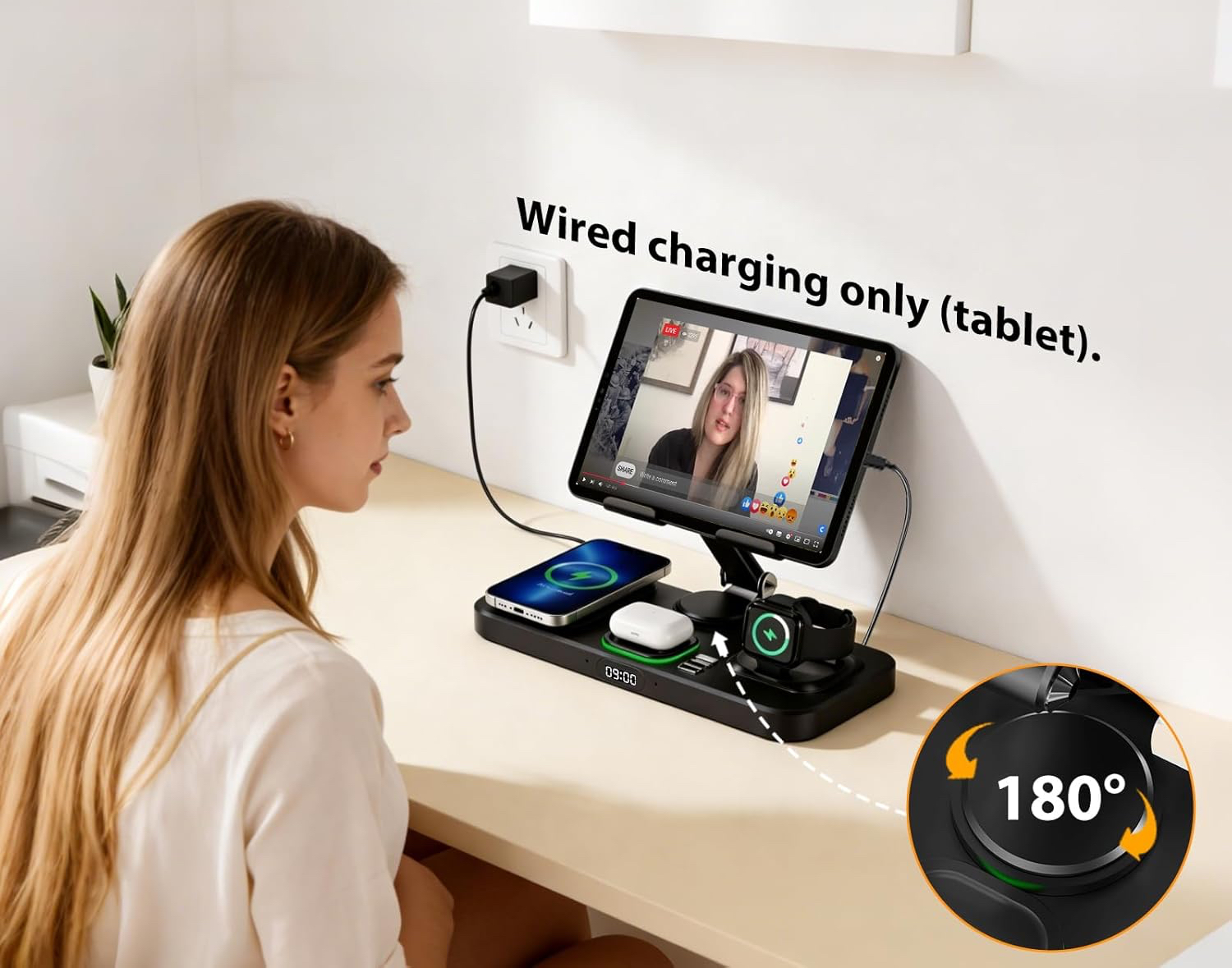
The charging station with clock display didn’t just show the time—it made the invisible visible. For Apple users accustomed to charging being something that happened in an informational void, seeing actual status felt revelatory. You could glance at the display and know whether devices were charging, how long they’d been charging, whether you had time to shower before they finished. The information had always existed, locked inside the devices. It just hadn’t been accessible without interrupting the process to check.
What shifted wasn’t the charging itself—it was the recognition that an entire category of uncertainty had been normalized as elegant design. Apple users who’d spent years developing estimation techniques and verification habits suddenly realized they’d been working around the absence of information that could have simply been displayed. The clock wasn’t even the main feature. It was the secondary benefit of a charger that acknowledged users might want to see what’s happening without consulting the devices themselves.
The price has quietly dropped since many users first adapted to this habit. It now costs less than when most Apple users learned to work around it. The price shift went largely unnoticed, much like the behavior itself. A link is included solely to document the change.
The display didn’t add information that didn’t exist. It surfaced information that had been trapped inside devices you couldn’t see while they charged. For Apple ecosystem owners who spent years perfecting the art of charging estimation and middle-of-the-night battery checks, that transparency feels less like a feature and more like someone finally questioning why charging had to be an act of faith.
"Note: Readers like you help support The Apple Tech. We may receive a affiliate commission when you purchase products mentioned on our website."