
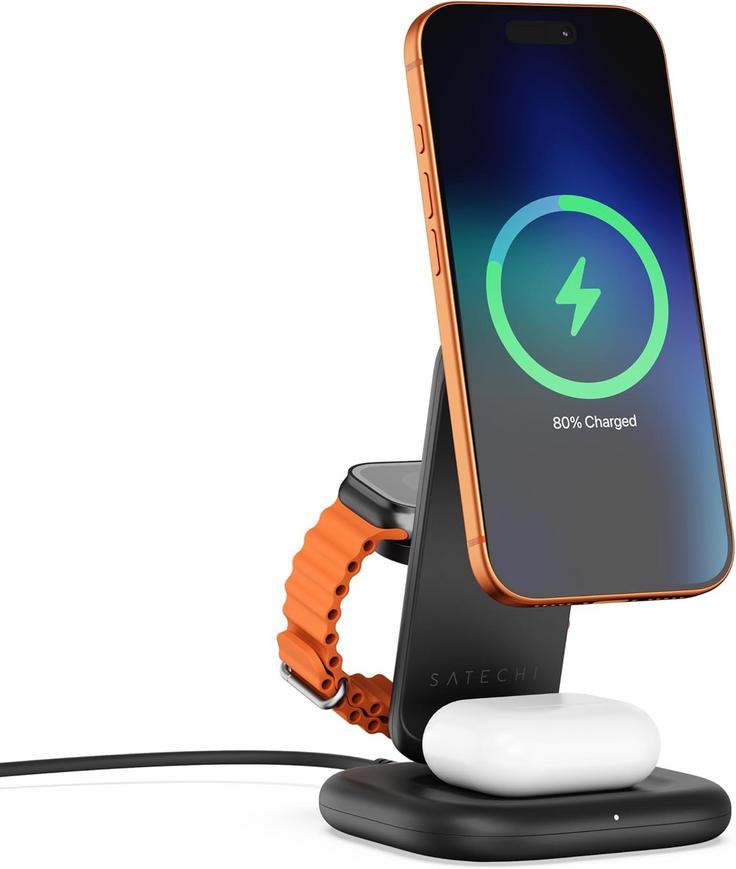
In many Apple-centered spaces, nightly charging unfolds less like a convenience and more like a cautious negotiation. As the room darkens, a muted lamp reveals the familiar tangle of cables beside an iPhone and an AirPods case. The Satechi 3-in-1 Qi2 Wireless Charging Station subtly inserts itself into this quiet choreography, promising to corral devices into a single resting spot. Yet its arrival matters only in how it reshapes the small habits we seldom scrutinize.
Just before sleep, reaching out for the phone in the dark offers a brief, familiar friction. The cool metal finish brushes against fingertips as the cable slides between knuckles. There’s a momentary pause: does the battery percentage sit above eighty percent? Can you trust the overnight top-off? These low-light rituals reveal a lingering concern that extends beyond one device—an unspoken anxiety woven into the palm of a hand.
On a cluttered desk, the foldable stand emerges as a silent organizer. It leans and tucks under a MacBook’s edge one moment, then props an iPhone upright for a quick glance at incoming notifications. The station’s contours nod to a workspace that resists more cables but still accommodates multiple battery domains. It does not announce itself; rather, it quietly accommodates the gentle tug between productivity and readiness.
Travel introduces another dimension of this dependence. Slipping the stand into a backpack, alongside an iPad and a charger block, becomes part of a growing list of compact routines. In coffee shops, the magnetic connection offers a reassuring click that punctuates the bustle. Such encounters underscore how device ecosystems persist outside the home, shaping the way we relocate power as much as we relocate ourselves.
Battery anxiety forms around unexpected meetings and impromptu commutes. It shows up in furtive glances at the AirPods case, whose indicator light can feel like a tiny heartbeat. The need to maintain a seamless link across iPhone, Apple Watch, and headphones drives these micro-adjustments. Even as charging times shrink, the mental ledger of remaining power extends the ritual beyond minutes into habitual checks.
There is a tactile punctuation when the magnetic disk aligns with the iPhone 17’s back. A subtle snap, almost inaudible, settles the phone into place. Adjusting the angle of the foldable arm, one becomes aware of the engineered resistance—a whisper of design that bridges grip and release. It is in these moments that the technology both fades into the hand and asserts its material presence.
By tracing these simple acts—tucking cables away, listening for a click, checking percentages—we glimpse the invisible choreography binding users to their Apple ecosystems. The Satechi station emerges less as a headline feature than as a quiet stagehand in this daily play. Ultimately, it is here, in the unremarked punctuation of routine, that the contours of our digital lives become visible.
This product is available on Amazon.
Check current availability here
Is the Satechi 3-in-1 station compatible with the iPhone 17 MagSafe feature?
The station is designed to align with Qi2 and MagSafe standards, allowing the iPhone 17’s magnets to snap securely into place without additional adapters.
Can this charger handle simultaneous charging for AirPods and Apple Watch?
Yes, the wireless pad and charging stand accommodate compatible AirPods models and an Apple Watch using their respective Qi and MagSafe protocols, though charging speeds may vary.
Does the station use a standard USB-C cable for power input?
The charging station relies on a USB-C power source, providing up to 25W of output when connected to a compatible charger block with USB-C Power Delivery.
How portable is the foldable stand for travel routines?
The stand’s foldable design reduces its footprint, making it easy to slip into a backpack or laptop bag, though it remains slightly bulkier than a single-cable setup.
Verdict
Over weeks of subtle adjustments, the station reveals itself as more than a consolidated charging point; it becomes a quiet arbiter of daily habits. By easing the choreography of cables and devices, it highlights a broader behavioral shift—one where convenience is measured in small gestures rather than headline features. In acknowledging our low-level dependencies, we gain insight into how Apple ecosystems quietly shape the rhythms of modern life.
"Note: Readers like you help support The Apple Tech. We may receive a affiliate commission when you purchase products mentioned on our website."