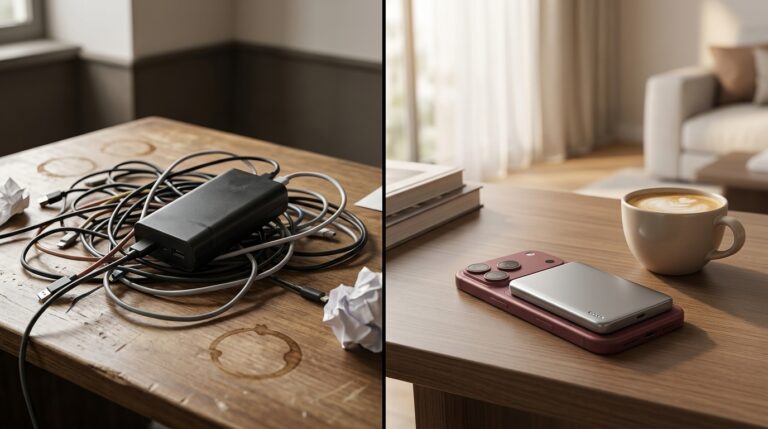
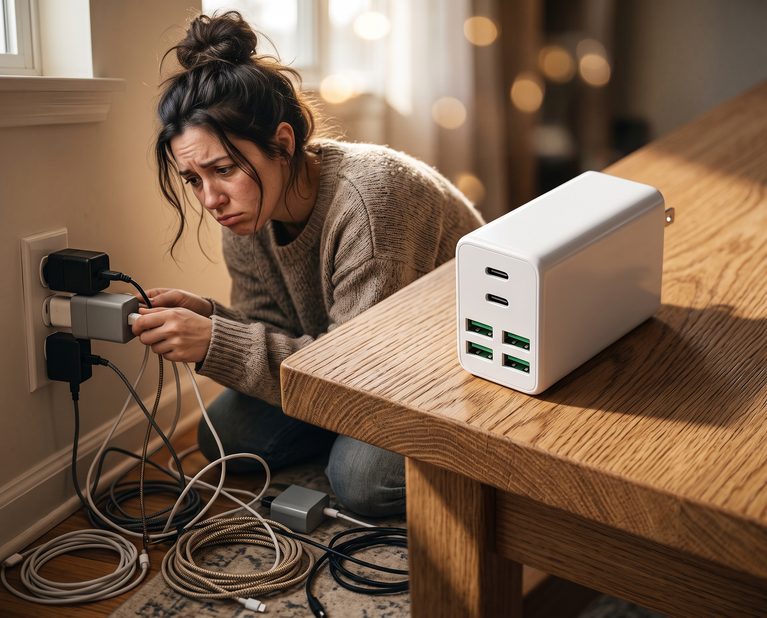
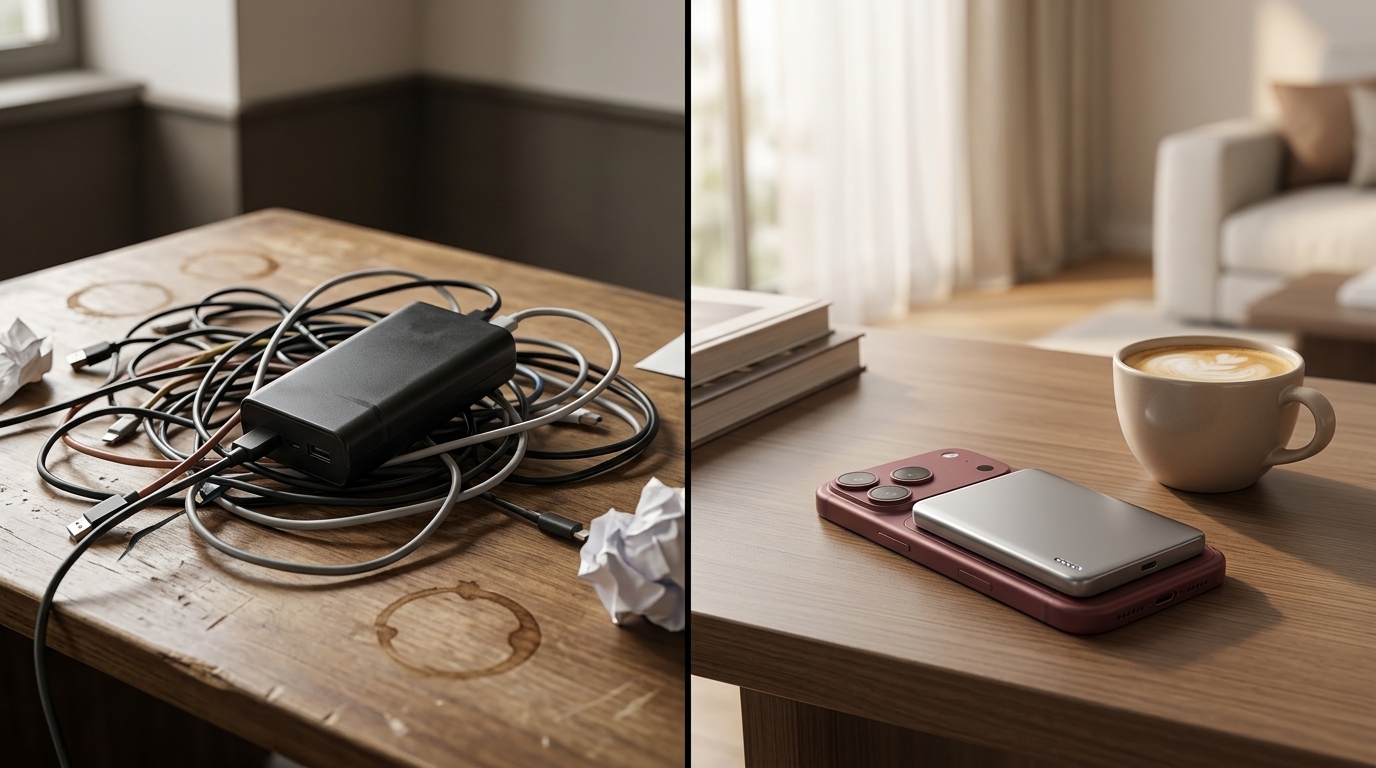
The three-device charging pad emerged from a specific frustration: travel. At home, people could spread their iPhone, Apple Watch, and AirPods across separate chargers on a nightstand. In hotel rooms, there was one outlet, often behind a bolted-down lamp or underneath a desk. The three-in-one pad compressed that sprawl into a single surface that could sit on any horizontal space and charge all three devices simultaneously. The convenience wasn’t about speed—it was about spatial efficiency and the elimination of multiple cables snaking across unfamiliar furniture.
The foldable design addressed the other travel problem: packing volume. A rigid charging pad takes up fixed space in a bag. The foldable version collapses flat, slipping into laptop compartments or carryon pockets. That collapsibility came with a trade-off. The hinges and magnetic closures introduced mechanical complexity and potential failure points. People who traveled frequently reported occasional issues with the fold mechanism weakening over time, which didn’t stop the charger from working but did make it less satisfying to open and close. The tactile quality degraded faster than the electrical function.
The magnetic alignment for iPhone charging worked flawlessly when the phone was perfectly centered, but the watch and AirPods sections required more deliberate placement. The watch charger used Apple’s standard puck design, which meant the watch needed to be positioned just so or it wouldn’t charge at all. AirPods cases had a similar finickiness—place them slightly off-center and they’d sit uncharged all night. The pad simplified setup but didn’t eliminate the need for precision, which meant the cognitive load shifted from managing cables to managing positioning.

The simultaneous charging capability created a new kind of evening routine. Instead of plugging in devices as they ran low throughout the day, people started depositing all three items on the pad at once, usually right before bed. That consolidation meant everything charged overnight, but it also meant that if someone needed their phone in the middle of the night—to check the time, silence an alarm, or read a message—they had to remove it from the pad, disrupting the magnetic connection. In the morning, they’d sometimes find the phone hadn’t fully charged because it had been moved and never properly reconnected.
The folding charger introduced a new kind of travel anxiety: remembering to pack the one device that powers everything else. Forget a Lightning cable and you could borrow one or buy a cheap replacement. Forget the three-in-one pad and you’d need to find three separate charging solutions in whatever city you’d landed in. That single-point-of-failure risk made some people keep a backup cable set in their travel bag anyway, which partially defeated the purpose of consolidation. The pad reduced cable clutter but increased dependency on a single piece of hardware.
Home use revealed different tensions. The pad worked beautifully on nightstands with enough surface area, but smaller tables forced compromises. The iPhone section might overhang the edge, or the watch charger might sit too close to a lamp. The pad assumed a certain amount of flat, unobstructed space, and not every bedroom provided that. Some people ended up clearing other items off their nightstands to make room, which meant the charger didn’t just consolidate devices—it reorganized furniture.
Previously listed at fifty-two dollars, current versions of these three-in-one foldable MagSafe pads appear around thirty-two dollars, a range that makes them accessible enough for frequent travelers but not so cheap that people treat them as disposable. The cost sits between a single Apple Watch charger and a set of individual charging cables, which positions the pad as a lateral purchase rather than an obvious upgrade. It solves specific problems—travel packing, nightstand clutter—but introduces new ones around mechanical durability and device placement precision. The pad doesn’t eliminate charging friction, it just redistributes it.
"Note: Readers like you help support The Apple Tech. We may receive a affiliate commission when you purchase products mentioned on our website."