
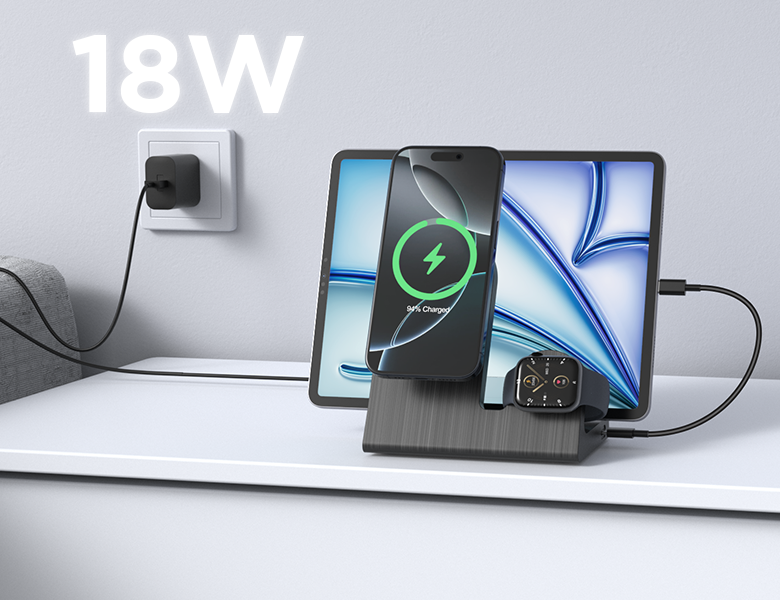
The Apple Watch introduced a charging constraint that didn’t exist with iPhones: it needs to charge quickly during narrow windows of time. Most people wear the watch almost continuously—throughout the day for activity tracking, increasingly at night for sleep monitoring. That leaves brief gaps for charging, usually during morning routines or while showering. A slow charger means the watch doesn’t fully replenish during those windows, which leads to the battery dying mid-day or mid-sleep tracking.
Combined charging stations that handle the watch alongside the iPhone and AirPods make sense in theory, but they only work if the watch actually charges at adequate speed. Early multi-device chargers often provided minimal power to the watch position, prioritizing the iPhone’s larger battery. The result was a watch that charged slowly enough to be problematic—technically charging, but not fast enough to be reliable for people with tight morning schedules.
Wattage distribution across the three charging positions determines whether the station is genuinely useful or just conceptually appealing. Eighteen watts total needs to split intelligently between devices with different charging requirements and priorities. The iPhone can tolerate slower charging overnight. The Apple Watch cannot. AirPods need minimal power. A station that allocates power poorly ends up being less functional than separate chargers, which defeats the entire purpose.

Stand-style charging differs from flat pads in ways that affect daily use. A vertical stand keeps the iPhone’s screen visible, which matters for StandBy mode, notifications, or using the phone as a bedside clock. Flat pads hide the screen, which is fine for overnight charging but less useful during daytime charging at a desk. The orientation changes how the phone integrates into the space—passive background presence versus active display.
iPad compatibility expands the utility beyond just the core iPhone-Watch-AirPods trio. Many people use iPads as secondary devices—reading in bed, watching content during meals, reference screens during work. If the iPad charges on the same station as the iPhone, it consolidates one more device into the unified charging setup. If it doesn’t, the iPad continues requiring its own cable and outlet, which partially undermines the consolidation benefit.
Price becomes a decision point once people realize they need multiple charging stations—one for home, possibly another for an office or second home. At higher price points, buying duplicates feels excessive. At lower price points, it’s more feasible to have charging stations in multiple locations, which keeps routines consistent across different spaces. That consistency is valuable in ways that aren’t obvious until it’s absent.
The broader pattern is Apple’s ecosystem encouraging device accumulation, which creates infrastructure challenges that third-party accessories attempt to solve. Apple sells its own charging solutions, but they’re expensive and narrowly focused. Multi-device charging stations from other manufacturers fill the gap for people who want unified charging without spending hundreds of dollars on Apple-branded accessories. They’re pragmatic solutions to problems Apple created by making all their devices essential but each requiring slightly different charging approaches.
The current listing shows $15 at the time of publishing. View current listing. Price at time of publishing. Subject to change.
"Note: Readers like you help support The Apple Tech. We may receive a affiliate commission when you purchase products mentioned on our website."