
A decade ago, device charging in shared spaces was manageable. A few people needed power at any given time. A handful of outlets sufficed. If someone needed a charge, they found a wall socket or asked to borrow a cable.
Now it’s universal. Walk into a classroom, a conference room, an open office, and nearly everyone has a device that needs charging. iPhones, iPads, laptops, sometimes multiple devices per person. The demand has scaled beyond what building infrastructure was designed to handle.
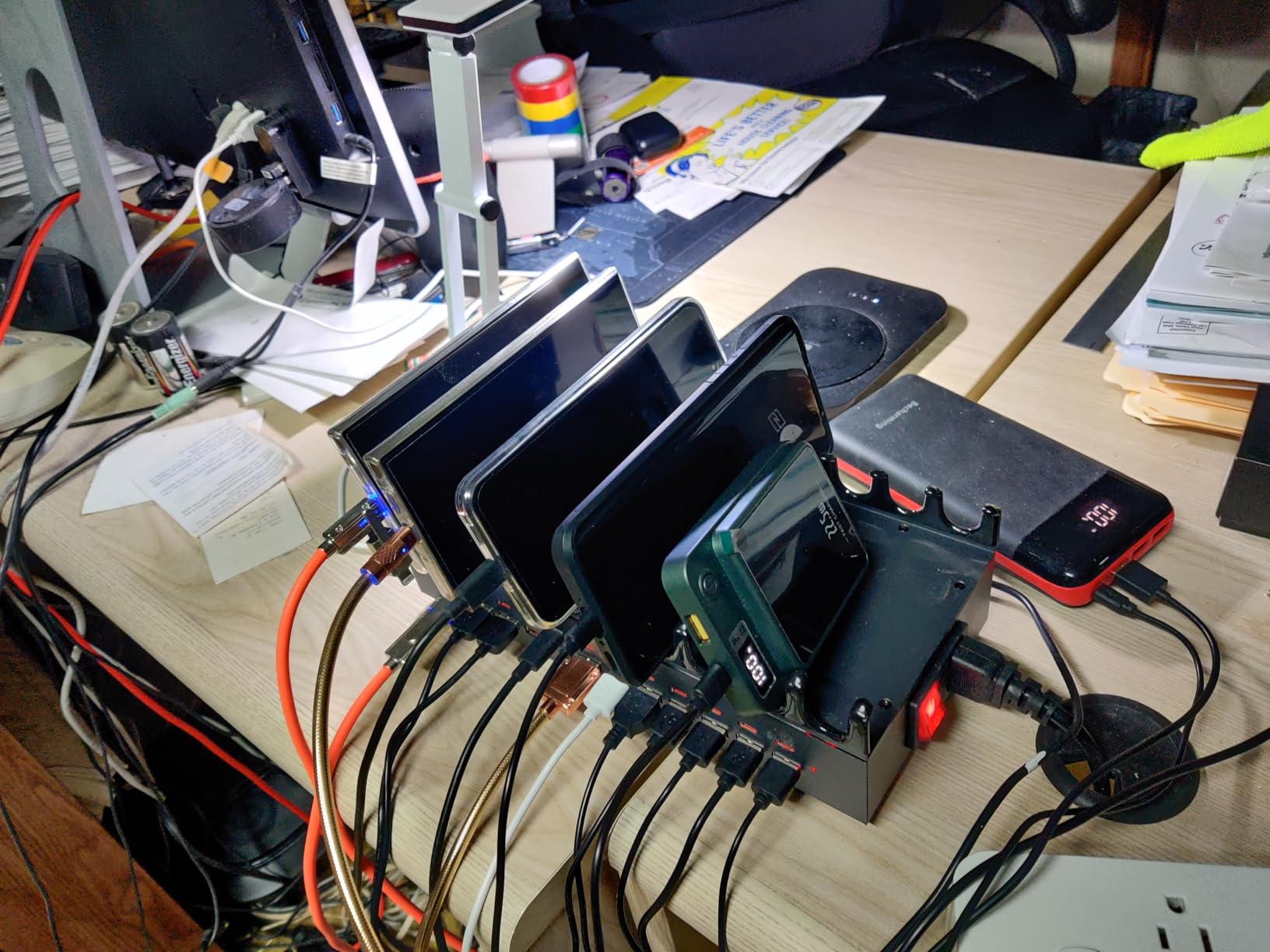
This has created a market for high-capacity charging stations—devices that can power dozens of items simultaneously from a single power source. They’re not elegant. They’re utilitarian racks or towers with rows of USB ports, designed for density and throughput rather than aesthetics.
Schools have adopted these for tablet programs and one-to-one device initiatives. Offices use them in conference rooms and hoteling stations. The goal is the same: allow everyone to charge without requiring everyone to compete for wall outlets or bring their own power adapters.
But these systems introduce new friction. Ports are often unlabeled, so people forget which slot they used. Cables get tangled or borrowed. Devices charge slowly when many are drawing power at once. The station solves the outlet problem but creates a coordination problem.
There’s also a spatial element. A charging station occupies significant room—counter space, floor space, shelf space. It’s visible, industrial-looking, not something that blends into most environments. It’s a functional object that announces its purpose, which is fine in a school but awkward in spaces trying to maintain a certain aesthetic.
Some institutions skip the centralized approach and just add more outlets. But that’s not always feasible, especially in older buildings where electrical capacity is limited. The wiring can’t support thirty devices charging in one room, so the charging station becomes a necessity—a way to manage power distribution without overloading circuits.
What’s revealing is how common this has become in just a few years. Institutional charging infrastructure used to be niche—specific to tech labs or media centers. Now it’s standard in spaces where groups gather regularly, because the assumption is that everyone’s device will need power at some point during the day. Previously listed at $62.99, some higher-capacity options now appear near $56.69, though the cost is negligible compared to retrofitting buildings with additional electrical capacity—which is often the only alternative when everyone’s iPhone needs to charge at once.
"Note: Readers like you help support The Apple Tech. We may receive a affiliate commission when you purchase products mentioned on our website."