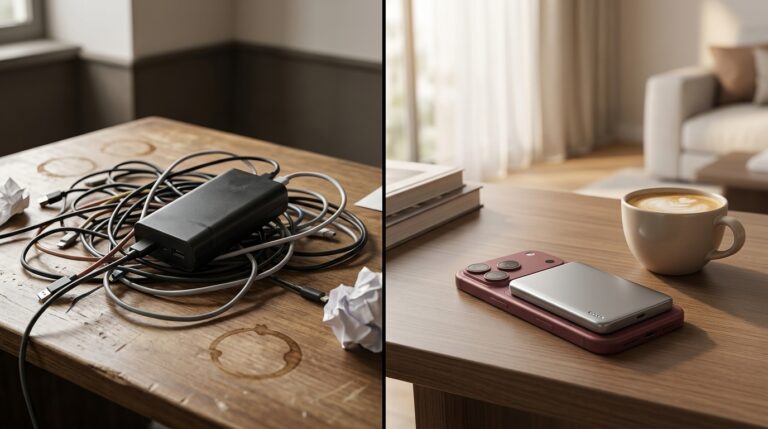


Apple’s adoption of USB-C for iPhone 15 and 16 eliminated one charging standard fragmentation but created another: households now managing three connector types across devices purchased over the past decade. Multi-tip cables address that specific transition friction.
The promise of USB-C was simplification: one port, one cable, universal compatibility. But the transition created a different problem. Most households still own devices that charge via Lightning, USB-A, or Micro USB—older iPhones, iPads, accessories, peripherals. Replacing all of those devices simultaneously isn’t practical, which means most people are managing a drawer full of cables for several more years.
Three-in-one cables with multiple connector tips emerged to address that specific transition window. They’re not elegant solutions. They’re pragmatic ones, designed for people who need to charge an iPhone 16, an iPad from 2019, and wireless earbuds that still use Micro USB without carrying separate cables for each device. The cable doesn’t represent progress—it represents the accumulated cost of a decade’s worth of incompatible charging decisions.

The 100W power delivery rating matters primarily for MacBook users who want a single cable that can handle both their laptop and their phone. Most iPhone charging scenarios don’t approach that wattage, but the headroom means the cable won’t become obsolete when faster charging standards eventually arrive. It’s future-proofing against a problem nobody can predict but everyone has learned to expect.
The E-Mark chip embedded in these cables serves a specific technical function: it negotiates power delivery protocols between the charger and device to prevent damage from incorrect voltage. For users, that chip is invisible—it just means the cable works reliably across different devices without requiring them to think about compatibility. That invisibility is the entire point.
SIMILAR
How iPhone owners navigate the reality that gaming peripherals treat Apple devices as secondary platforms
How iPad Pro photographers created workarounds for a fundamental file transfer limitation Apple never quite solved
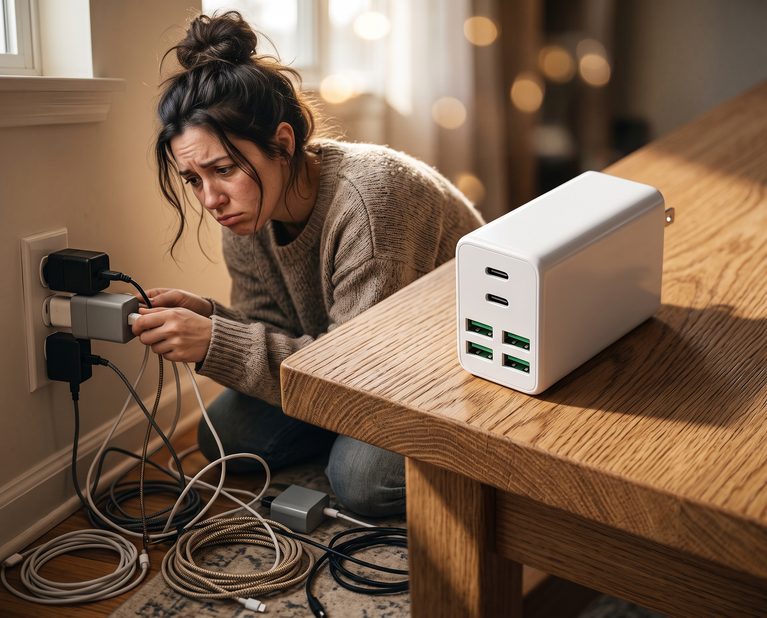
How iPhone users negotiate the nightly ritual of charging five devices from a single nightstand footprint
What’s interesting is how quickly these multi-tip cables went from niche accessory to household standard. Two years ago, most people would have considered them unnecessary clutter. Now they’re treated as basic infrastructure, kept in cars, bags, and bedside drawers for the inevitable moment when someone needs to charge a device with the “wrong” port type.
The real utility emerges during travel. Instead of packing three separate cables—one for your current iPhone, one for an older iPad, one for miscellaneous accessories—a single multi-tip cable handles all scenarios. The consolidation doesn’t improve the charging experience, but it reduces the mental overhead of travel packing, which for frequent travelers carries its own value.
The cable’s length and flexibility matter more than spec sheets suggest. A cable that’s too short forces you to position devices awkwardly near outlets. One that’s too rigid doesn’t coil neatly for storage. The cables that succeed in this category tend to balance those variables in ways that feel obvious in retrospect but required iteration to discover.
Pricing compression in the multi-tip cable category has been dramatic. Models that launched near $16 current listings hover around $5(CODE HIHTOQ2L), with some promotional listings pushing below that threshold. The collapse reflects both manufacturing scale and the commodification of what was briefly a specialized product category.
"Note: Readers like you help support The Apple Tech. We may receive a affiliate commission when you purchase products mentioned on our website."