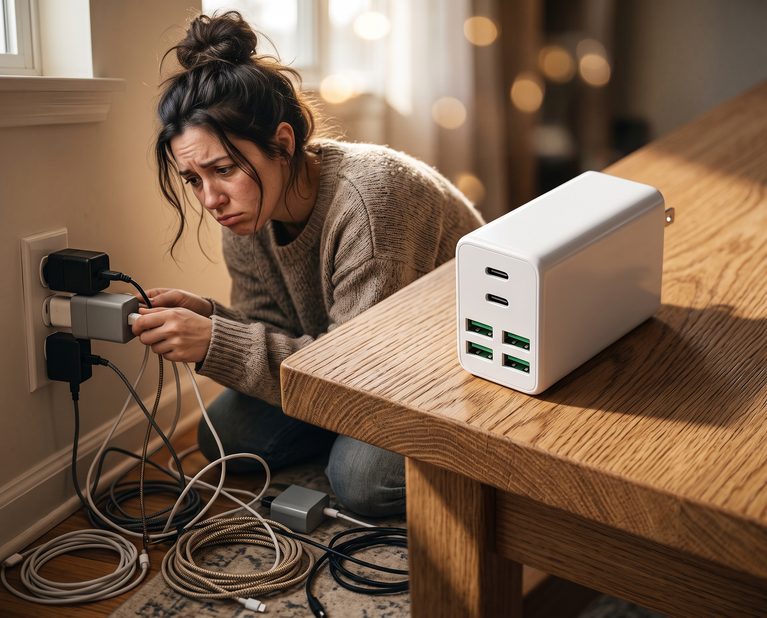


There’s a specific kind of contortion that iPhone owners know well. You’re sitting on the couch, or lying in bed, and you want to keep scrolling, but the battery is low. So you plug in, and suddenly you’re leaning forward, or sitting at an awkward angle, or holding the phone closer to your face than feels natural. The cable doesn’t reach. It never quite reaches. You adjust.
For most people, this has been the unspoken contract of charging. The outlet is where it is—usually low on the wall, behind furniture, nowhere near where you actually sit. The cable that came with the phone, or the one you bought to replace it, is three feet long, maybe six if you splurged. That’s enough to connect the phone to power, but not enough to use it comfortably while it charges. So the phone was always either charging or being used, rarely both at the same time, and nobody really questioned why.
Longer cables—10 feet, sometimes more—have started to appear in enough households that the old compromise is becoming visible. Not everyone has made the switch, but the ones who have describe it the same way: a small relief they didn’t know they needed. The phone reaches the couch now. It reaches the bed. You can plug in and keep doing what you were doing, no adjustment required.
It sounds trivial, but it’s changed evening routines in subtle ways. People who used to wait until they were done using their phone to charge it now plug in earlier, let it charge while they scroll or watch or text. The battery anxiety that used to creep in around 20 percent has softened—there’s less urgency when you can top off without interrupting what you’re doing. The phone spends more time tethered, but it doesn’t feel like tethering anymore, because the tether is long enough to forget about.
What’s interesting is how much of this friction was normalized. Apple has never included long cables with iPhones—the ones in the box have always been short, practical, designed for charging overnight on a nightstand. The assumption was that charging happens when you’re not using the phone, that the two activities are separate. And for a long time, that made sense. Batteries were smaller, charging was slower, it was easier to just plug in and walk away.
But iPhones have gotten bigger, batteries have gotten better, and people use their phones constantly, even when they’re low on power. The three-foot cable that once felt sufficient now feels like an obstacle, a reminder that the infrastructure wasn’t built for the way people actually behave. A 10-foot cable doesn’t solve a technical problem—it solves a spatial one, a mismatch between where the power is and where people want to be.
There’s also the cost. Longer cables used to mean cheaper materials, slower charging, the kind of accessory you’d buy at a gas station and regret. But the gap has narrowed. Some longer cables now support the same fast-charging speeds as the short ones, built with materials that feel less flimsy, priced low enough—especially during discount periods, where they can drop by half—that the old tradeoff between length and quality has mostly disappeared.
Not everyone cares. Some people still prefer short cables, like the tidiness, don’t want the extra slack hanging around. But for the ones who’ve switched, the difference is hard to articulate and harder to give up. It’s not that the phone charges faster or better. It’s that the act of charging no longer requires you to stop doing something else. The cable reaches, and that small bit of reach has turned out to matter more than anyone expected. View Current Listing
"Note: Readers like you help support The Apple Tech. We may receive a affiliate commission when you purchase products mentioned on our website."