

For most of the iPhone’s existence, charging has been the least interesting part of owning one. You plug it in before bed, you wake up, it’s full. The charger itself might as well be invisible—a white brick, a beige cube, something tucked behind furniture or left dangling from an outlet. It did its job by not requiring attention.
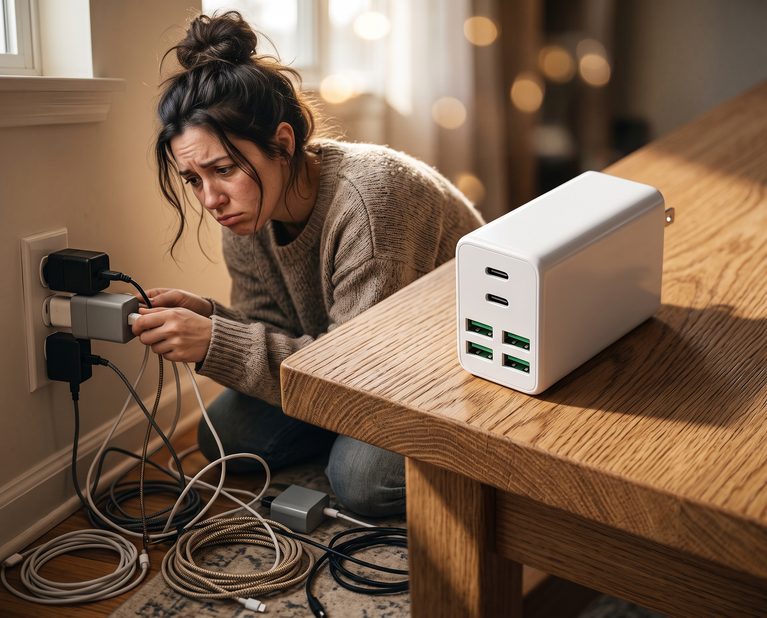
That assumption is fraying. A growing number of chargers now come with small displays embedded in the plug itself, showing wattage, voltage, charging status in real time. It’s a minor addition, the kind of feature that seems practical in theory. But in practice, it’s introduced a new behavior: people standing near outlets, watching numbers flicker, monitoring something that used to happen entirely out of sight.
The impulse makes a certain kind of sense. iPhones have supported fast charging for years now, but the experience has always been opaque. You plug in, you see a lightning bolt or a battery icon, you wait. Whether the phone is pulling 20 watts or 5 watts is invisible, tucked behind Apple’s preference for simplicity. A display on the charger changes that. Suddenly you can see whether the phone is actually drawing maximum power, whether the cable is holding up, whether the outlet itself is delivering what it should.
There’s something oddly compulsive about knowing the wattage in real time, even though it changes nothing about how quickly the phone actually charges. The information doesn’t empower you—it just exists, a tiny feedback loop that turns charging from a passive act into something you can observe. And once you can observe it, it becomes harder to ignore.
It’s not universal. Plenty of people plug in and leave, never glance at the screen, treat it the way they’ve always treated chargers. But others find themselves checking, comparing, noticing when the number drops or climbs. It’s the same instinct that makes people refresh their battery percentage obsessively, the need to confirm that things are happening the way they should be, that the invisible process is proceeding correctly.
What’s strange is that the iPhone itself has never encouraged this. Apple’s design philosophy has always leaned toward abstraction—you don’t need to know how many watts are flowing, you just need to know the battery is filling. The phone trusts you to trust it. But the charger with a display undermines that. It offers transparency where there was once only faith, and in doing so, it creates a small gap between what the phone shows and what the charger shows, a gap that some people feel compelled to monitor.
There’s also the question of what the display is solving. Maybe it’s peace of mind—proof that the charger is working, that the cable isn’t failing, that the phone is charging as fast as it can. Maybe it’s a response to the ecosystem’s growing complexity, the proliferation of cables and adapters and standards that don’t always play nicely together. Or maybe it’s just information for information’s sake, the ambient hum of data that’s become so normal we don’t question whether we actually need it.
Either way, charging isn’t quite as invisible as it used to be. The plug has a face now, a tiny screen that glows softly in the dark, showing numbers that flicker and settle. And for some people, that’s enough to turn a habit that used to require no thought at all into something they check, monitor, and second-guess—proof that even the smallest piece of feedback can change how we relate to the tools we use every day. View Current Listing
"Note: Readers like you help support The Apple Tech. We may receive a affiliate commission when you purchase products mentioned on our website."