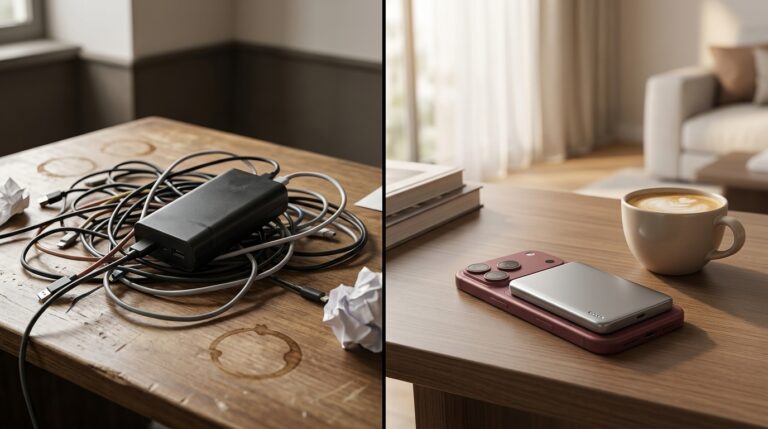
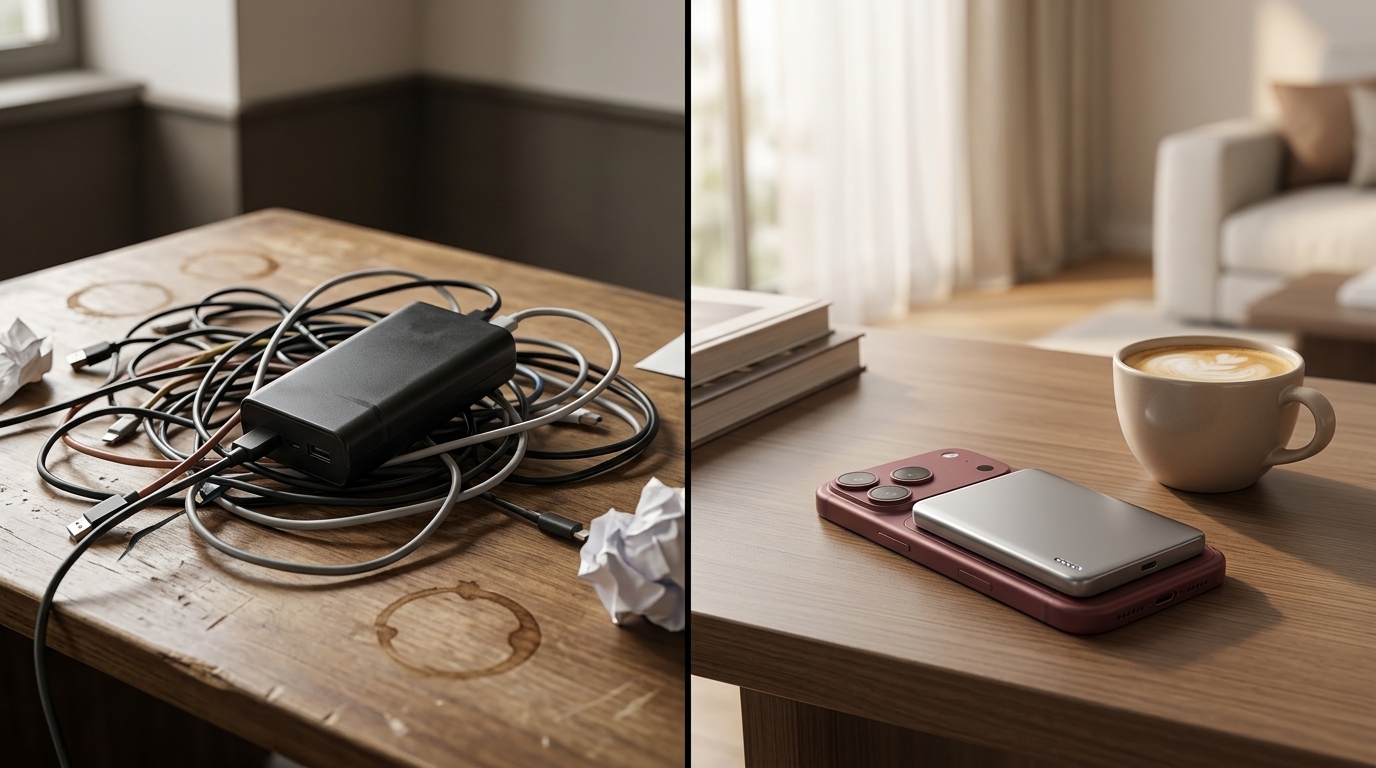
For a few years, the trajectory seemed clear: wireless was the future, cables were the past, and MagSafe had made the transition feel inevitable. You just snapped the power bank onto the back of your iPhone, and it charged. No fumbling with Lightning or USB-C connectors, no cables to carry separately, no orientation to worry about. It was frictionless, elegant, the kind of user experience Apple had spent decades perfecting.
But a countermovement has started to appear among some iPhone owners who’ve tried magnetic wireless power banks and found them wanting in one specific, measurable way: speed. Wireless charging is slower than wired charging—sometimes significantly so—and for people who need their phone to charge quickly, that difference has started to outweigh the convenience of not plugging anything in.
The numbers tell part of the story. A wired connection can deliver power more efficiently, charging a phone faster and with less energy lost to heat. Wireless charging, by contrast, involves more waste, more time, and a gentler trickle of power that feels noticeable when you’re watching the percentage climb. For users who’ve internalized the speed of wired charging, going back to wireless can feel like a downgrade, a step backward disguised as progress.
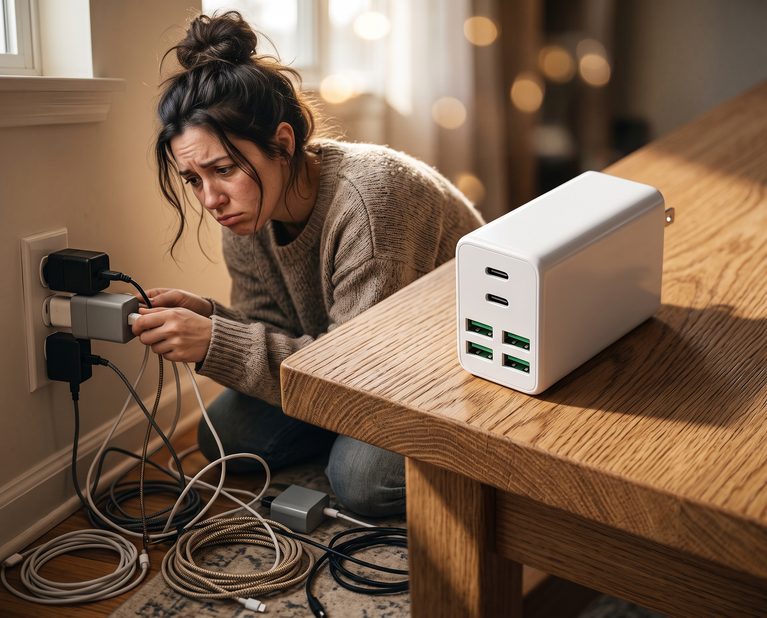
This has led some people to seek out ultra-slim power banks with built-in cables—devices that are just as portable as their wireless counterparts but tethered to the phone during use. The cable is permanent, attached to the battery pack itself, which solves one of the old problems with wired charging: losing the cable, forgetting it, packing the wrong one. You can’t misplace something that’s built in. And because the cable is wired directly into the power bank, it charges faster than magnetic alternatives, sometimes cutting the charging time nearly in half.
There’s something frustrating about watching your phone charge slowly when you know a cable would do it faster—the elegance stops mattering when you’re in a hurry. People who’ve made the switch from wireless back to wired often describe the same realization: they thought they wanted the convenience of MagSafe, but what they actually wanted was their phone charged quickly. The magnetic snap is satisfying for the first few uses, but when you’re at 15 percent and need to be out the door in twenty minutes, satisfaction doesn’t help.
The trade-off is real, though. Wired power banks require you to plug the phone in, which means dealing with orientation, making sure the connector is aligned, accepting that there’s a cable dangling while the phone charges. It’s a return to a slightly more cumbersome experience, one that wireless charging was explicitly designed to eliminate. For some users, that’s a dealbreaker—they’ve gotten used to the seamlessness of magnetic charging and don’t want to go back. For others, the speed gain is worth the minor inconvenience.
What’s notable is how price has influenced this choice. Wired power banks tend to be cheaper than their wireless equivalents, and during discount periods—some models are currently listed at 40 percent off on platforms like Amazon—the gap widens further. That makes the wired option more accessible, especially for users who are price-sensitive or who see power banks as disposable accessories rather than long-term investments. If the wired version is faster and cheaper, the case for wireless becomes harder to justify unless convenience is the overriding priority.
Not everyone is making this calculation. Plenty of iPhone users still prefer wireless, still value the aesthetic and tactile experience of MagSafe, still don’t mind the slower charging speed because they’re not usually in a rush. But for those who have switched back—or who never switched to wireless in the first place—the wired power bank represents a kind of pragmatic resistance to the idea that newer always means better.
The built-in cable also changes the relationship with the accessory. You can’t upgrade the cable, can’t swap it out if it frays, can’t use it with a different device if the connector doesn’t match. It’s locked in, permanent, which makes the power bank feel slightly less modular, slightly more committed to a specific ecosystem. But it also simplifies decision-making. You don’t think about whether you packed the right cable. You don’t worry about compatibility. The cable is there, always, and that certainty has its own kind of value.
What’s emerging is a split in how people think about portable charging. Some want it to be invisible, effortless, something that happens in the background without requiring thought. Others want it to be fast, efficient, something that solves the problem as quickly as possible so they can move on. Wireless charging leans toward the first. Wired leans toward the second. And increasingly, iPhone users are choosing based not on what’s newer or more elegant, but on which priority matters more in the moments when their phone is dying and they need it not to be.
"Note: Readers like you help support The Apple Tech. We may receive a affiliate commission when you purchase products mentioned on our website."