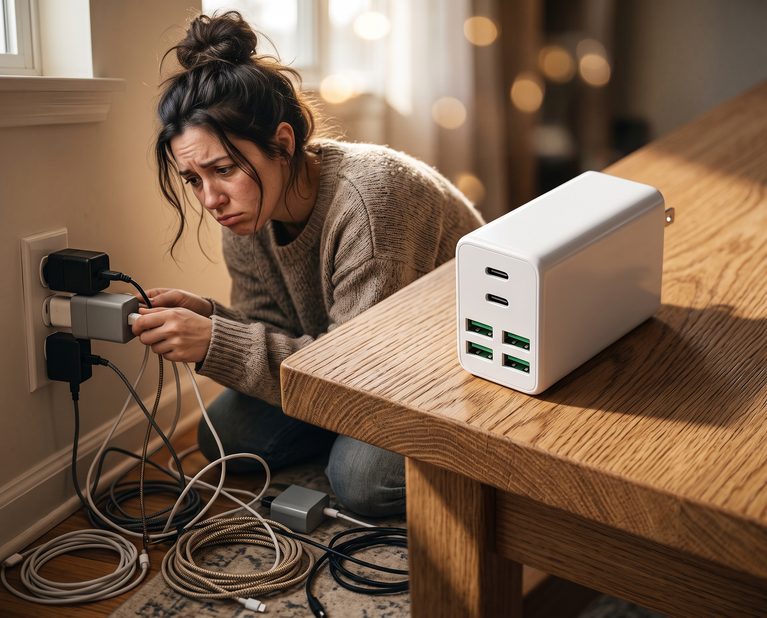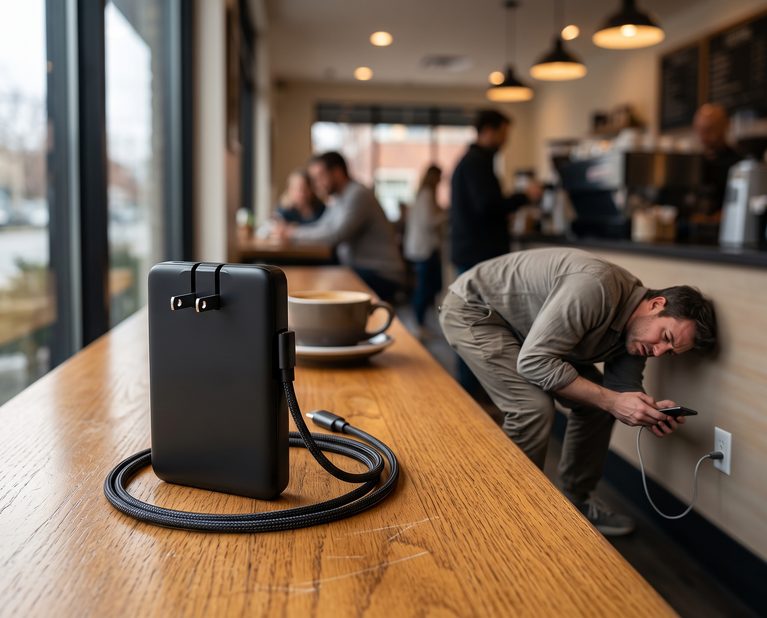


Built-in cables eliminated the “forgot my cable” problem but introduced a new one: carrying a power bank locked to specific connector types as devices evolve.
Power banks with built-in cables seemed like obvious design evolution. No more rummaging through bags to find the matching cable, no more carrying redundant accessories, no more untangling. Just grab the battery, and the cable comes with it. This worked beautifully in 2019 when most people had one iPhone with Lightning and maybe an older Android with micro-USB.
Then USB-C happened. Not all at once, but in waves. iPad Pro switched first. Then MacBooks standardized on it. Android phones migrated gradually. Finally, iPhone 15 made the jump. Suddenly that power bank with built-in Lightning cable became partially obsolete. It still charges older devices, but the newest iPhone in your household requires a separate cable, which defeats the original purpose.
The built-in plug—connecting directly to wall outlets—addresses a different frustration. Traditional power banks need their own charging cable, which means remembering to pack two cables: one for the power bank and one for your devices. Integrating the plug reduces this to just the device cable. But wall plug designs vary by country, which creates problems for international travel. The power bank that works in US outlets won’t work in Europe without an adapter, reintroducing the accessory you were trying to eliminate.
Capacity calculations expose user confusion. 10,000mAh sounds substantial, but actual charge delivery is lower due to conversion losses and cable inefficiency. An iPhone 15 Pro has roughly a 3,300mAh battery, so theoretically you’d get three full charges. Reality delivers closer to 2.5 charges, maybe two if you’re using the phone while charging. The gap between specification and experience creates disappointment that users blame on themselves rather than physics.
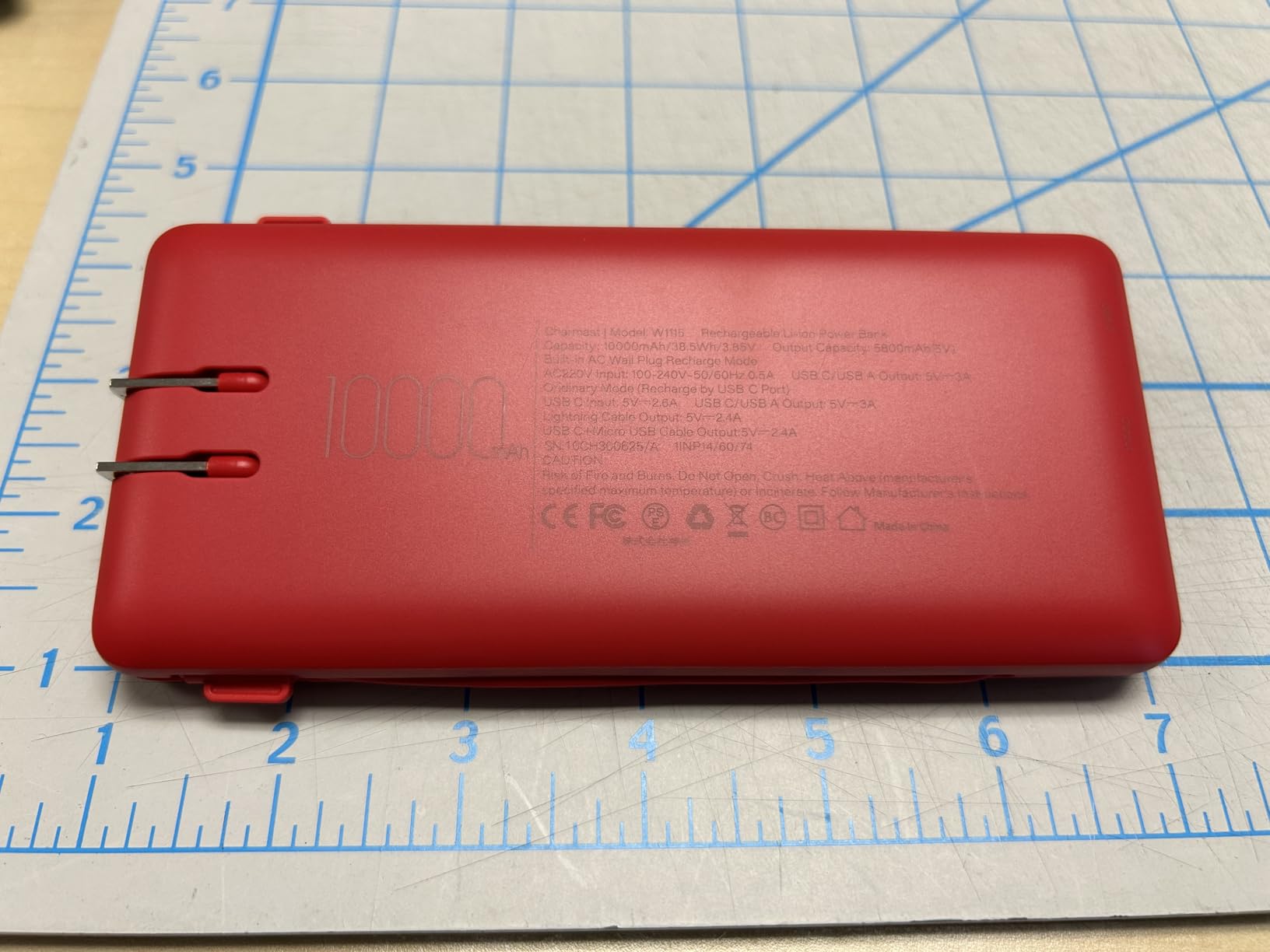
The “slim” descriptor matters for pocket carry, but it conflicts with capacity. Higher-capacity batteries require more physical cells, which means more thickness. A truly slim power bank either has lower capacity or uses more expensive cell technology. Most settle for a compromise: thin enough not to bulge in a jacket pocket, thick enough to feel substantial in a backpack. The ideal thickness doesn’t exist because use cases vary too widely.
Travel essentials positioning is accurate but incomplete. The power bank works great for a weekend trip with one or two devices. Extend that to a week-long journey with iPhone, iPad, and wireless earbuds, and suddenly the single power bank becomes a bottleneck. You’re managing a charging queue: phone first, then AirPods, then iPad, each requiring hours. Multiple power banks solve this but negate the portability benefit.
Fast charging claims require context about what “fast” means. Built-in cables typically max out at 20W for iPhones, which is fast compared to old 5W chargers but standard for current expectations. The power bank itself might recharge quickly via its built-in plug, but that doesn’t accelerate how fast it delivers power to connected devices. The speed asymmetry—fast in, standard out—rarely gets explained clearly. Previously listed at $37, current listings hover around $29.59.
"Note: Readers like you help support The Apple Tech. We may receive a affiliate commission when you purchase products mentioned on our website."