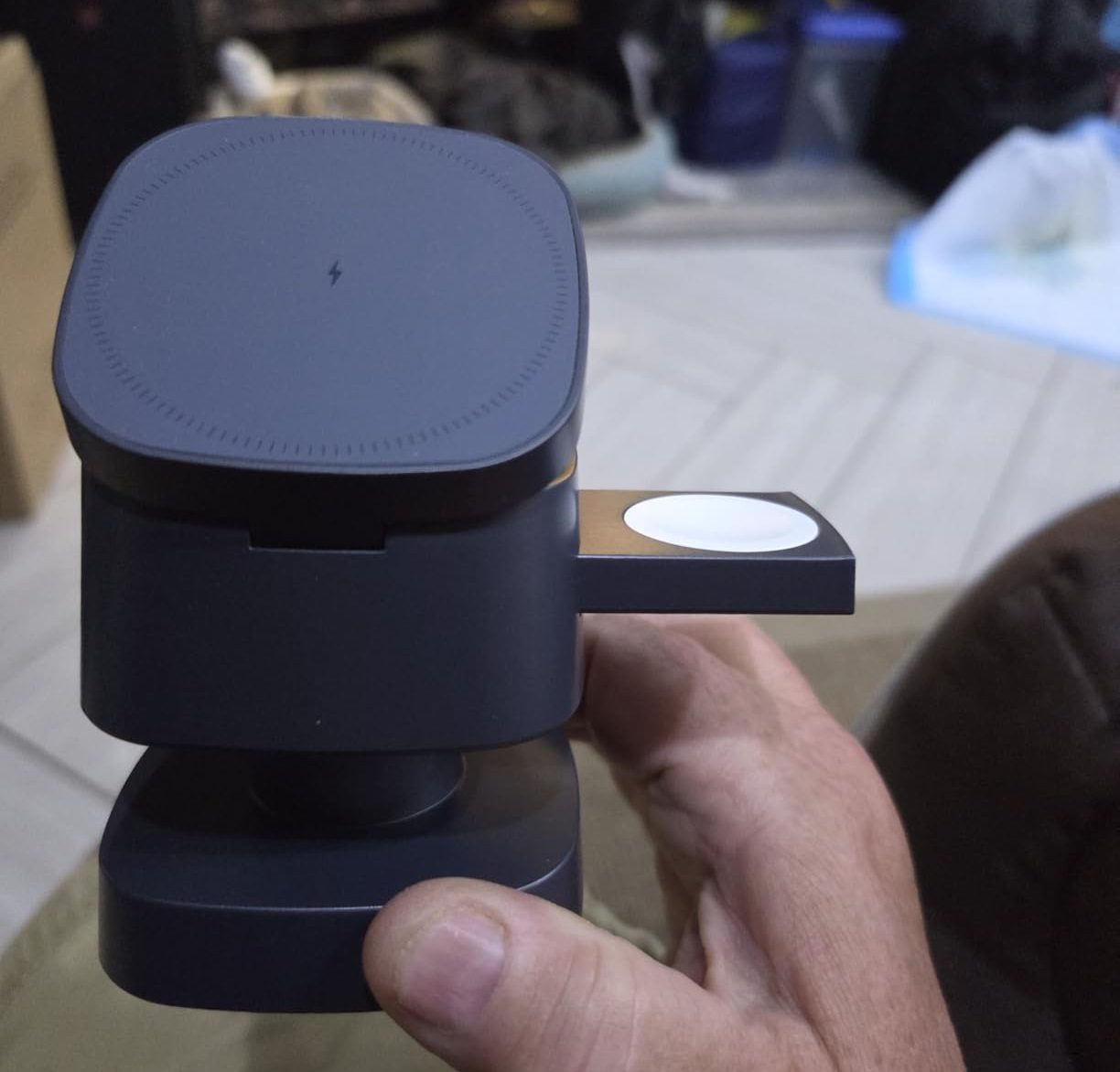
There was a time when charging your phone meant plugging in a cable and turning off the lights. The two actions were separate. Now, for a growing number of iPhone users, they’ve collapsed into a single object that sits on the nightstand and glows softly until morning.
The shift is small but telling. Charging docks that accommodate an iPhone, Apple Watch, and AirPods simultaneously have become common. What’s newer is the addition of a night light—a feature that nobody asked for but that, once present, changes the texture of the evening routine.

It’s not bright. It’s not intrusive. But it’s there. And that presence does something. For some, it replaces the need to keep a lamp on or to fumble for a phone screen in the dark. For others, it introduces a low-level glow into a space that used to be completely dark. The line between helpful and disruptive is thinner than it seems.
The appeal, from a design perspective, is obvious. Consolidation. Fewer cables, fewer outlets, fewer decisions about what goes where. But the behavioral consequence is harder to track. When the charging station becomes a light source, it also becomes a visual anchor. It’s the last thing you see before sleep and the first thing you notice when you wake. That’s not neutral.
There’s also the question of what happens when your phone, watch, and earbuds are all in one place. It creates a hub. A single point of dependency. If the dock fails, or if you forget to place everything just right, the next morning becomes a scramble. The convenience of centralization introduces a new kind of fragility.
SIMILAR
iPhone and MacBook users are compensating for a port problem Apple created
iPhone users are eliminating the tangled cable from every car charging session
iPhone users are transforming nightstands into silent charging infrastructure
The charging speed—fifteen watts for the iPhone—is fast enough that most people don’t think about it. But the ritual matters more than the speed. Placing the phone on the stand, watching it light up, hearing the faint click of magnetic alignment—it’s a signal that the day is over. The night light extends that signal, keeping the boundary between active and passive slightly blurred.
Some people disable the light feature. Others leave it on by default and stop noticing it after a few nights. Either way, the design has embedded a choice that didn’t used to exist: whether your charging station should also shape the ambient environment of your bedroom.
Previously listed around $56, current listings now appear closer to $46. At that price, the feature set—charging, alignment, lighting—feels less like a luxury and more like an expected baseline for anyone managing multiple Apple devices from a single nightstand.
"Note: Readers like you help support The Apple Tech. We may receive a affiliate commission when you purchase products mentioned on our website."