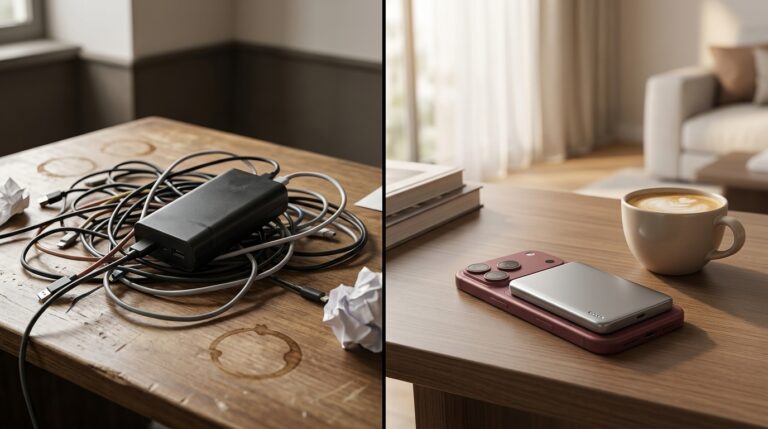
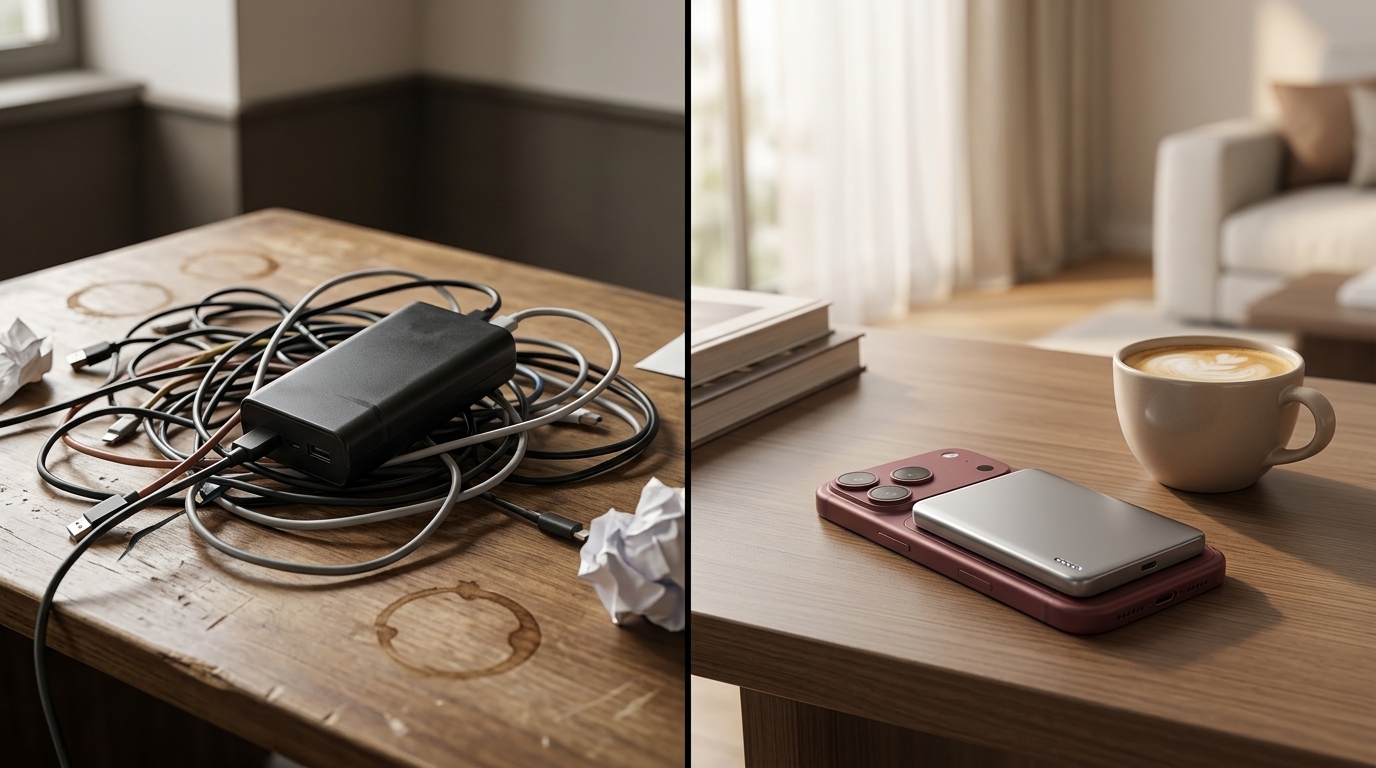
For years, carrying a power bank meant accepting bulk. A brick in the bag, a cable in the pocket, the mental overhead of remembering to charge both the phone and the backup battery. It worked, but it required planning, and planning created friction.
MagSafe changed the calculus. A power bank the size of a credit card, thin enough to slip into a pocket, magnetically attached to the back of the phone—no cable, no bag, no decision to make. It’s either on the phone or it isn’t, and when it’s on, it delivers a slow, steady charge that extends the day without the bulk of traditional external batteries.
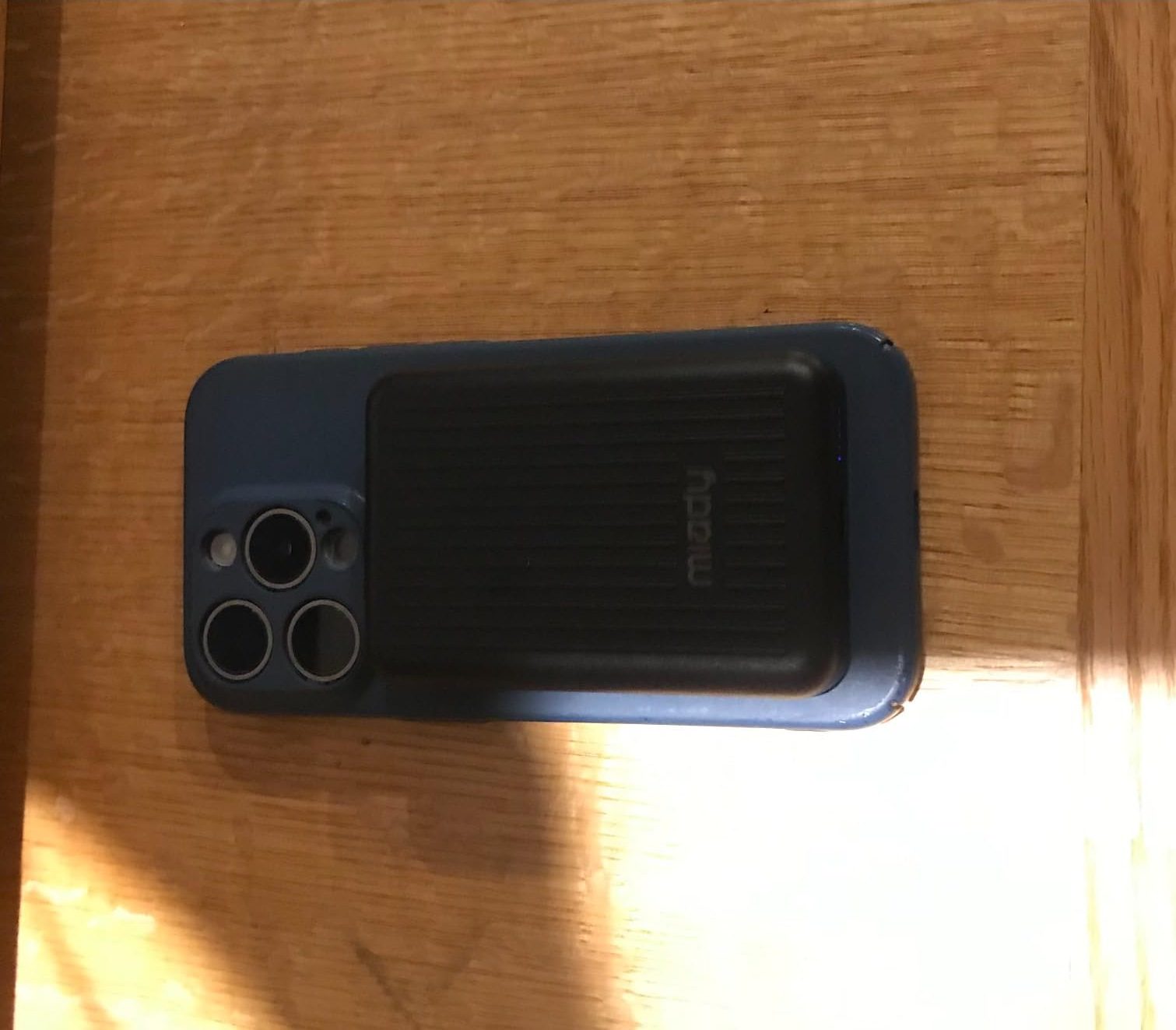
The behavior this enables is subtle but widespread. iPhone users no longer think in terms of “Do I need a power bank today?” They think in terms of “Is this a day where I might drop below 40%?” If yes, the MagSafe bank snaps on during the morning commute and stays there, invisible under a hand, delivering power in the background while the phone remains usable.
This is a fundamentally different relationship with charging. It’s not emergency preparedness—it’s continuous support. The power bank becomes an extension of the phone, not a separate object to remember. It’s also a hedge against Apple’s battery optimization promises, which work well in ideal conditions but falter under real-world load: navigation, camera use, mobile hotspot, all running simultaneously.
SIMILAR
iPhone and MacBook users are compensating for a port problem Apple created
iPhone users are eliminating the tangled cable from every car charging session
iPhone users are transforming nightstands into silent charging infrastructure
What’s notable is how this behavior bypasses Apple’s own battery case entirely. Apple discontinued the Smart Battery Case for iPhone after the 11, leaving MagSafe as the de facto charging extension strategy. But Apple doesn’t sell a first-party MagSafe power bank. The gap got filled by third parties who understood that users wanted thinness over capacity, convenience over power.
Previously listed at $15.99, current listings hover around $9.99. That pricing reflects the power bank’s role as daily carry, not occasional backup—cheap enough to justify the purchase, small enough to justify the habit.
The power bank becomes invisible infrastructure, attached and forgotten until the end of the day when it’s swapped for a fresh one. It’s the opposite of deliberate charging, and for a generation of iPhone users, it’s become the default.
"Note: Readers like you help support The Apple Tech. We may receive a affiliate commission when you purchase products mentioned on our website."