


Apple Watch charging happens primarily at night, which means the charging cable lives on or near the nightstand. But nightstands aren’t always positioned near outlets. Older homes have outlets spaced for lamps, not smartphones and wearables. Shared bedrooms have outlets claimed by a partner’s devices. Apartments have furniture arrangements dictated by window placement or room shape, putting the bed—and therefore the nightstand—several feet from the nearest power source.
The one-meter cable Apple includes with the Watch reaches from outlet to nightstand only if the geometry cooperates. When it doesn’t, users face a choice: move the nightstand closer to the outlet, which disrupts the room’s layout, or accept that the Watch will charge somewhere else—on a dresser across the room, on the floor near the baseboard, anywhere the short cable can reach. Either option introduces friction into what should be a seamless nightly ritual.
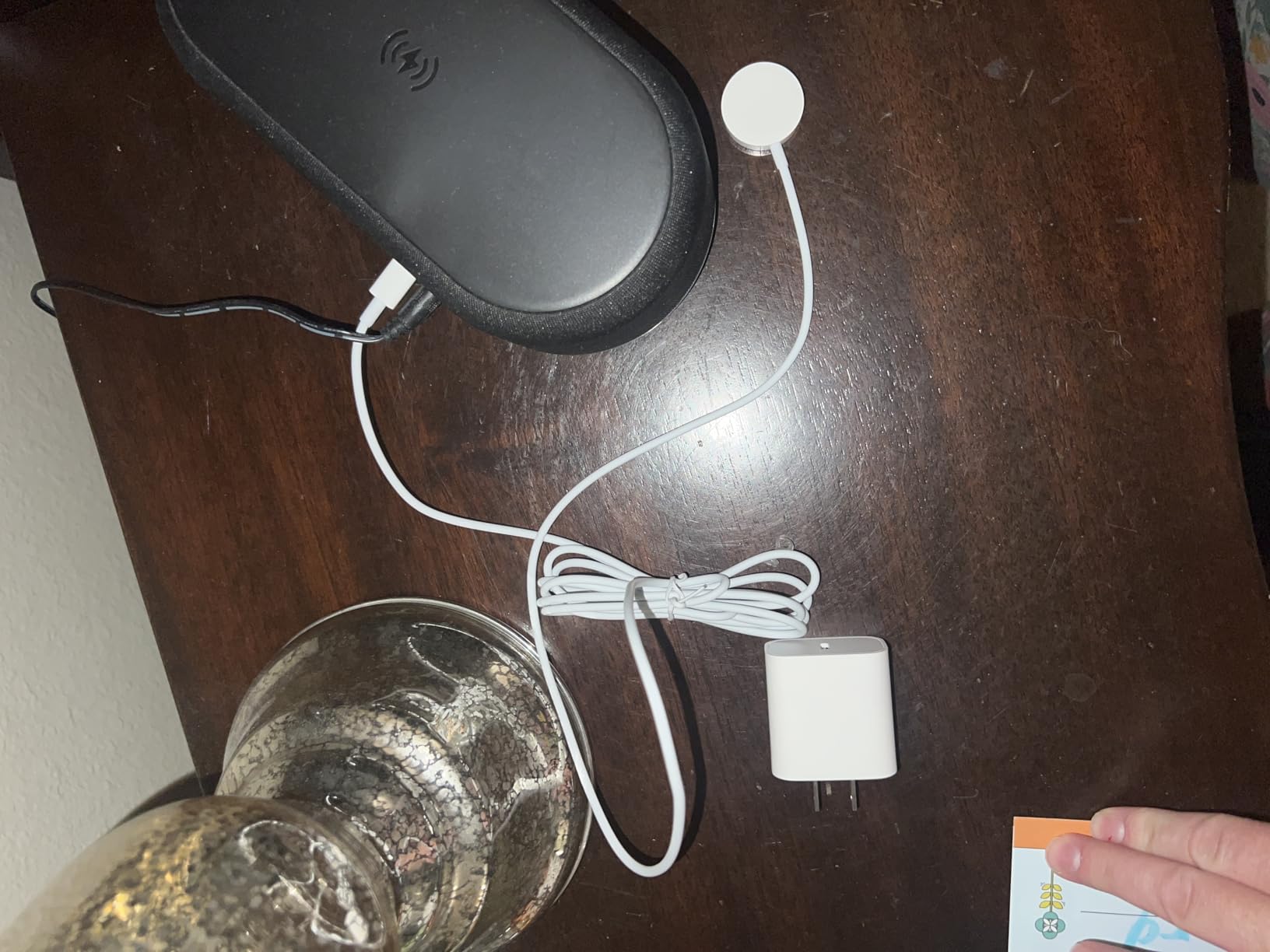
The extended cable—6.6 feet instead of Apple’s standard meter—solves this by making the outlet’s location irrelevant. The Watch can charge on the nightstand regardless of where the nearest power source sits. The cable snakes along the baseboard, behind furniture, across whatever distance separates the ideal charging location from the actual outlet. It’s inelegant, but it works, and it preserves the Watch’s role as a bedside alarm clock in Nightstand Mode.
What makes this behavior widespread is how common the problem is. Most people don’t have outlets positioned for modern device density. They have outlets installed decades ago, when bedrooms needed power for one lamp and maybe a clock radio. The Watch, the iPhone, the AirPods case—each one assumes outlet access that simply doesn’t exist in sufficient quantity or convenient placement in most real-world bedrooms.
SIMILAR
iPhone and MacBook users are compensating for a port problem Apple created
iPhone users are eliminating the tangled cable from every car charging session
iPhone users are transforming nightstands into silent charging infrastructure
The fast charging capability addresses a secondary friction point. Apple Watch charges slowly on its standard puck—80% in about 90 minutes, full charge in two hours. For users who forget to charge overnight and need a quick top-up before leaving for work, the standard charging speed is painfully inadequate. Fast charging cuts that time roughly in half, making it possible to gain a usable amount of battery during a morning shower or breakfast routine.
The USB-C adapter is telling. Apple still ships some Watch models with USB-A charging cables, despite transitioning the rest of the ecosystem to USB-C. Users who’ve replaced their old power bricks with newer USB-C versions find themselves unable to charge the Watch without digging out an old adapter or buying a new one. The third-party solution bundles both—USB-C compatibility and the longer cable—addressing two separate failures in Apple’s default setup.
What’s interesting is how this accessory exists purely to compensate for Apple’s assumptions about domestic space. The company designs for an idealized bedroom where outlets are plentiful and conveniently located, where the nightstand sits within a meter of power, and where no other devices compete for outlet access. That idealized bedroom doesn’t match most users’ reality, and the gap gets filled with longer cables that treat outlet scarcity as a given, not an edge case.
The “portable” framing in the product name is ironic. A 6.6-foot cable isn’t portable—it’s the opposite. It’s infrastructure designed to bridge spatial gaps in fixed locations. But the length does make the Watch chargeable in more contexts: hotel rooms with inconvenient outlet placement, Airbnbs where the nightstand is across the room from power, guest bedrooms in friends’ homes where you can’t rearrange furniture. The cable adapts to spaces Apple’s default setup cannot.
Previously listed at $23.99, current listings hover around $15.87. That pricing reflects the cable’s role as corrective infrastructure—bought to fix a problem that shouldn’t exist, but does, because Apple optimized for an outlet placement reality that doesn’t match how most bedrooms are actually wired.
The cable length becomes the constraint that determines where the Watch can charge, forcing users to choose between a reachable charger and a reachable alarm. The extended cable eliminates that choice, but its necessity exposes how little thought Apple gave to the spatial logistics of nightstand charging in homes where outlets weren’t installed with wearables in mind. The Watch works beautifully as a bedside alarm clock, but only if the cable can reach from outlet to bed—and for millions of users, Apple’s one-meter default simply can’t.
"Note: Readers like you help support The Apple Tech. We may receive a affiliate commission when you purchase products mentioned on our website."






