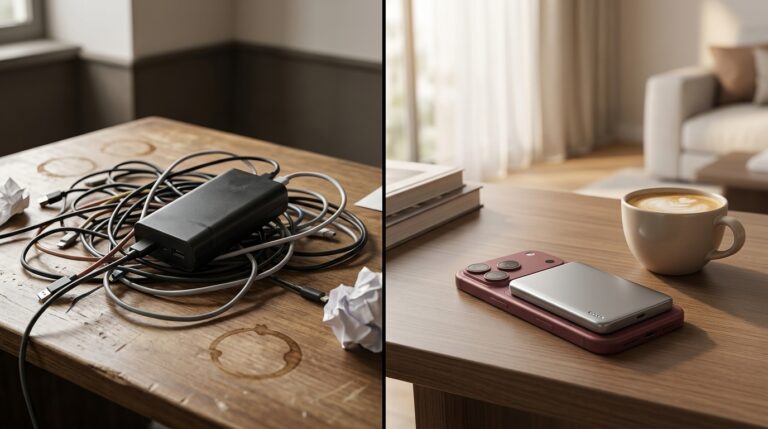
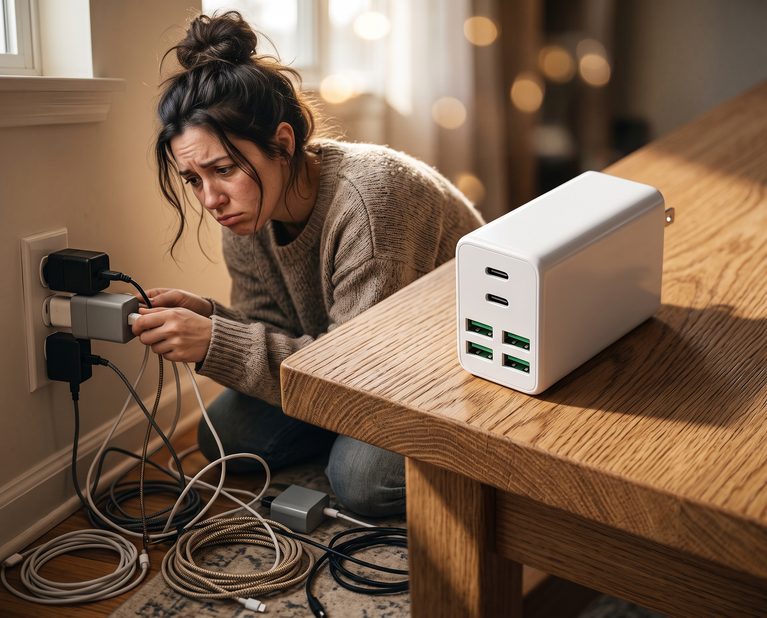
The single-port charger made sense when the iPhone was the only device that needed daily charging. But that era is over. Now there’s the iPhone, the iPad, the AirPods, the Apple Watch, sometimes a second iPhone for work. The outlet hasn’t changed. The number of devices has.
The dual-port charger addresses this with blunt simplicity: two ports, one plug. USB-C and USB-A, side by side, each capable of delivering power independently. The total wattage is split between them, 42 watts distributed according to what’s connected. An iPad Pro pulls more than an iPhone 17. An Apple Watch charger pulls less. The block negotiates the distribution automatically.

What this creates is a kind of charging hierarchy. The user decides which device gets plugged in first, which one can wait. That decision used to be spatial—whichever device was closest to the available outlet. Now it’s strategic. Do you charge the iPhone or the iPad overnight? Do you top up the AirPods case or the Apple Watch? The dual-port charger doesn’t eliminate the choice, but it reduces the frequency.
There’s also a shift in how charging happens while traveling. Hotel rooms rarely have enough outlets near the bed or desk. Power strips help, but they add bulk. The dual-port charger consolidates two charging tasks into a single outlet, freeing up space for a laptop or lamp. It’s not revolutionary, but it’s the difference between needing an extension cord and not needing one.
The inclusion of both USB-C and USB-A is a hedge against the transition period the Apple ecosystem is still navigating. The iPhone 17 is USB-C. So is the iPad Air and iPad Pro. But older iPhones are still in circulation, along with accessories that charge via USB-A. The dual-port charger accommodates both, which means it doesn’t become obsolete the moment a user upgrades their phone.
Fast charging is listed as a feature, but it’s worth noting that 42 watts split between two devices doesn’t always mean fast charging for both. If the iPhone and iPad are both connected, the iPad will likely pull the majority of the power. The iPhone will charge, but not at maximum speed. The block isn’t magic. It’s a compromise.
What’s revealing is that the dual-port charger has become default infrastructure. It’s no longer a specialty accessory for power users. It’s the baseline. Single-port chargers feel inadequate, almost obsolete. The assumption is that everyone has at least two devices that need daily charging, and that assumption is increasingly accurate.
Previously listed at $30.99, current listings hover around $23.99. The price reflects the commodification of multi-port charging, but the real shift is infrastructural. The single-device household is gone, and the charging setup has adapted. The dual-port block isn’t just about convenience. It’s about acknowledging that the Apple ecosystem has expanded beyond the phone, and the power delivery system has to keep pace.
"Note: Readers like you help support The Apple Tech. We may receive a affiliate commission when you purchase products mentioned on our website."