
The modern Apple ecosystem, for many, is a tapestry of interlinked devices: an iPhone, an Apple Watch, and AirPods are common companions, often joined by an iPad or a MacBook. Each of these tools, while enhancing daily life, introduces a quiet, persistent challenge: power. The reliance is so ingrained that the underlying anxiety of a low battery often surfaces only in its absence, a subtle reminder of our invisible technological habits.
For years, managing this collection of devices meant a sprawl of individual chargers, each claiming a precious wall socket or a port on a power strip. The ritual of plugging in devices at night, or ensuring they’re topped up before a commute, has been a low-level friction point, a minor inconvenience normalized over time. We’ve adapted, often unconsciously, to a nightly dance of cables and adapters, a routine born of necessity rather than design.
Consider the nightstand: a critical hub for many. In the dim light before sleep, there’s often a fumbling search for the right Lightning or USB-C cable, an iPhone nudged into alignment, an Apple Watch settled onto its magnetic puck. The simple act of charging becomes a brief, almost subconscious interaction with physical clutter, a minor negotiation with gravity and tangled wires that has simply become “the way it is.” This daily moment, repeated hundreds of times a year, illustrates the quiet demands these devices place on our physical spaces.
Battery anxiety, while rarely articulated, subtly guides many decisions throughout the day. A quick glance at the iPhone’s battery icon before leaving the house, the mental calculation of remaining charge on AirPods during a long flight, or ensuring the Apple Watch will last through a full day of notifications and workouts – these are all manifestations of a quiet dependence. This pervasive need for power drives a constant, often unnoticed, search for more efficient charging solutions.
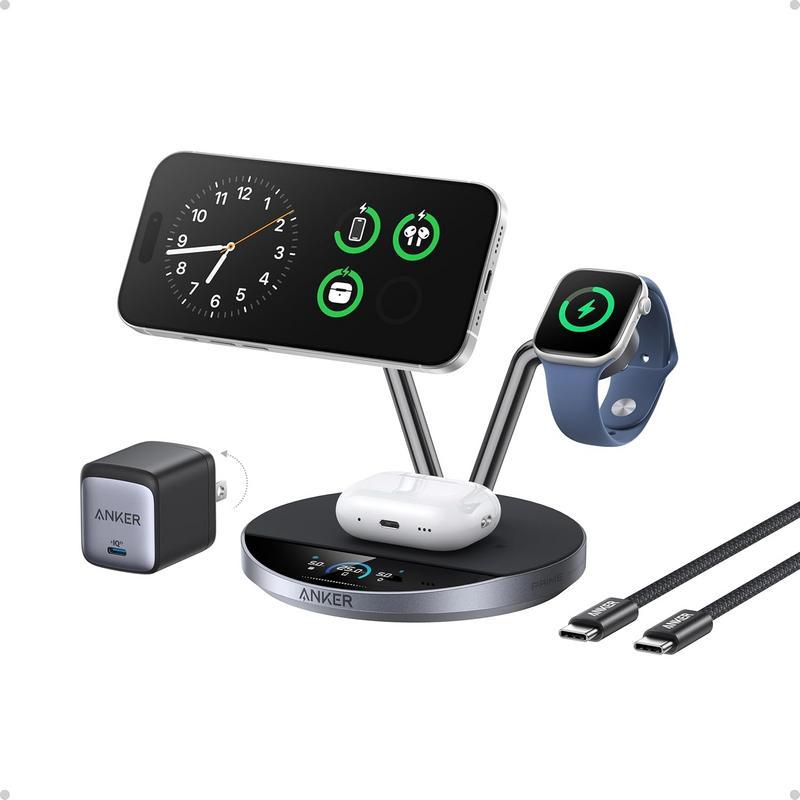
It’s against this backdrop that the subtle shift towards consolidated charging solutions begins to make sense. Not as a revolutionary product, but as a natural evolution in behavior. The desire to simplify, to reduce the number of discrete actions required to maintain a ready suite of devices, has led many to consider hubs that can service an iPhone, Apple Watch, and AirPods simultaneously, often from a single power outlet. This behavioral adaptation speaks to a deeper need for order and efficiency in our increasingly device-dense lives.
The integration of MagSafe technology in recent iPhones further refines this experience. The satisfying snap of an iPhone onto a magnetic charging pad removes the last vestiges of fumbling for alignment, turning a minor chore into an almost effortless gesture. With the advent of Qi2, which extends MagSafe-like magnetic alignment and faster charging to a broader range of accessories, this consolidation feels less like a compromise and more like a quiet triumph of user experience over past inconveniences.
This evolving landscape reflects a quiet confidence in the Apple ecosystem. Users are not simply buying products; they are integrating tools into their routines, seeking to minimize friction and maximize preparedness. The continuous optimization of these peripheral experiences is where the true story lies. Recent listings show certain charging solutions reflecting reductions compared with their earlier availability, with some noted at around 35% below previous points, indicating a dynamic market responding to these enduring needs.
This product has recently appeared more often in conversations around portable Apple setups and everyday charging routines.
Check current availability here
How do integrated charging stations affect desk organization for Apple users?
Consolidated charging stations reduce cable clutter and the number of power adapters needed, contributing to a more streamlined and visually organized workspace for multiple Apple devices.
What role does Qi2 technology play in the modern Apple charging routine?
Qi2 enhances wireless charging by introducing magnetic alignment, similar to MagSafe, ensuring optimal placement and faster charging speeds for compatible iPhones and other devices, simplifying the daily charging ritual.
Are these consolidated chargers suitable for travel with multiple Apple devices?
Many integrated charging solutions offer a more compact and singular unit compared to carrying individual chargers and cables for an iPhone, Apple Watch, and AirPods, potentially simplifying packing and reducing travel clutter.
How does MagSafe influence the daily interaction with charging an iPhone?
MagSafe provides a precise magnetic connection, removing the need for careful alignment and ensuring consistent, efficient wireless charging. This subtle interaction normalizes a more effortless charging habit for iPhone users.
Verdict
The evolution of how Apple users power their devices is less about new technology and more about a quiet behavioral adaptation. What began as a scattered collection of cables and adapters has subtly shifted towards consolidated, friction-reducing solutions. This change reflects an underlying desire to simplify daily routines and minimize the cognitive load associated with maintaining a suite of indispensable devices, illustrating how invisible technological habits quietly shape our lived environments.
"Note: Readers like you help support The Apple Tech. We may receive a affiliate commission when you purchase products mentioned on our website."