A new matte black charging stand recently appeared in many Apple devotees’ setups, its slim metal frame blending seamlessly with MacBook edges. Designed to dock an iPhone, an Apple Watch and AirPods in a single gesture, it introduces a subtle shift in how devices rest overnight—no longer scattered across different pads, but aligned to a central fixture. This transformation of routine often passes unnoticed until the morning light reveals an unfamiliar symmetry on the nightstand.
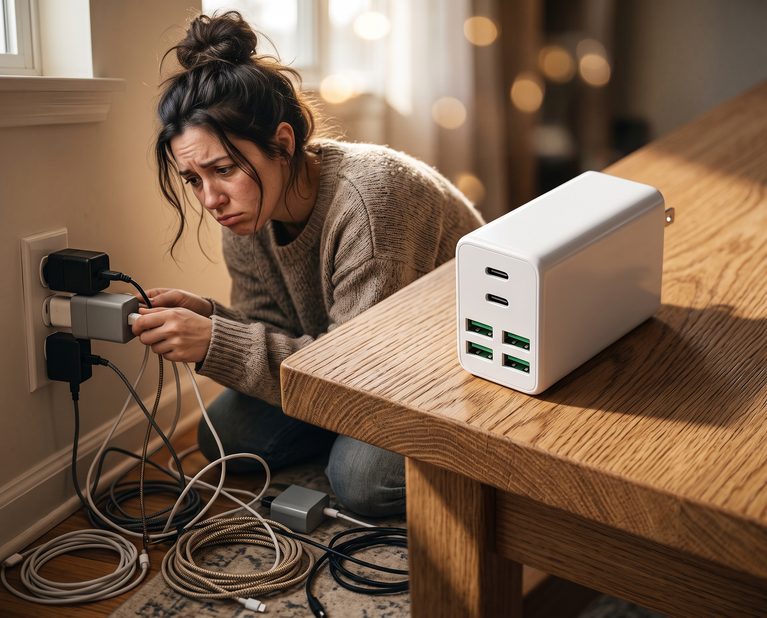
On a cluttered desk, the stand’s USB-C cable snakes alongside a MacBook charger and an extra power brick. Users often pause mid-task, untangling the threads that bind the iPhone dock, the watch module and the wireless earbud cradle. It’s a quiet dance—hands sliding across metal to locate the right port, fingers memorizing a choreography born from the need to reduce low-level friction.
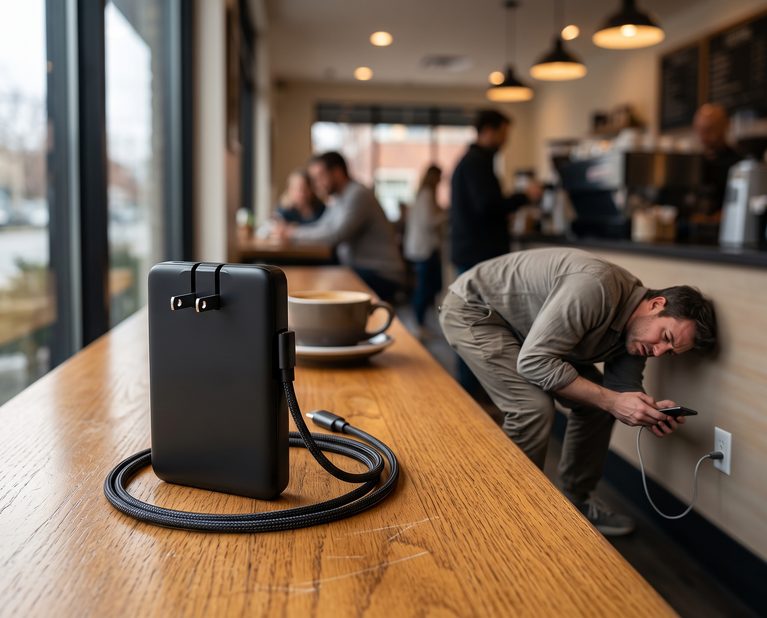
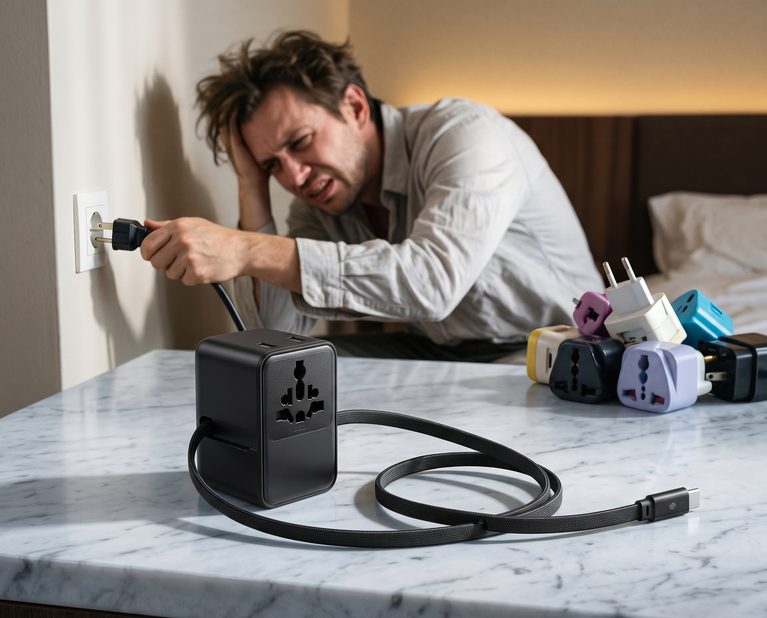
For those packing a carry-on or a backpack, the stand’s compact footprint demands a new spatial calculation. Will it rest beside the MacBook or replace the portable battery in its dedicated pouch? Each trip introduces a decision matrix: balance weight, maintain cable order, and preserve enough outlets in hotel rooms. In practice, the stand and a bundle of cables become a single unit, prompting users to reorganize their packing cubes around a central pivot point of charging needs.
Late at night, the bedroom lamp dimmed to a sliver, a hand reaches for the iPhone propped on the stand. It brushes against the narrow MagSafe coil embedded in its metal top and then the raised pad of the watch charger. The slight click of alignment registers as an everyday reassurance, a ritual that settles more than just devices. In that moment, the space grows intentional—no longer a random assortment of power accessories, but a calibrated arrangement that maps out the next 24 hours of battery life.
Within broader Apple workflows, this stand doesn’t overwrite existing patterns; it layers on top of them. An AirPods case once perched on a shelf now finds a dedicated spot below the watch module. The iPhone’s overnight charging routine synchronizes with the watch’s 10-p.m. top-off and the AirPods’ brief midday boost. These overlapping cycles embed themselves into morning routines: a glance at each LED indicator, a gentle nudge of the phone to realign it with MagSafe magnets, a check on whether the watch dock is lit.
There’s a nuanced anxiety that extends from checking an iPhone’s battery percentage to anticipating the power status of three devices at once. The iOS widget now lists the stand’s wireless output alongside other accessories, reminding users that this triage of energy demands requires intermittent attention. The result is a rhythm punctuated by small pauses—moments when screens dim or LEDs blink—which subtly guide the day’s workflow and punctuate transitions between meetings, breaks and travel preparations.
Rather than displace familiar habits, the integrated stand tends to reinforce them. As the fixture becomes a constant on desks and nightstands, it nudges subtle rearrangements of space and schedule. The look of surfaces shifts: fewer loose cables, more intentional grouping of power adapters. And amid these shifts, users find themselves adapting not just to a product, but to a new pattern of coexistence among their iPhone, Apple Watch and AirPods.
This product is available on Amazon.
Check current availability here
Is this stand compatible with iPhone MagSafe charging?
Yes. The stand uses built-in MagSafe magnets to align and charge any iPhone model that supports MagSafe wireless charging.
Can I use the stand to charge an Apple Watch model?
The integrated watch pad charges Apple Watch models when the magnetic charging cable is connected; power is supplied via the stand’s USB-C input.
Does the stand require a specific USB-C power adapter?
It accepts any USB-C power delivery adapter. Charging speed depends on the adapter’s wattage, which may affect how quickly each device reaches full battery.
Will my AirPods case charge on this stand?
MagSafe-compatible AirPods cases will wirelessly charge on the designated pad, while earlier models may require their own Lightning cable.
Verdict
The emergence of a consolidated MagSafe charging stand reveals how Apple users negotiate multiple device workflows through space and routine. By unifying iPhone, Apple Watch and AirPods charging into a single object, it surfaces the intricate choreography of low-level adjustments that govern our daily habits. Far from simply tucking cables away, this subtle fixture reframes where and how we pause to restore power, underscoring a quiet evolution in ecosystem dependency and the choreography of our tech-laden surfaces.
"Note: Readers like you help support The Apple Tech. We may receive a affiliate commission when you purchase products mentioned on our website."