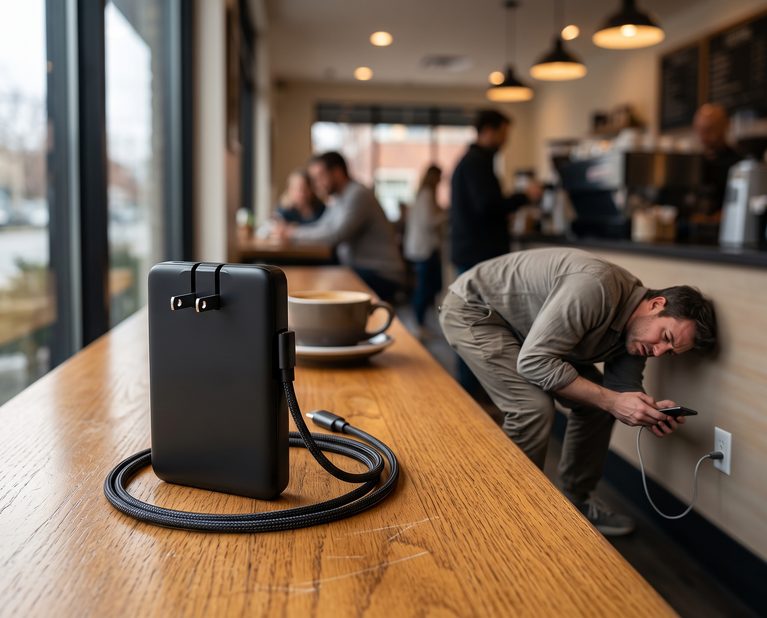
There was a time when carrying a power bank felt like admitting defeat.
You knew before leaving the house that your phone might not make it through the day, so you packed a small brick of reassurance into your bag. It had a cable attached to it, another cable somewhere nearby, and enough weight to make its presence obvious. Portable power worked, but it demanded that you organize your life around it.
The modern iPhone has made that arrangement feel increasingly strange.
The phone itself has become a remarkably self-contained object. Your maps, boarding pass, camera, messages, tickets, notes, payments and entire working life can sit behind one sheet of glass. MagSafe pushed that idea further by turning charging into something that could happen without a cable dangling from the bottom of the phone. The expectation changed quietly: accessories shouldn’t necessarily interrupt the device they’re supposed to support.
That creates an interesting contradiction. We have spent years making phones thinner, lighter and easier to carry, yet many of the accessories we depend on still behave like miniature industrial equipment.
I’ve noticed this in my own bag. The moment a conventional power bank goes in, the phone may be pocket-sized, but the system isn’t. There’s a cable to find. There’s a battery to position somewhere. Sometimes the accessory is so bulky that you end up deciding whether you actually need it before leaving home.
That isn’t really a battery problem. It’s a design problem.
The old idea of portable power was based on capacity. More milliamp-hours sounded inherently better. Bigger batteries suggested greater security. The physical object was allowed to become larger because its usefulness was measured primarily by what it could store.
But people don’t experience battery capacity as a number. They experience it as interruption.
A power bank is useful when your iPhone is at 12 percent and you’re about to spend three hours away from a wall socket. It’s useful when you’re traveling through an unfamiliar city with Apple Maps open, taking photographs, checking messages and occasionally pulling up a boarding pass. It’s useful during a long day of meetings when your MacBook isn’t the device running your life anymore—your phone is.
In those moments, the ideal accessory isn’t necessarily the one with the largest battery. It’s the one that asks the least from you.
That’s where the newer generation of magnetic battery packs becomes interesting. Qi2 and the magnetic alignment inherited from the MagSafe era make portable charging feel less like connecting two pieces of hardware and more like temporarily extending the phone itself. Apple didn’t invent the idea of magnetic charging accessories as a category, but the company’s broader approach to hardware has helped establish a particular expectation: accessories should fit into the existing behavior of the device rather than create a new behavior.
The LISEN 0.3-inch Ultra Slim Magnetic Power Bank is an unusually literal expression of that idea. Its defining characteristic isn’t a complicated feature set. It’s physical restraint.
The unit is built around a 5,000mAh battery and a very thin body, with the current Qi2 version designed to provide up to 15W wireless charging on compatible devices. LISEN lists dimensions of roughly 99 by 67.5 by 9 millimeters and a weight of about 104 grams. (LISEN)
Those numbers matter less than what they imply.
Put a traditional power bank in your hand and you immediately recognize it as a separate object. Put something this thin against the back of a compatible iPhone and the distinction starts to blur. The phone remains the primary object. The battery becomes an attachment to the phone rather than another device you happen to be carrying.
That distinction sounds cosmetic until you spend an entire day using it.
An iPhone user’s routine is already full of moments where the phone stays in the hand: walking with navigation open, waiting for a train, shooting video, reading an article, working from a café, answering messages between meetings. A magnetic battery pack can stay attached during those moments without requiring the choreography of plugging in a cable and finding somewhere to put the battery.
The result isn’t magical, and wireless charging still has the ordinary realities of heat and efficiency. A rated wireless speed also doesn’t mean every charging session will deliver that exact figure; temperature, alignment, phone behavior and battery conditions can all affect what actually happens. That’s part of the reason the more interesting story here isn’t raw charging speed.
It’s friction.
Apple users have become accustomed to accessories that disappear into the workflow. AirPods disappear into a pocket. Apple Watch charging happens on a small magnetic puck. MagSafe accessories attach without requiring a separate mechanical connection. The best versions of these ideas share a quality that’s easy to overlook because it isn’t a specification: they reduce the number of decisions you have to make.
A slim magnetic battery extends that philosophy to one of the oldest annoyances in mobile computing.
And there’s something revealing about the size of the device itself. The industry spent decades treating portable technology as a problem of miniaturization, but we’re now reaching a different stage. The challenge isn’t simply making components smaller. It’s making technology occupy less mental space.
That’s a more difficult design problem.
A colleague recently pointed out that the accessories we remember most fondly aren’t always the ones with the longest specification sheets. They’re the ones we stop thinking about. A charger that sits in a drawer until the phone needs it is useful. A charger that can remain attached while you walk, work or travel starts to feel like part of the phone’s ordinary behavior.
That’s the appeal of something like the LISEN pack. Not that it turns an iPhone into an entirely different machine, and not that a 5,000mAh battery somehow eliminates the need for conventional charging. Rather, it reflects a broader shift in how accessories are being designed: less as standalone gadgets and more as temporary extensions of devices we already carry.
For anyone curious about the physical object behind that idea, the LISEN 0.3-inch Ultra Slim Magnetic Power Bank is a useful example to examine. Its current version combines the slim form factor with Qi2-certified 15W wireless charging, while the company’s own specifications put the body at about 9mm thick.
The larger story, though, has little to do with one battery pack.
Every generation of personal technology teaches us to expect less physical baggage. First it was computers leaving the desk. Then cameras disappeared into phones. Cables became wireless connections. Wallets became screens. Now even the things that keep those screens alive are being asked to become almost invisible.
Perhaps that’s where portable technology is heading: not toward carrying more capability, but toward carrying less evidence that the capability is there.
"Note: Readers like you help support The Apple Tech. We may receive a affiliate commission when you purchase products mentioned on our website."