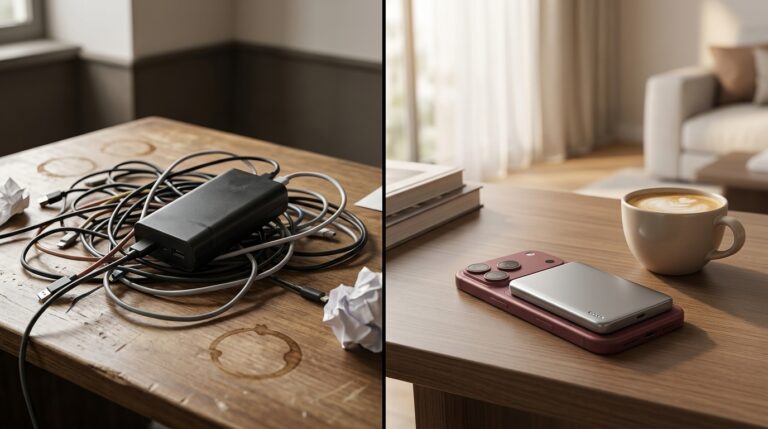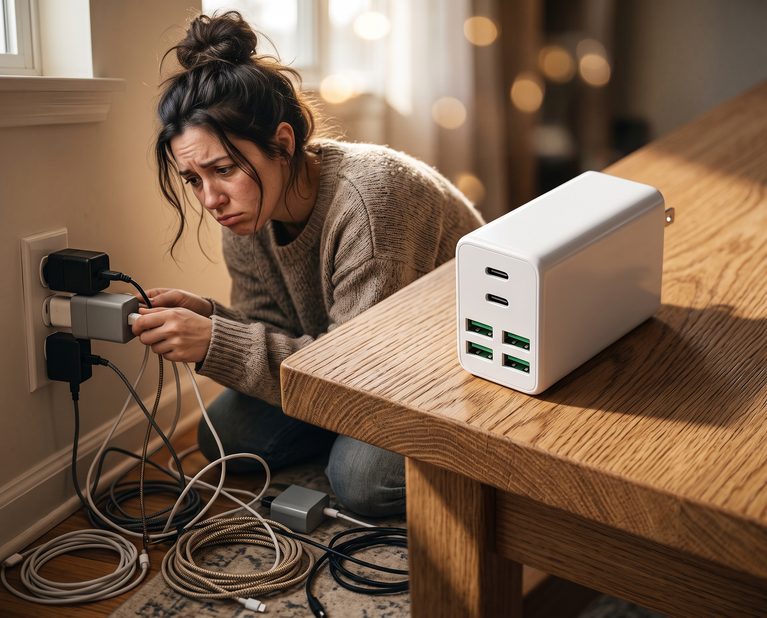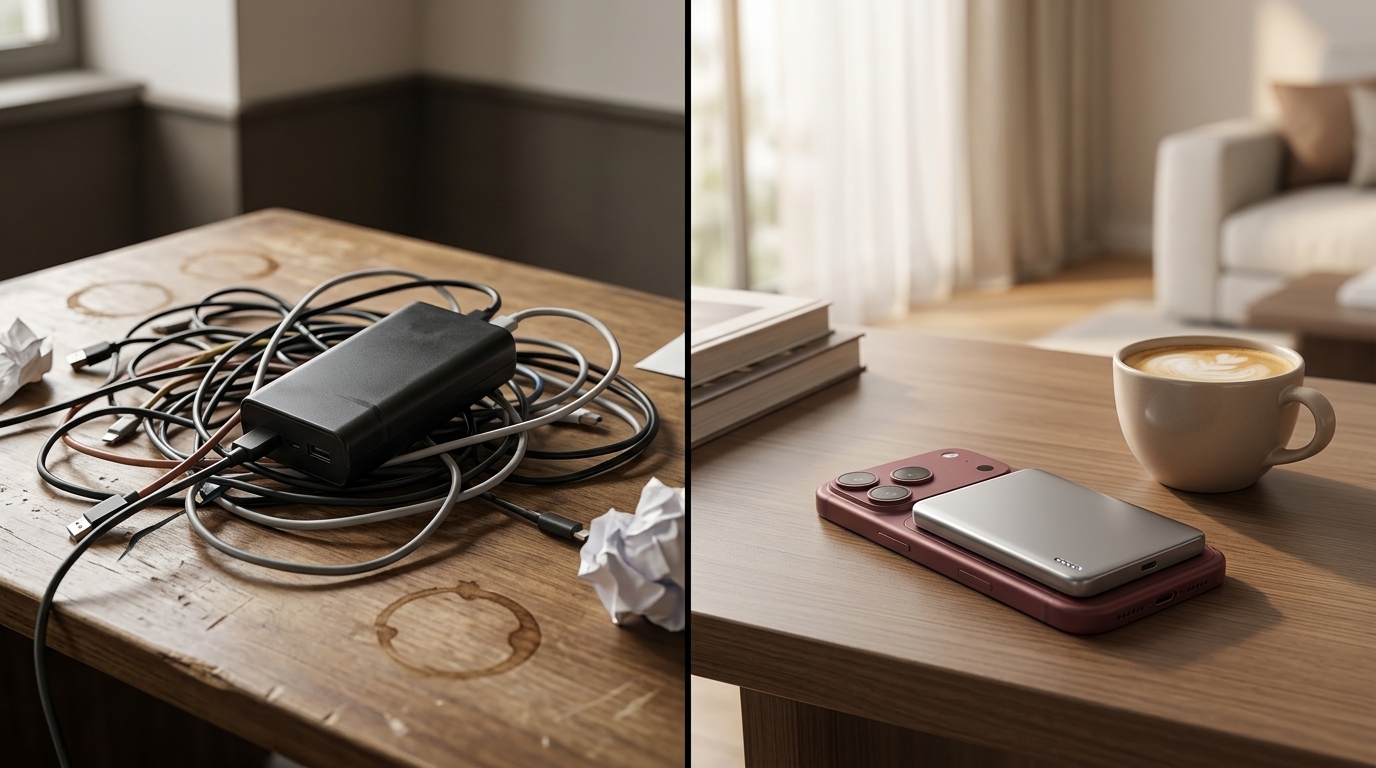
The expansion of USB-C across iPhones, iPads, and accessories has enabled a shift toward integrated power solutions that reduce what users pack without reducing charging capacity.
The wall adapter, cable, and battery bank used to be three separate objects; now they’re increasingly a single piece of hardware that does all three jobs simultaneously. This consolidation reflects how iPhone users travel now—assuming they’ll need both wall power and portable power, often on the same trip, sometimes on the same day. Carrying separate components for each scenario meant managing multiple cables, remembering to pack each piece, and dealing with the accumulated bulk in carry-on bags. The integrated approach collapses that complexity.
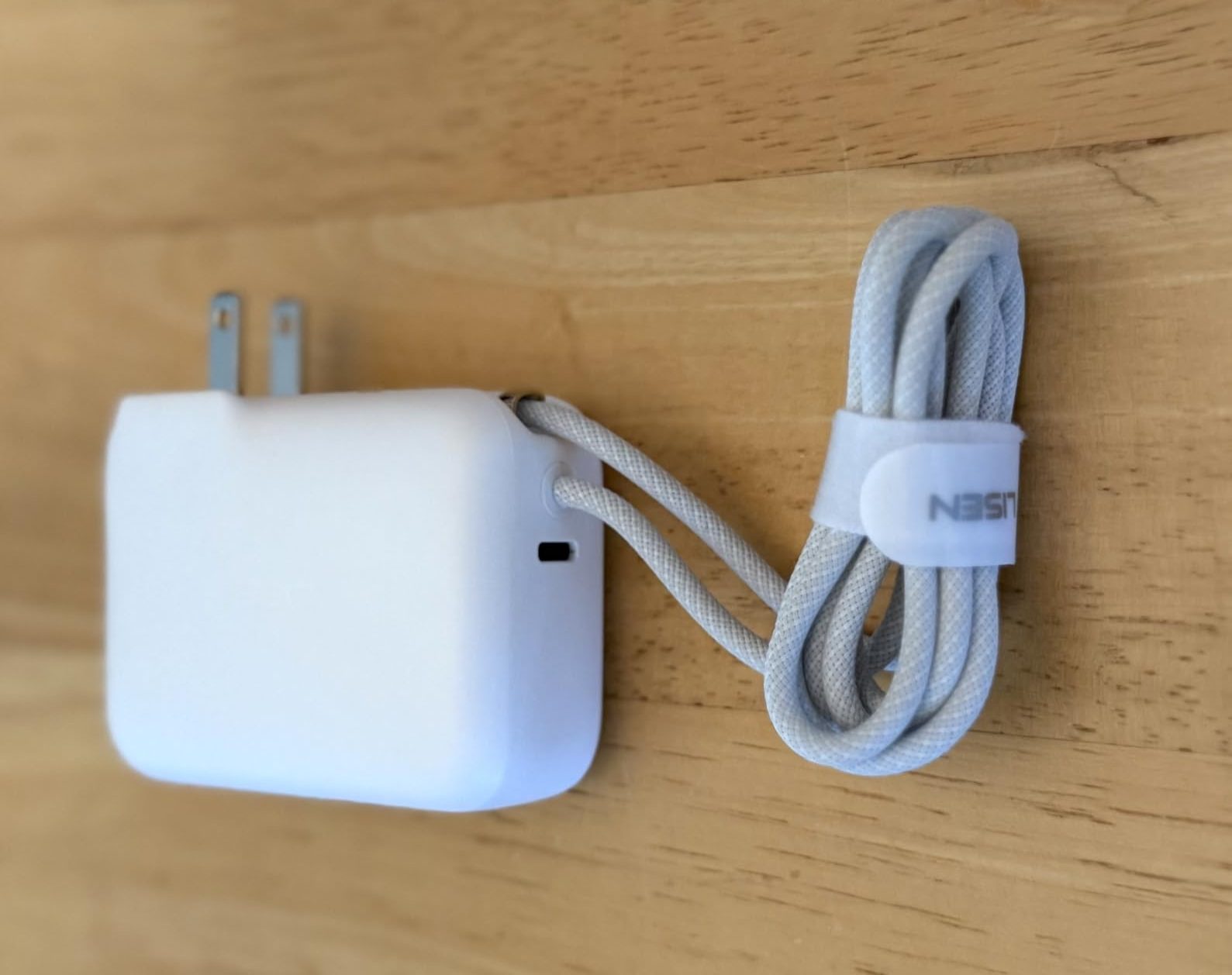
The behavior this enables is less about new capabilities and more about reducing friction in situations that were already manageable but annoying. An iPhone user at an airport can plug the unit into a wall outlet, charge the device directly, and simultaneously recharge the internal battery. Later, on a flight or during a long day away from outlets, the same unit detaches and functions as a portable power source. The cable doesn’t need swapping because it’s permanently attached. Nothing gets left behind because everything is physically connected.
Apple’s MagSafe accessories don’t integrate this way. The company sells battery packs and wall chargers as separate products, each optimized for its specific function but incompatible with the other’s role. Third-party manufacturers filled the gap by combining what Apple kept distinct. The result works within the ecosystem—USB-C charging, compatibility with recent iPhones and iPads—but exists outside Apple’s design language. It’s functional rather than elegant, pragmatic rather than refined.
The built-in cable is both the primary advantage and the main limitation. For users who charge only iPhones or only USB-C devices, it’s perfect. For users with Lightning-era accessories still in rotation—older AirPods cases, previous-generation iPads—the fixed cable becomes a constraint. The unit can’t adapt to devices it wasn’t designed for, which means travelers with mixed-generation Apple hardware still need additional cables. The consolidation works completely only for users whose entire ecosystem has moved to USB-C.
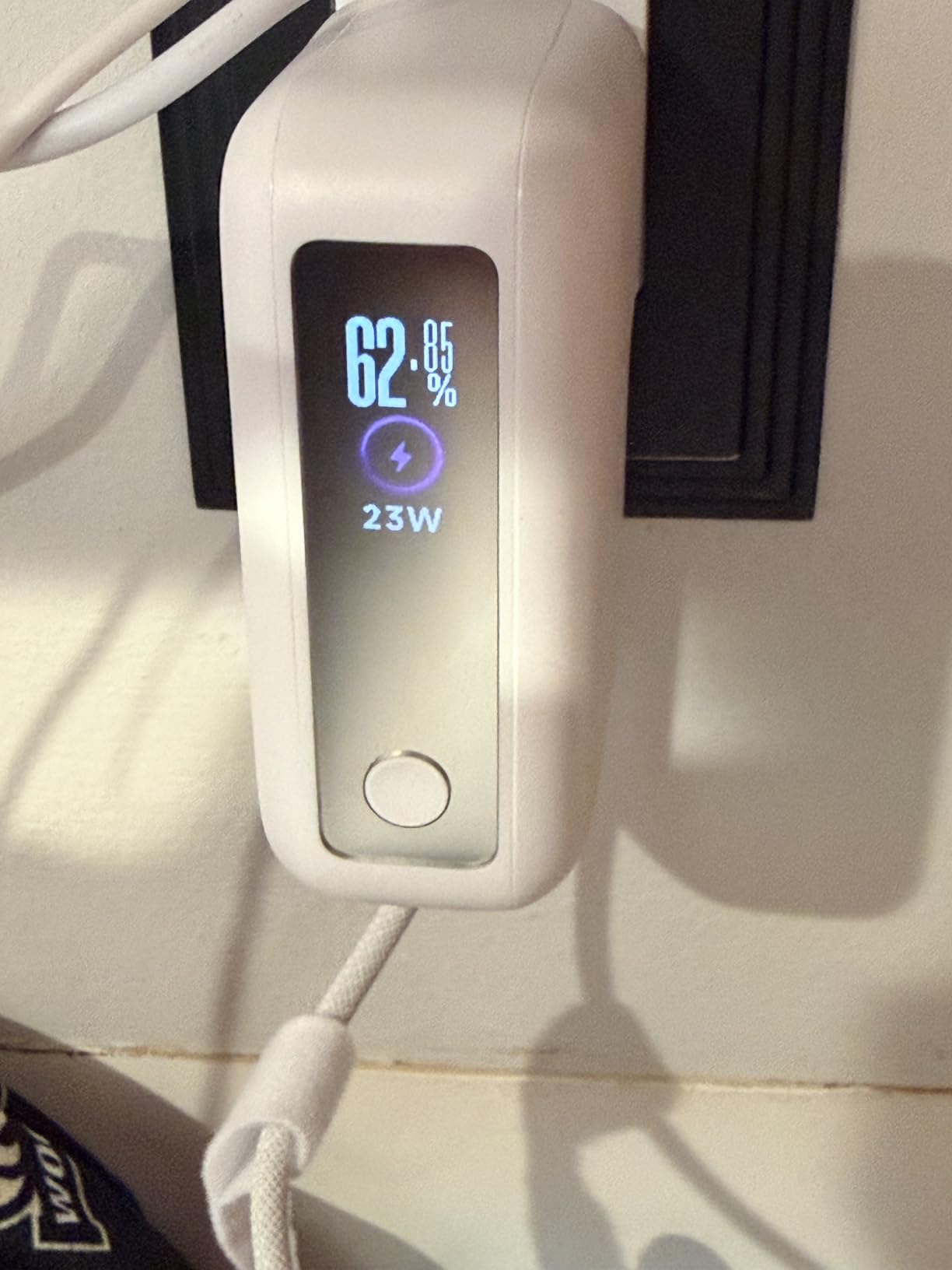
Capacity sits in a middle range: enough to fully charge most iPhones once, maybe top off an iPad partially. It’s not a multi-day solution but a same-day buffer, designed for situations where wall access is intermittent rather than absent. Business travelers use these for flights and conference days. Vacation travelers use them during long sightseeing days. The appeal isn’t unlimited power but predictable power in situations where outlets are scarce or inconveniently located.
The wattage supports fast charging, which matters when time at a wall outlet is limited. A thirty-minute airport layover becomes enough to bring an iPhone from twenty percent back to eighty percent, assuming the unit itself has charge remaining. The integrated design means this happens with one object pulled from a bag, not three. The saved time is small but the reduced cognitive load—not having to remember or organize multiple components—feels significant.
Previously listed at $49.99, current listings hover around $27.99(CODE G3ZNFZCE) for integrated units combining wall adapters, built-in cables, and 7,000mAh battery capacity with support for 35W charging speeds. The pricing positions these as premium travel accessories rather than commodity power banks, reflecting both their multi-function design and the convenience premium users apparently accept for consolidated charging solutions.
"Note: Readers like you help support The Apple Tech. We may receive a affiliate commission when you purchase products mentioned on our website."