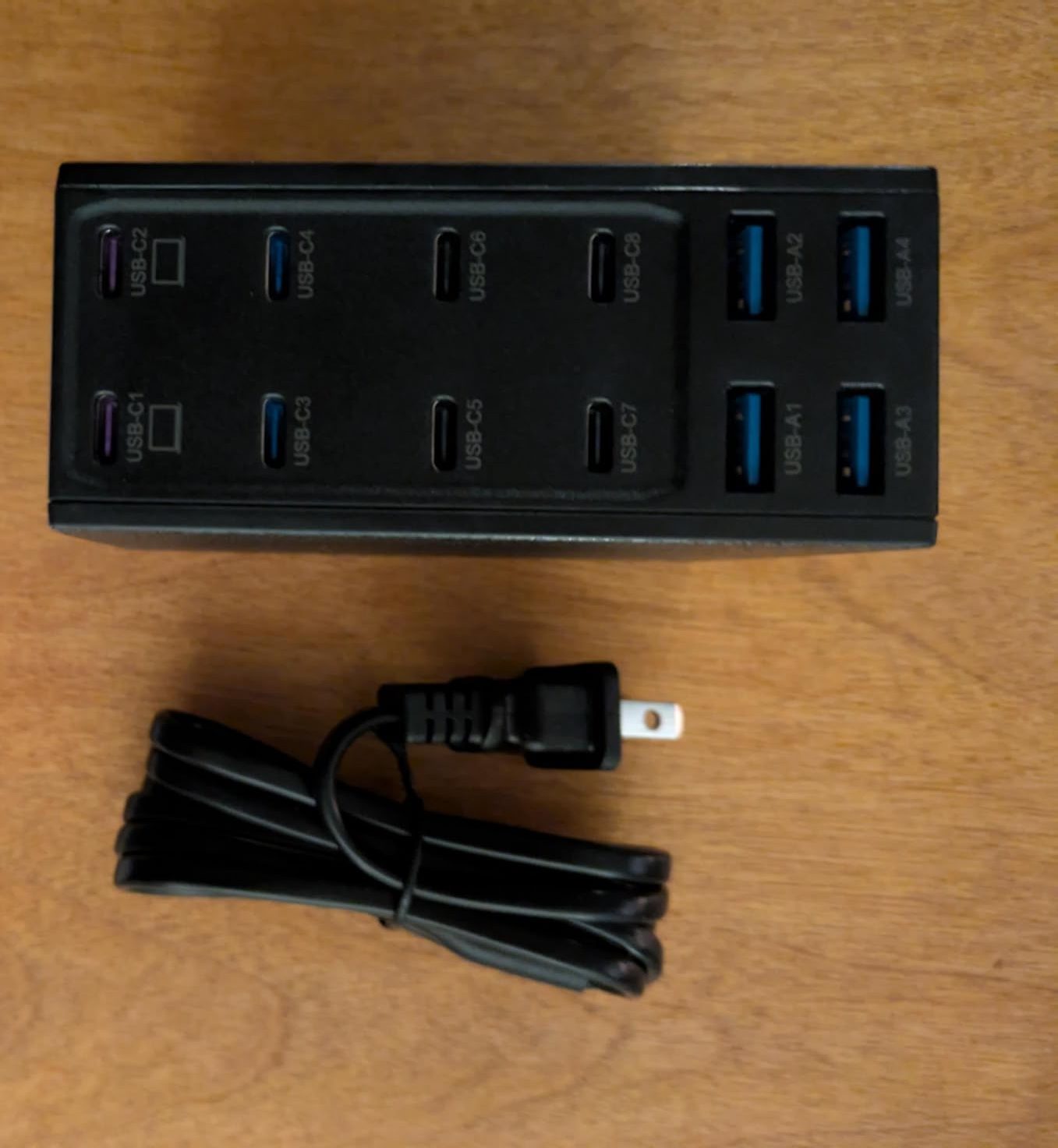
The leather texture suggested this wasn’t meant to be hidden—it was meant to be visible on the desk as a permanent fixture. Most charging accessories prioritize function over aesthetics, resulting in plastic blocks that users tuck behind monitors or under desks. A leather-textured finish signals different thinking: this object will be seen, so it should look intentional.
Twelve ports handling 500W total output positions this as small office infrastructure rather than personal accessory. A team of four or five people, each carrying a MacBook, iPad, and iPhone, generates twelve to fifteen devices needing simultaneous charging. Traditional solutions—power strips with individual adapters—create visual chaos and outlet scarcity.

The dual 65W PD ports matter for MacBook users specifically. Most multi-port chargers distribute wattage across all ports, which means no single device gets full charging speed. Dedicated 65W outputs ensure two MacBooks can charge at near-maximum rates simultaneously, even while ten other devices draw power from the remaining ports.
This reflects a shift in how small teams think about workspace setup. Instead of each person bringing their own charging infrastructure, the team invests in centralized power. It’s more efficient, cleaner visually, and eliminates the negotiation over who gets the accessible outlets.
But centralization introduces dependencies. If the charging hub fails, the entire team’s charging capacity disappears simultaneously. There’s no redundancy, no fallback. With individual chargers, one person’s adapter failure doesn’t affect anyone else. With shared infrastructure, everyone is vulnerable to the same point of failure.
What’s notable is how this mirrors broader shifts in office design. Hot desking, shared workspaces, and flexible seating arrangements all assume devices can be charged anywhere rather than at assigned personal stations. High-capacity charging hubs enable this flexibility by making power abundant and location-agnostic within the shared space.
Previously listed at $45.99, current listings hover around $30.39. The pricing reflects the high wattage and port count, but it’s distributed across multiple users, which changes the cost calculus from individual purchase to team investment.
"Note: Readers like you help support The Apple Tech. We may receive a affiliate commission when you purchase products mentioned on our website."