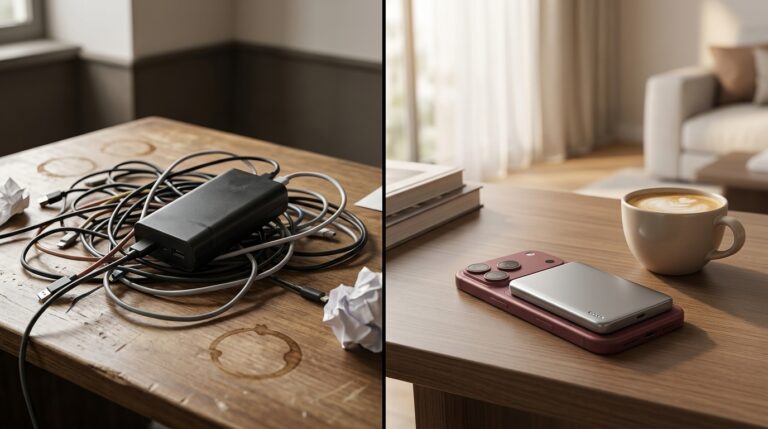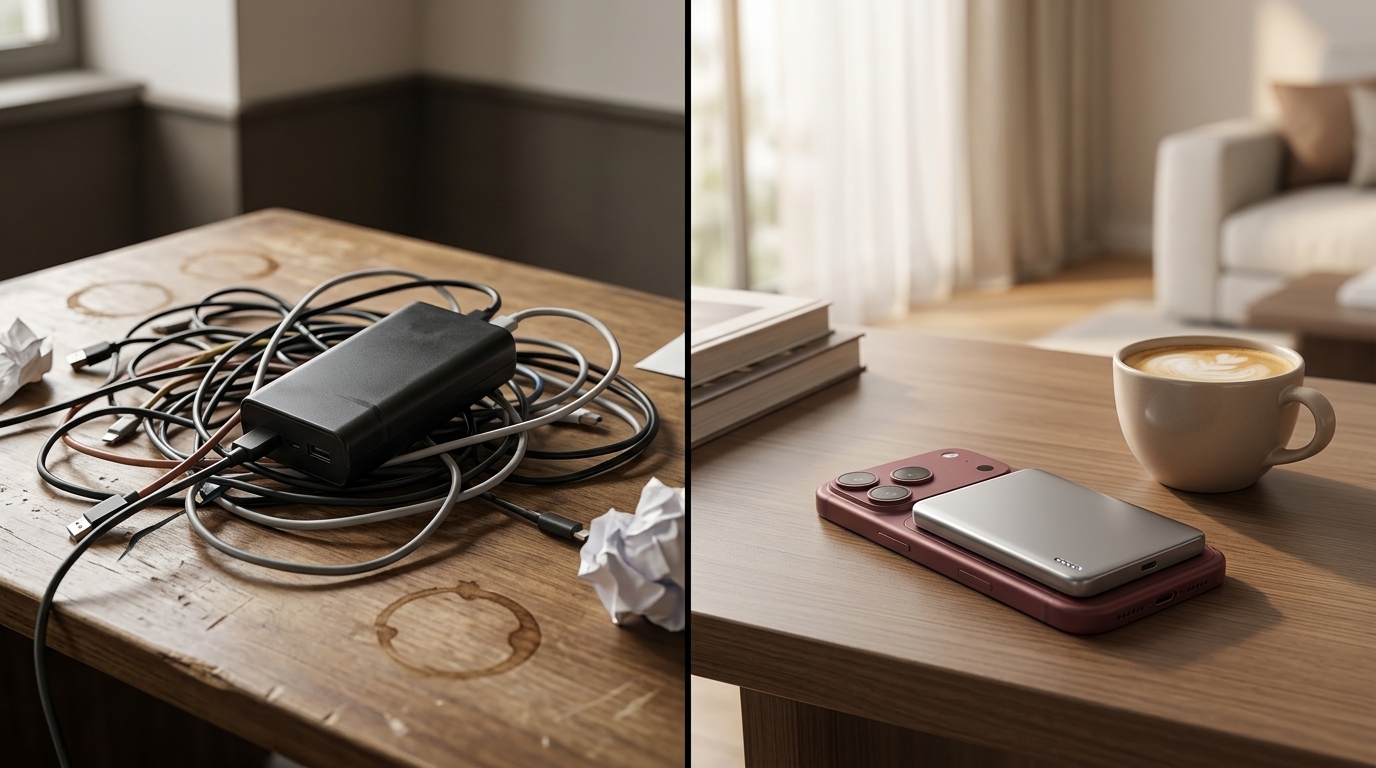


There’s a moment when people stop thinking about charging as something they do and start treating it as something that just happens. It’s not conscious. The iPhone gets placed on a surface at night. The Apple Watch lands on its spot. AirPods return to their case. No cables are plugged in, no ports are aligned, no thought is given to the mechanics. The devices are simply there in the morning, powered and ready.
This wasn’t always the case. Wireless charging spent years as a feature people acknowledged but didn’t prioritize. It was slower than wired charging, finicky about alignment, and required buying separate accessories for each device. Most people stuck with cables because they worked predictably. But somewhere in the transition from iPhone 12 to 13 to 14, the calculus shifted. MagSafe made alignment effortless. Charging speeds improved. The friction that made wireless feel optional started to dissolve.
The Apple Watch accelerated this shift in ways that aren’t always obvious. Unlike the iPhone, it never had a Lightning port. Wireless charging was the only option from the start, which meant anyone with an Apple Watch already lived in a hybrid charging world—cable for the phone, puck for the watch. That split system worked, but it also planted the idea that maybe everything could eventually charge the same way. When the iPhone adopted MagSafe, the gap narrowed. When AirPods cases started supporting wireless charging, it closed entirely.
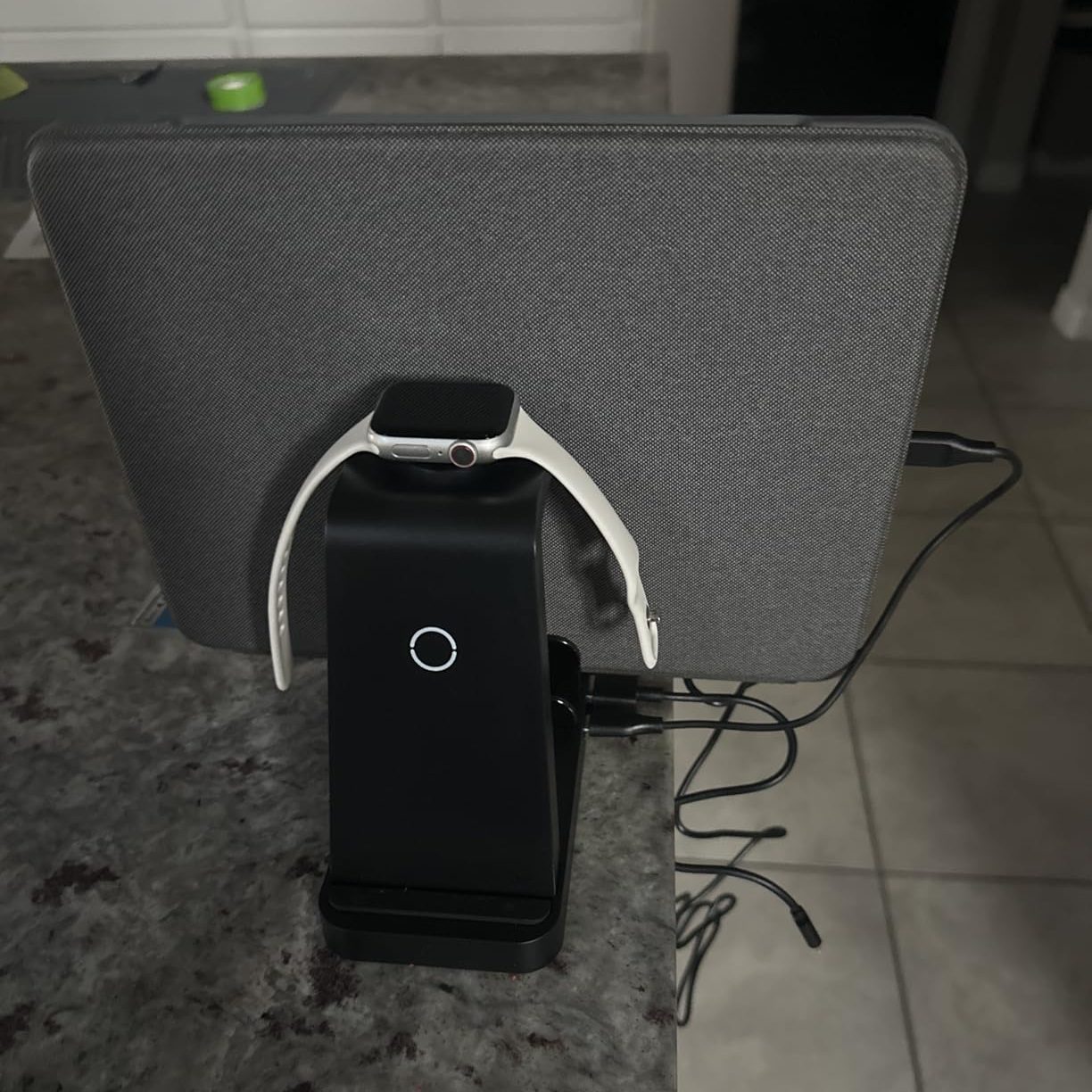
Multi-device wireless stands aren’t solving a technical problem so much as a spatial one. Three devices charging separately require three surfaces, three cables, or three moments of attention throughout the day. A single stand that handles all of them collapses that sprawl into a single, predictable routine. The iPhone docks vertically, the Apple Watch attaches magnetically, the AirPods rest below. It’s choreographed in a way that distributed charging never is.
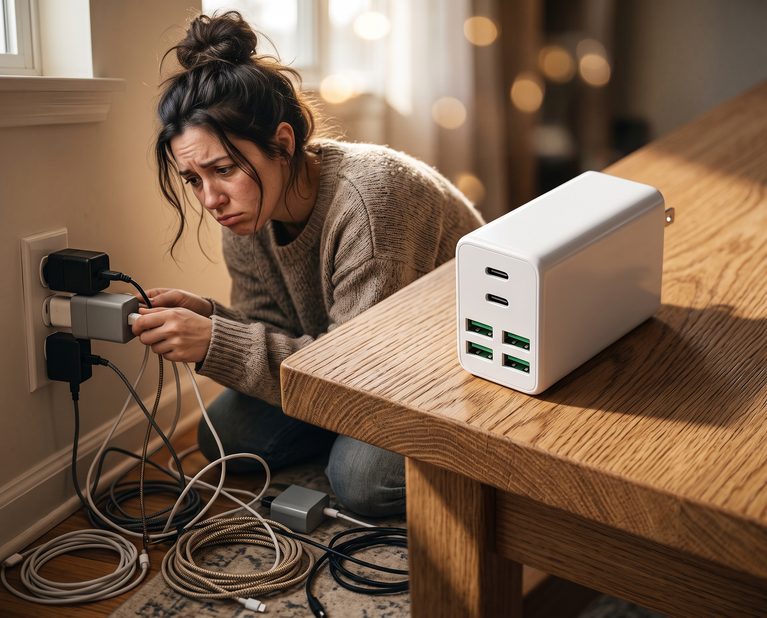
Travel is where this setup proves itself most clearly. Packing for a trip used to mean gathering the iPhone cable, the Apple Watch charger, and the AirPods cable, then hoping the hotel room had enough outlets within reach of the bed. A single wireless charging stand eliminates that calculus entirely. One device, one outlet, everything charges. It’s not just convenient—it’s one less thing to think about when away from home, which matters more than it sounds.
The shift also changes how people interact with their devices overnight. When the iPhone charges flat on a nightstand, it’s face-down or face-up, but either way it’s horizontal. On a vertical stand, it becomes a bedside display. Notifications are visible without lifting the phone. StandBy mode on newer iPhones turns the screen into a clock or photo frame. The charging method alters the device’s role in the room, from something that’s just resting to something that’s still subtly active.
Not everyone has made this transition, and that’s fine. Cables still work. Some people prefer the speed of wired charging, or don’t want another accessory on their nightstand. But for those who’ve adopted wireless charging across their Apple devices, the old way—fumbling with cables in the dark, checking that each device is actually connected—starts to feel unnecessarily manual. The behavior changes quietly, but once it does, it’s hard to go back.
Previously listed at $40, the current listing shows $24.17 at the time of publishing. View current listing. Price at time of publishing. Subject to change.
"Note: Readers like you help support The Apple Tech. We may receive a affiliate commission when you purchase products mentioned on our website."