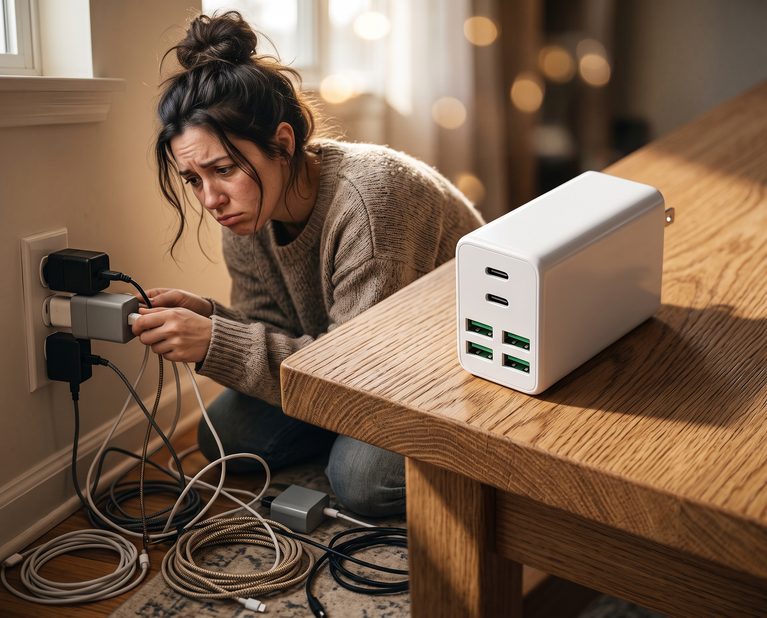
There’s a specific moment most people who carry multiple Apple devices recognize: standing near an outlet, mentally calculating which device needs charging most urgently. It’s not dramatic, but it’s constant. The iPhone is at thirty percent, the MacBook needs a top-up before a meeting, and the iPad sat uncharged overnight. For years, this meant carrying multiple cables, occupying multiple outlets, or accepting that something would run low.
The proliferation of USB-C across Apple’s lineup—from MacBook to iPad to the latest iPhones—should have simplified things. Instead, it created a new friction: more devices sharing the same charging standard, but still competing for limited power sources. Hotel rooms, coffee shops, and home desks weren’t designed for this density of personal electronics. People adapted by developing charging hierarchies, prioritizing the iPhone over the iPad, or leaving the MacBook tethered overnight while everything else waits.
What’s shifted isn’t the devices themselves, but the infrastructure around them. Multi-port charging stations with enough wattage to handle a MacBook Pro alongside smaller devices have quietly altered daily routines. Instead of rotating through a single charger or clustering adapters into power strips, users can dock everything simultaneously. It’s less about speed and more about eliminating the decision fatigue that comes with managing four or five devices that all need power at overlapping times.

The behavioral change is subtle but measurable. People stop thinking about charging as a sequential task. The MacBook doesn’t need to finish before the iPhone starts. The iPad doesn’t sit idle because the AirPods case took the only available port. This kind of passive efficiency doesn’t announce itself, but over weeks it compounds—fewer mornings spent hunting for the right cable, fewer moments of low-battery anxiety during travel.
Apple’s ecosystem encourages device accumulation. Handoff, AirDrop, and Continuity only work if everything is powered and nearby. A charging hub that can deliver laptop-level wattage while supporting multiple lower-power devices fits naturally into that workflow. It’s not about having the newest technology; it’s about reducing the invisible tax of keeping that technology ready to use.
Travel amplifies this. A single charging station in a hotel room replaces the usual tangle of adapters and cables. International trips become slightly less chaotic when one device handles the MacBook, iPhone, and iPad without requiring multiple outlet configurations. It’s the kind of convenience that only becomes obvious once it’s absent—trying to revert to individual chargers feels inefficient in a way it didn’t before.
The broader pattern here isn’t unique to Apple users, but the density of devices in their hands makes it more acute. When someone owns a MacBook, an iPhone, an iPad, and wireless earbuds, the question isn’t whether they need centralized charging—it’s why they waited so long to address it. The shift doesn’t feel revolutionary because it isn’t. It’s infrastructure catching up to behavior that already existed.
Previously listed at $43, the current listing shows $32 at the time of publishing. View current listing. Price at time of publishing. Subject to change.
"Note: Readers like you help support The Apple Tech. We may receive a affiliate commission when you purchase products mentioned on our website."