The way people distribute power adapters throughout their homes has shifted as device dependency increased and patience for extended charging times evaporated.
There’s a behavioral pattern that’s become standard in homes where multiple Apple devices are in constant rotation. People stopped relying on a single charging location and started planting fast chargers in the rooms where they actually spend time—kitchen counter, bedside table, home office desk. The shift isn’t about convenience alone. It’s about eliminating the window of vulnerability when your iPhone hits fifteen percent and you need it functional again soon.
This happened because charging stopped being something you do overnight and ignored the rest of the day. Device usage intensified. Your iPhone runs navigation, authentication, payments, communication, entertainment. Running low isn’t a minor inconvenience—it disrupts your ability to move through the world as you’ve organized it. The response was to reduce charging time from background task to active management.

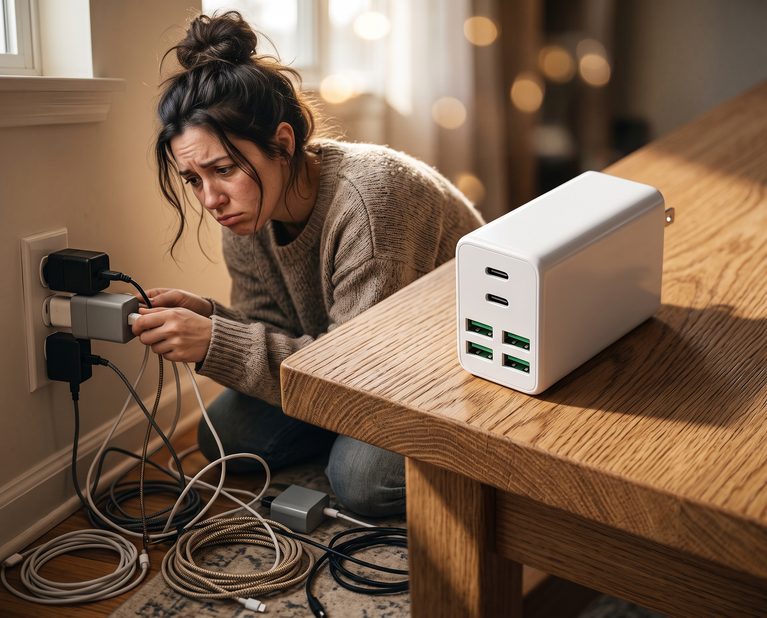
Fast charging technology made this possible, but the real change was recognizing that outlet location matters. If your charger lives in the bedroom but you spend your morning in the kitchen, you’re either separated from your phone or carrying it back and forth at partial charge. Neither works when you need the device ready to leave with you in thirty minutes.
What emerged is a kind of charging choreography. The bedside charger handles overnight. The kitchen charger catches the phone during breakfast when you notice it’s lower than expected. The office charger rescues you mid-afternoon when a long call drained more battery than usual. Each location serves a specific moment in the daily rhythm of device dependency.
This also reveals something about how Apple’s battery promises have collided with real-world usage. The company talks about all-day battery life, but that assumes moderate use. People don’t use their iPhones moderately anymore. They use them constantly, for everything. The gap between promised battery duration and actual depletion created the need for faster, more accessible charging throughout the day.
There’s also an economic dimension that rarely gets mentioned. Distributing multiple fast chargers through your home requires buying several of them. People accept this cost because the alternative—time spent managing a single charger or tolerating slow charging—creates more friction than the expense. They’ve essentially purchased their way out of a design constraint.
SIMILAR
Apple Home users are managing smart outlets through competing voice assistants as HomeKit compatibility remains inconsistent
Why some Apple ecosystem users are quietly adding Windows machines to home offices
iPhone users are redesigning car charging setups as multiple devices compete for limited power during commutes
The broader pattern is that Apple ecosystem habits have forced spatial adaptations in how people organize their homes. You can’t just have one charger anymore, the way you might have had one landline phone. The infrastructure has to match the intensity and unpredictability of device use.
Previously listed at $19.99, compact fast-charging adapters current listings hover around $9.99(CODE CUKTECH50).
"Note: Readers like you help support The Apple Tech. We may receive a affiliate commission when you purchase products mentioned on our website."