

Fast charging has been technically possible on iPhones for years, but adoption lags behind capability in ways that aren’t immediately obvious. The iPhone 15 and 16 series support significantly faster charging speeds than older models, but only with the right combination of cable and power adapter. Most people don’t know this, or don’t think about it, so they continue using whatever cable and charger they already have. The result is phones that could charge in under an hour taking twice that long, simply because the infrastructure hasn’t caught up to the hardware.
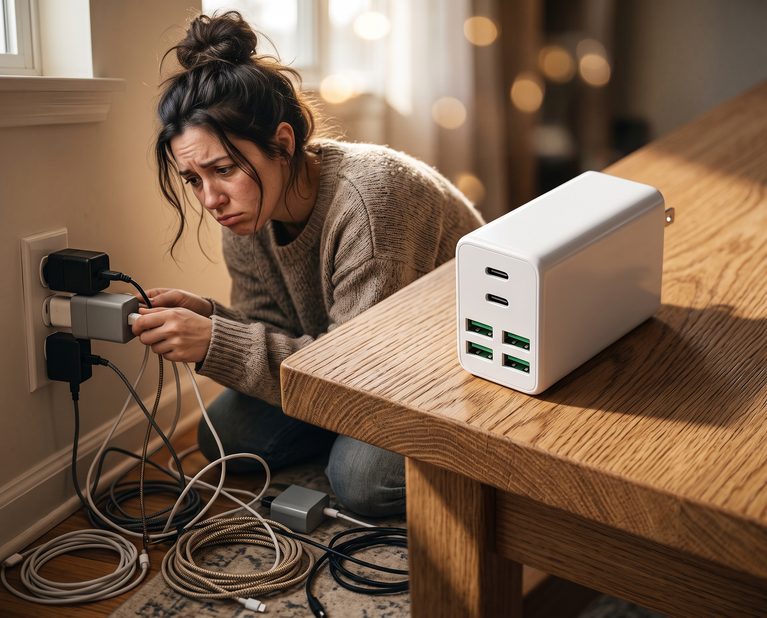
Cable length matters more than people expect. A standard cable is usually three feet, maybe six if you’re lucky. That’s fine if the outlet is directly beside the bed or desk, but it’s inadequate almost everywhere else. Coffee shops, airports, hotel rooms—outlets are rarely positioned conveniently. People end up sitting on floors, hunched over awkwardly, or leaving their phones across the room while they charge. Longer cables don’t solve the charging speed problem, but they solve the spatial problem, which affects daily comfort in ways that compound over time.
The frustration becomes acute during travel. A single short cable means choosing between charging the iPhone near the bed or near the desk, rarely both. Multiple cables of varying lengths provide options—one for nightstand use, another long enough to reach from an inconveniently placed outlet to wherever you’re actually sitting. That flexibility seems minor until you’re in a hotel room with outlets behind furniture or across the room from where you need your phone.

Power adapters are the variable most people overlook entirely. The small cube that came with older iPhones charged slowly by design. It was sufficient when phones had smaller batteries and lower power limits, but it’s inadequate for modern iPhones that can accept much higher wattage. Using an old charger with a new iPhone means forfeiting the fast charging capability entirely, even if the cable supports it. The phone charges, just slowly, and most people never realize they’re leaving performance on the table.
Fast charging matters most when time is constrained. Twenty minutes plugged in during a morning routine, a quick top-up between meetings, or charging during a short break before heading out. In those scenarios, a fast charger delivers meaningfully more battery life than a standard one. But those gains only materialize if both the cable and adapter support the necessary wattage. Miss either component and the charging speed defaults to the slowest link in the chain.
The USB-C transition should have simplified this, but it mostly just shifted the confusion. Yes, one cable type now works across iPhone, iPad, and many laptops. But not all USB-C cables are equivalent. Some support data transfer but not fast charging. Others handle power delivery at different wattage levels. The standardization of the physical connector didn’t eliminate the variation in capability, which means people still end up with cables that look identical but perform differently.
Multiple cables at different lengths address the practical reality that charging happens in different locations with different constraints. One cable lives in the bedroom, another at the desk, a third in a bag for travel. Having several eliminates the need to move cables around or unplug one device to charge another. It’s an organizational solution to a problem that shouldn’t exist but does—charging infrastructure that’s still catching up to how people actually use their devices.
The current listing shows $19.99 at the time of publishing. View current listing. Price at time of publishing. Subject to change.
"Note: Readers like you help support The Apple Tech. We may receive a affiliate commission when you purchase products mentioned on our website."