Every international trip begins the same way: checking that the phone, laptop, and tablet are charged, then hunting for the right power adapter. Europe uses a different plug standard than the US, which means American travelers need physical adapters to connect their devices. This has been true for decades. Yet people still get it wrong, forgetting adapters entirely or bringing incompatible ones that don’t fit German, French, or Spanish outlets.
The confusion comes from assuming all European countries use the same plug type. They don’t. Most of Western and Central Europe uses Type C, E, or F plugs—often interchangeable, but not always. Italy has its own variation. The UK uses yet another. Switzerland has outliers. Travelers accustomed to USB-C standardization across their Apple devices expect similar consistency from wall outlets and are surprised when it doesn’t exist.
iPhone and MacBook chargers complicate this in unexpected ways. Both now use USB-C charging bricks, but those bricks still need to plug into the wall. The cable standardization helps—one cable works for phone, tablet, and laptop—but it doesn’t eliminate the need for physical plug adapters. Some people assume newer Apple chargers will somehow work universally. They don’t. The plug interface remains region-specific, regardless of how modern the device is.
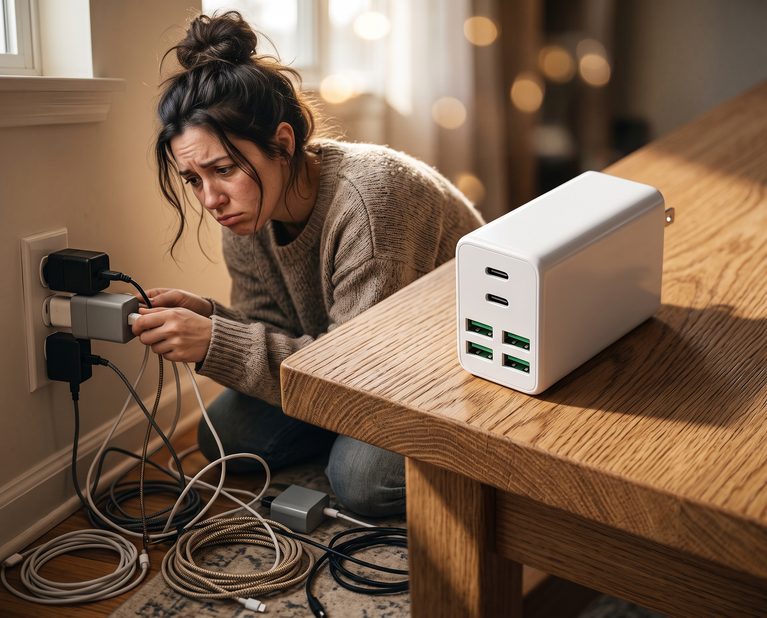
Packing multiple adapters makes sense once you’ve been caught without one, but it’s hard to predict how many you’ll actually need. A hotel room might have two outlets near the bed. A hostel might have one per room. An Airbnb could have several, but none near where you want to charge devices overnight. Bringing a small set of adapters—enough for a phone, laptop, and watch charger simultaneously—means not having to choose which device gets power first.

Certification matters in ways that aren’t obvious until something goes wrong. Cheap plug adapters work until they don’t—loose connections, overheating, or failure under sustained load. Apple devices aren’t fragile, but they’re expensive enough that people prefer not to test their durability with questionable electrical connections. Certified adapters aren’t foolproof, but they reduce the likelihood of problems that could ruin a trip or damage hardware.
The real issue is that plug adapters are easy to forget and annoying to replace once abroad. Airport shops sell them, but at inflated prices. Hotels sometimes loan them, but supplies are limited. Local electronics stores carry them, but finding one requires time and navigation most travelers don’t want to spend. Having a few packed in advance eliminates the problem before it starts, which is the only reliable solution.
Some travelers now carry universal adapters that work in multiple countries, but those tend to be bulkier and more expensive. For people who primarily travel within Europe, region-specific adapters are smaller and more practical. The trade-off is needing different sets for different trips, which reintroduces the organizational problem they were trying to avoid. There’s no perfect solution—just varying degrees of inconvenience.
The current listing shows $11.99 at the time of publishing. View current listing. Price at time of publishing. Subject to change.
"Note: Readers like you help support The Apple Tech. We may receive a affiliate commission when you purchase products mentioned on our website."