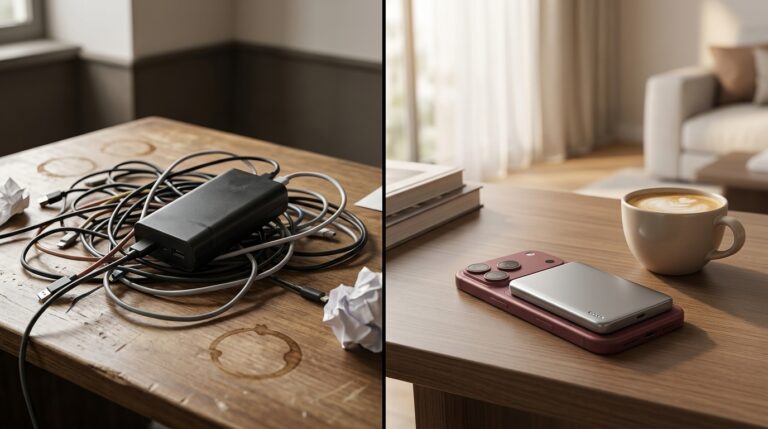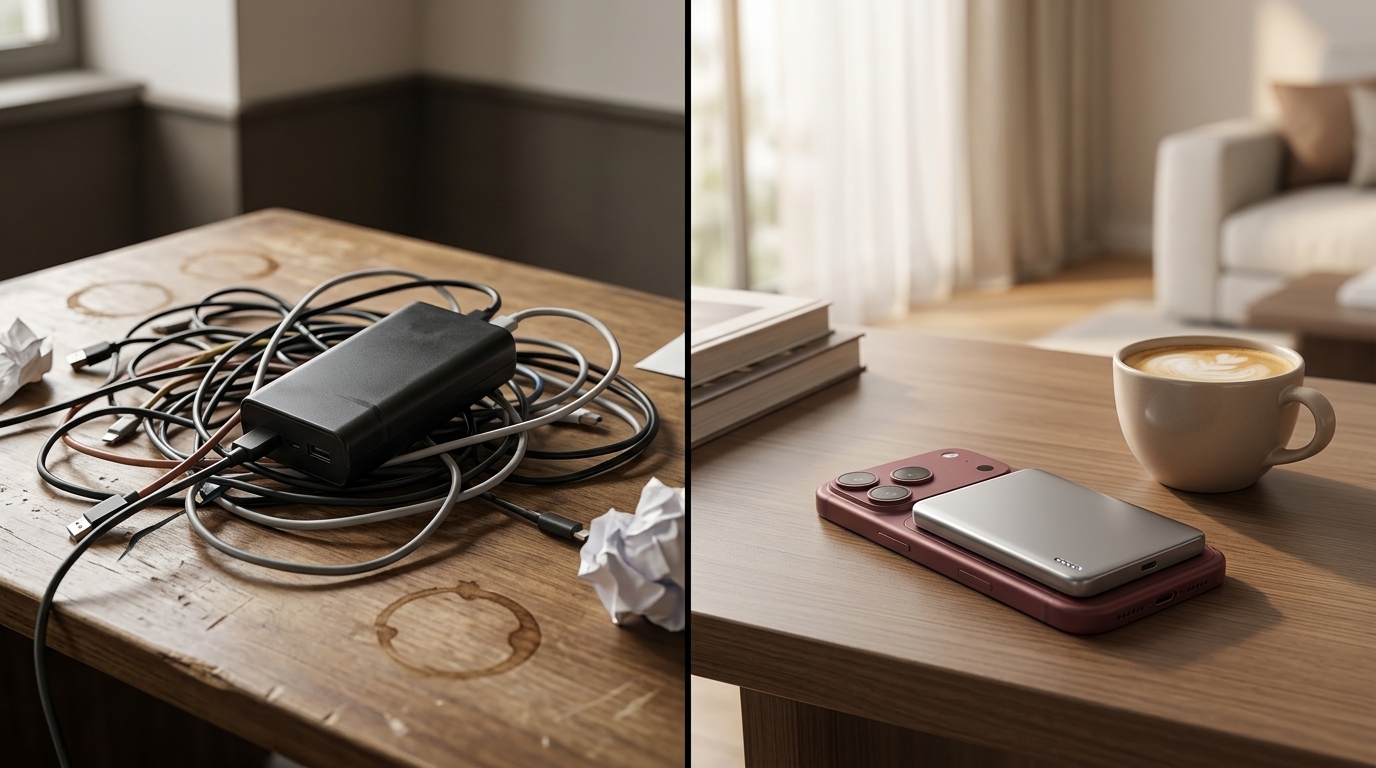


The shift from portable chargers to fixed desktop power stations reflects a quiet acknowledgment that most charging happens in predictable locations. Multi-device households are choosing permanent infrastructure over the flexibility Apple’s original adapter model assumed people needed.
Apple stopped including charging adapters with iPhones in 2020, framing the decision as environmental stewardship. The practical result was that millions of people suddenly needed to supply their own power delivery infrastructure. Most reached for the adapters they already owned, leftover from previous devices. But a subset began rethinking the entire premise of portable charging blocks.
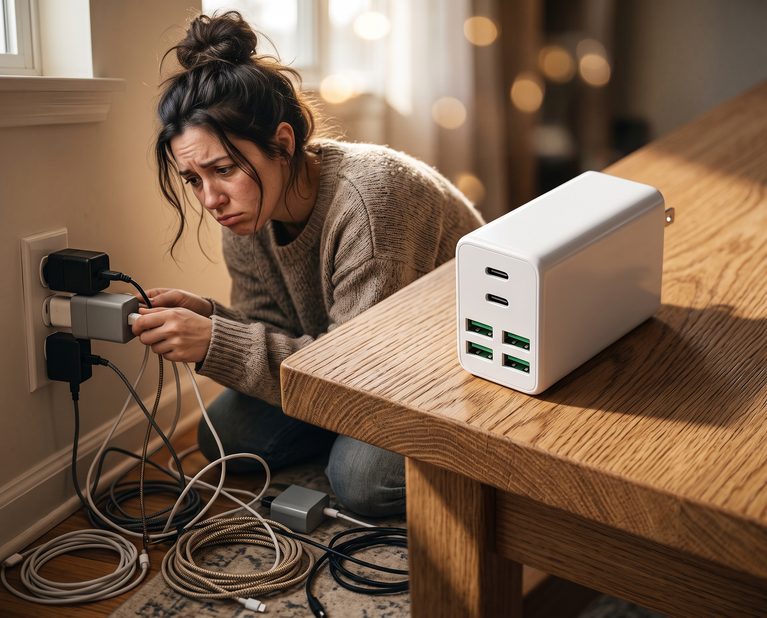
The desktop charging station—a fixed hub with multiple ports and integrated cable management—has become common in homes where the same spot always handles overnight phone charging, laptop top-ups, and accessory power needs. These aren’t portable. They’re not meant to be. They assume you charge in the same place every night, and that assumption turns out to be correct for most people.

What’s driving adoption isn’t novelty. It’s exhaustion with the daily ritual of plugging and unplugging adapters, managing cable sprawl, and hunting for available outlets behind furniture. A charging station consolidates all of that into a single unit that sits on a desk or nightstand permanently. You plug devices in, they charge, you unplug them. The adapter itself never moves.
The retractable cable feature addresses another low-level annoyance: coiled cables that tangle, fray, or dangle off surfaces. A cable that retracts into the charging hub when not in use eliminates visual clutter and reduces wear from repeated bending. It’s a small refinement, but it removes a specific friction point that portable adapters can’t solve.
SIMILAR
How iPhone owners navigate the reality that gaming peripherals treat Apple devices as secondary platforms
How iPad Pro photographers created workarounds for a fundamental file transfer limitation Apple never quite solved
How iPhone users negotiate the nightly ritual of charging five devices from a single nightstand footprint
For households managing multiple Apple devices—iPhone, MacBook, iPad, AirPods—the appeal is consolidation. Instead of four separate charging locations with four sets of cables, everything converges on a single station. The AC outlets handle the MacBook’s larger power brick if needed, while the USB-C and USB-A ports cover everything else. It’s not elegant in the way Apple’s design language defines elegance, but it’s functional in ways Apple’s minimalist adapter approach isn’t.
The psychological shift is subtle but real. Once you install a charging station, you stop thinking about charging infrastructure entirely. The device becomes invisible furniture, like a lamp or a power strip. You don’t optimize its placement or move it when traveling because it was never meant to be portable. That permanence is liberating for people who’ve spent years managing adapter logistics.
The multi-port configuration also reflects how device ownership has evolved. Ten years ago, most people owned one phone and maybe a laptop. Now the average household juggles phones, tablets, watches, earbuds, and various accessories—all requiring periodic charging. A single-port wall adapter can’t keep pace with that density. A seven-port hub can.
Pricing for these desktop charging stations has remained relatively stable, with most models hovering between $80 and $90. Current listings hover around $79.99, though the category hasn’t seen the dramatic compression visible in simpler accessories like cables or single-port adapters.
"Note: Readers like you help support The Apple Tech. We may receive a affiliate commission when you purchase products mentioned on our website."