

The decision to open Find My to third-party hardware has created a parallel accessory ecosystem built around Apple’s tracking infrastructure but freed from its form factor constraints. Thin cards that slip into wallets represent the clearest expression of that divergence.
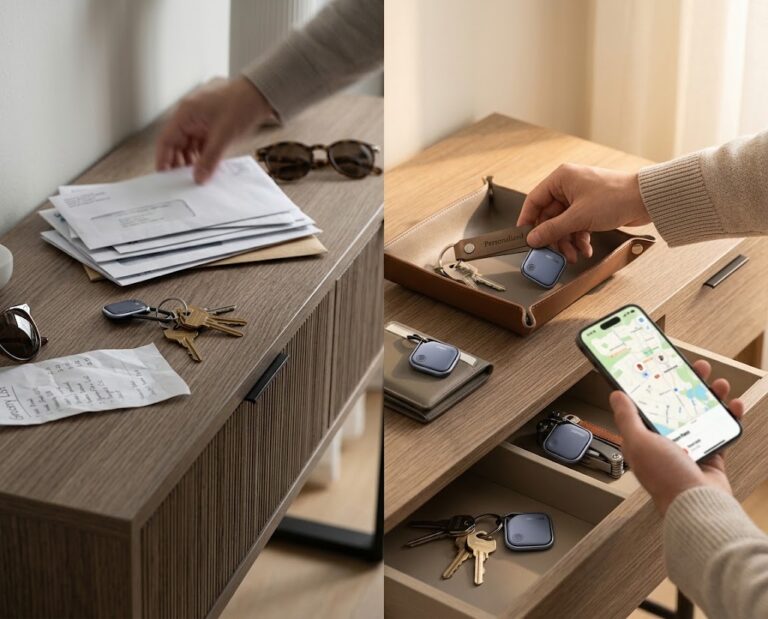
AirTags solved the problem of tracking keys, bags, and bulky items. But they created a new one: how do you track something flat? A wallet, a passport holder, a laptop sleeve—none of these accommodate a disc-shaped tracker without introducing bulk that defeats the purpose. For years, the workaround was creative: people tucked AirTags into pockets designed for other things, accepted the added thickness, or simply chose not to track those items at all.
Apple’s decision to license the Find My network to third-party manufacturers eliminated that compromise. Companies began producing card-shaped trackers—thin enough to slide into a wallet’s card slot without displacing anything else. They ping the same satellite network of nearby iPhones that AirTags use, appear in the same Find My app, and offer roughly the same location precision. The only difference is form factor.

The shift has been quietly transformative for iPhone users who’ve already committed to the Find My ecosystem. Instead of choosing which items are trackable based on whether they can accommodate an AirTag, users can now extend tracking to nearly everything they carry daily. The psychological impact is subtle but measurable: the low-level anxiety around misplaced wallets diminishes when you know retrieval is a few taps away.
What’s less obvious is how these third-party trackers have also exposed limitations in Apple’s original design assumptions. AirTags were optimized for durability and replaceable batteries, which necessitated their shape and size. Card trackers, by contrast, prioritize thinness and accept trade-offs in battery longevity—often lasting one to three years before requiring replacement rather than simple battery swaps.
For many users, that trade-off is acceptable. A wallet card tracker that lasts two years and costs under $10 is effectively disposable, more like a phone case than a permanent accessory. The calculus shifts when the item being tracked changes hands frequently or lives in environments where a thicker tracker would be impractical.
SIMILAR
How iPhone owners navigate the reality that gaming peripherals treat Apple devices as secondary platforms
How iPad Pro photographers created workarounds for a fundamental file transfer limitation Apple never quite solved
How iPhone users negotiate the nightly ritual of charging five devices from a single nightstand footprint
The integration with iOS is seamless in ways that make the tracker’s non-Apple origin irrelevant. Setup happens through the Find My app, notifications appear alongside other tracked items, and precision finding works identically to AirTags when in Bluetooth range. Apple’s branding may not be on the hardware, but the experience is indistinguishable from first-party products.
Battery life on these card trackers has also improved as the category matures. Early models struggled to maintain charge beyond twelve months. Current versions often advertise three-year runtime, though real-world performance varies based on how frequently the tracker pings nearby devices. The extended lifespan reduces the friction of ownership—replacement becomes a rare event rather than an annual obligation.
Pricing for Find My–compatible card trackers has compressed significantly since the category emerged. Models that debuted near $20 have drifted toward $10, with current listings appearing closer to $9.99. The commodification suggests widespread adoption and indicates that Apple’s licensing terms haven’t inflated costs to the point of limiting market competition.
"Note: Readers like you help support The Apple Tech. We may receive a affiliate commission when you purchase products mentioned on our website."