

MagSafe introduced magnetic attachment as elegant and effortless—a satisfying snap, a secure hold, no fumbling with clips or clamps. But that promise was built around static environments. A nightstand. A desk. A wireless charging puck that doesn’t move. The moment users tried to apply that same magnetic logic to car mounts, the physics changed.
A phone mounted to a dashboard experiences forces Apple never designed MagSafe to handle. Acceleration pushes it backward. Hard braking pulls it forward. Potholes jolt it downward. Sharp turns create lateral stress. Every bump, every sudden stop, every swerve tests whether the magnetic hold is strong enough to keep a $1,200 device from flying off the mount and into the footwell.
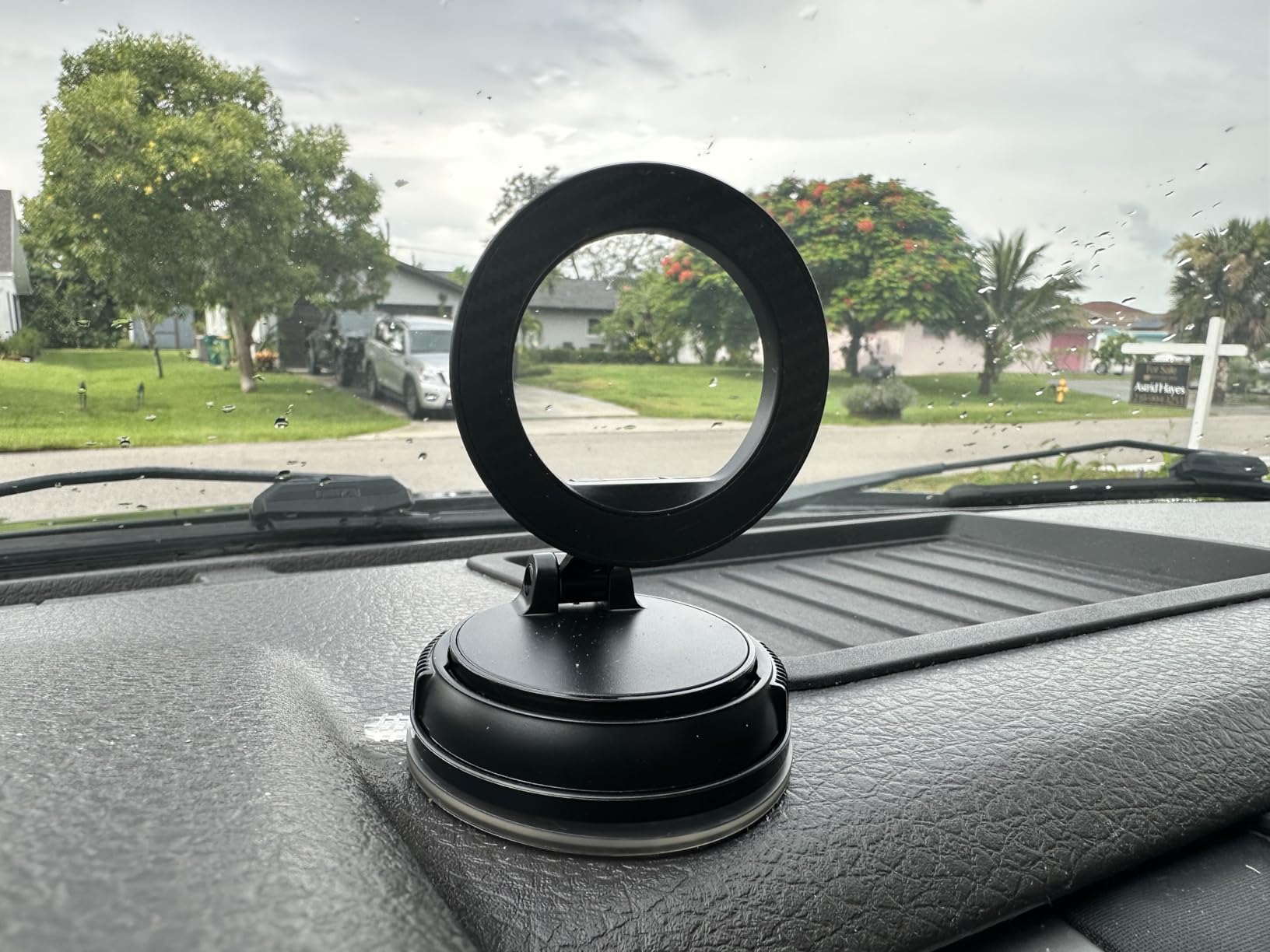
The anxiety this creates is low-grade but persistent. Drivers mount their iPhone, start navigation, and spend the first few minutes of every trip hyper-aware of the phone’s position. Is it sitting flush? Did the case align properly with the magnets? Will that upcoming pothole be the one that breaks the connection? The mount becomes a trust exercise repeated at every rough patch of road, where you glance over to confirm the phone hasn’t detached and slid under the seat.
Apple’s own MagSafe accessories don’t address this. The company sells chargers and wallets, not car mounts. The assumption seems to be that CarPlay eliminates the need for the phone to be visible—navigation happens on the dashboard screen, not the phone itself. But that assumption breaks down constantly. Not every car supports wireless CarPlay. Not every driver trusts their car’s navigation interface. And even with CarPlay enabled, many users prefer the phone visible as a secondary reference point, a backup in case the car’s system glitches mid-route.
SIMILAR
iPhone and MacBook users are compensating for a port problem Apple created
iPhone users are eliminating the tangled cable from every car charging session
iPhone users are transforming nightstands into silent charging infrastructure
Third-party manufacturers stepped into that gap with mounts engineered for forces Apple never considered. Suction cups rated to hold 78 pounds. Magnets generating 2400 grams of force. These aren’t specifications Apple would ever publish—they’re inelegant, they’re excessive, and they reveal that the baseline MagSafe spec wasn’t sufficient for the use case users actually needed.
The result is a mount that feels like overkill in static conditions but barely adequate in motion. On a smooth highway, the magnetic hold is plenty. On a city street with aging asphalt and constant stop-and-go traffic, every bump becomes a test. The driver learns which roads are smooth enough to trust the mount and which ones require a hand hovering near the phone, ready to catch it if the magnets fail.
What’s interesting is how normalized this anxiety has become. Drivers don’t question whether the phone should be magnetically mounted—they just accept that magnetic mounting requires stronger magnets than Apple provides, and they buy third-party solutions to compensate. The ecosystem created the expectation, but it didn’t deliver the implementation, so users fill the gap with accessories that feel excessive by design.
Previously listed at $42.59, current listings hover around $25.61. That pricing reflects the mount’s role as essential infrastructure for drivers who’ve committed to MagSafe but discovered that commitment requires aftermarket reinforcement to survive real-world driving conditions.
The mount becomes a trust exercise repeated at every rough patch of road, where you glance over to confirm the phone hasn’t detached and slid under the seat. It’s a small friction, but it’s constant, and it exposes a larger truth: Apple built MagSafe for stationary elegance, and users adapted it for mobile utility, and the gap between those two use cases remains wide enough that drivers still worry whether their phone will stay attached through the next pothole.
"Note: Readers like you help support The Apple Tech. We may receive a affiliate commission when you purchase products mentioned on our website."