


Satellite emergency features on newer iPhones address worst-case scenarios, but a growing number of users are looking for real-time communication tools that work independently of cellular networks and Apple’s infrastructure.
The iPhone shows one bar, then no bars, then “SOS Only.” You’re an hour into a hike, or driving through a rural area, or in a building where signal doesn’t penetrate. The device is still functional—you can take photos, use apps that don’t require data—but the primary thing it’s supposed to do, which is connect you to other people, has stopped working.
Apple’s satellite emergency features address the most extreme version of this problem. If you’re injured or stranded in a remote area, you can send a distress signal to emergency services. This is a meaningful safety feature, but it’s reactive rather than proactive. It assumes you’re already in trouble. It doesn’t help with coordination, with checking in, with maintaining contact during activities where cellular coverage is intermittent or absent.
Direct device-to-device communication fills that gap. Radios that operate on FMR frequencies don’t depend on cell towers or satellites. They create a direct link between two or more devices within a certain range—sometimes a few miles in open terrain, sometimes much less in forests or urban environments with obstacles. The range limitation is also the appeal: these are local, immediate, person-to-person connections that don’t require infrastructure.
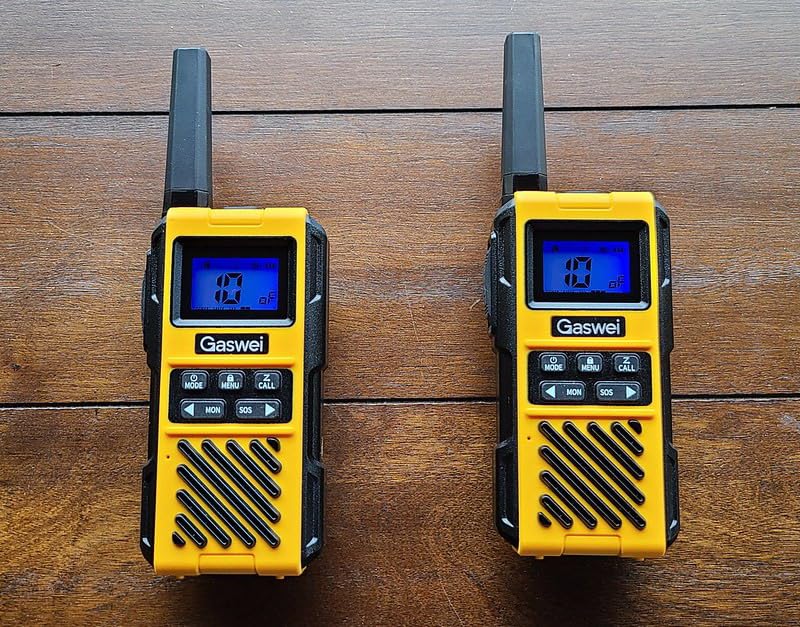
The iPhone can’t replicate this. iOS supports peer-to-peer AirDrop and some limited mesh networking for specific use cases, but these features weren’t designed for long-range communication or emergency coordination. They work well for sharing files across a room, less well for staying in contact across a mountain or during a power outage when Wi-Fi is down.
Weather alerts and emergency broadcasts add another layer of utility. The iPhone can deliver notifications if you have signal and if you’ve enabled them, but in the scenarios where direct radios are most useful—backcountry hiking, rural travel, storm preparation—cellular service is often the first thing to fail. Having a device that can receive NOAA weather alerts independently of the phone creates redundancy, which becomes important when conditions deteriorate.
USB-C charging has made these devices easier to integrate into existing routines. You’re already carrying a USB-C cable for the iPhone or the iPad, and now the same cable can charge the radio. This small compatibility detail reduces the friction of keeping yet another device powered and ready. The radio isn’t an entirely separate system—it’s part of the same charging ecosystem you’re already managing.
There’s a cultural dimension to this, too. The assumption that connectivity is always available has shaped how people move through the world. When that assumption breaks, the iPhone is remarkably capable until it isn’t, and the transition from connected to isolated happens faster than most people expect. Previously listed at $90, current listings hover around $45 (CODE HR434EVJ) for models that prioritize durability and battery life over features. The shift reflects a quiet acknowledgment that Apple’s ecosystem, as comprehensive as it is, still has edges where other tools are necessary—not as replacements, but as supplements for the moments when the network isn’t there.
"Note: Readers like you help support The Apple Tech. We may receive a affiliate commission when you purchase products mentioned on our website."






