Getting into a car used to involve a sequence: start the engine, adjust the mirrors, place the phone in the mount, tighten the clamp, plug in the cable. The auto-clamping wireless charger eliminates the last two steps. The phone approaches the mount, and mechanical arms close around it automatically. Charging begins on contact. The entire process takes a second.
This matters because driving is a moment of divided attention. Hands are on the wheel, eyes are scanning traffic, and the cognitive load of securing a phone—even briefly—creates friction. The auto-clamp removes that friction. The phone clicks into place without requiring fine motor adjustment or visual confirmation. The driver can focus on merging into traffic or navigating an unfamiliar intersection instead of fiddling with a spring-loaded grip.
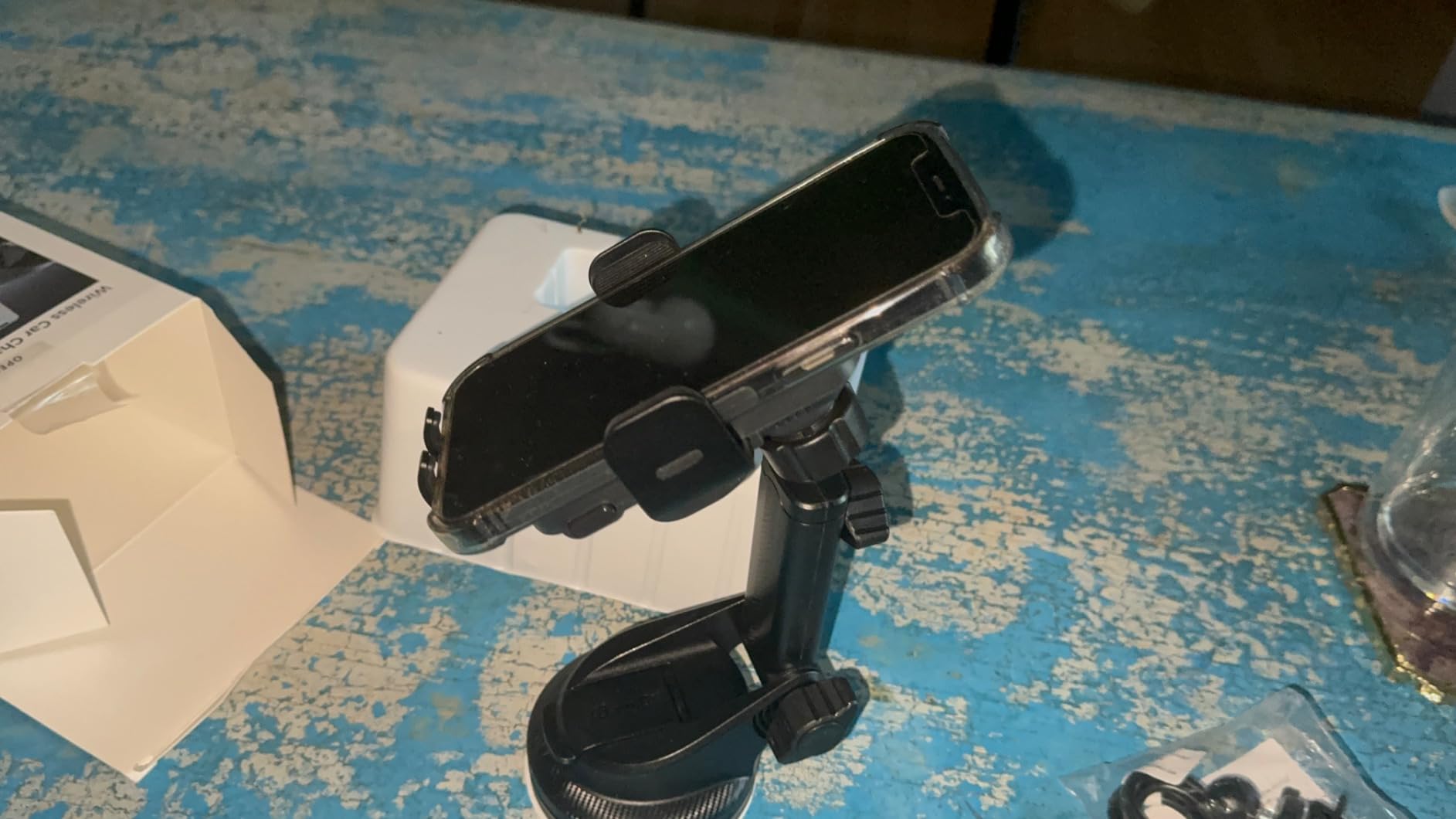
The 15-watt charging capacity is significant for iPhone users who’ve upgraded to models with MagSafe or fast wireless charging. The phone doesn’t just sit in the mount—it actively replenishes battery during the drive. For commuters, this means the phone arrives at the destination with more charge than it had at departure, even if navigation and music streaming were running the entire time. The car becomes a charging opportunity, not just a transit interval.
The mount’s versatility—windshield, dashboard, or air vent attachment—reflects the reality that no two car interiors are identical. Some vehicles have deeply recessed dashboards. Others have vents that can’t support weight. The mount adapts to these constraints, but the underlying behavior is the same: the iPhone occupies a fixed, visible position where it mediates the driving experience.
What’s changed is the expectation that charging should be passive. Plugging in a cable requires locating the port, aligning the connector, and ensuring a secure connection. Wireless charging requires only proximity. The mount handles alignment through its clamping mechanism, and the phone charges without the driver needing to think about it. The action becomes automatic, which means it can happen more frequently and with less resistance.
There’s also a durability consideration. Charging ports wear out. Lightning connectors accumulate lint and debris. USB-C ports, while more robust, still suffer from repeated insertion and removal. Wireless charging sidesteps this entirely, reducing the mechanical stress on the phone’s physical components. The mount becomes the intermediary, absorbing the wear that would otherwise accumulate on the device itself.
Previously listed at $21.99, current listings hover around $19.66. The price reflects the commodification of wireless charging technology, but the behavioral shift is more revealing. The car mount is no longer just a holder. It’s an automatic charging station that activates the moment the phone enters its range. The driver’s role has been reduced to placing the phone near the mount. Everything else happens without intervention, turning a multi-step process into a single, thoughtless gesture.
"Note: Readers like you help support The Apple Tech. We may receive a affiliate commission when you purchase products mentioned on our website."