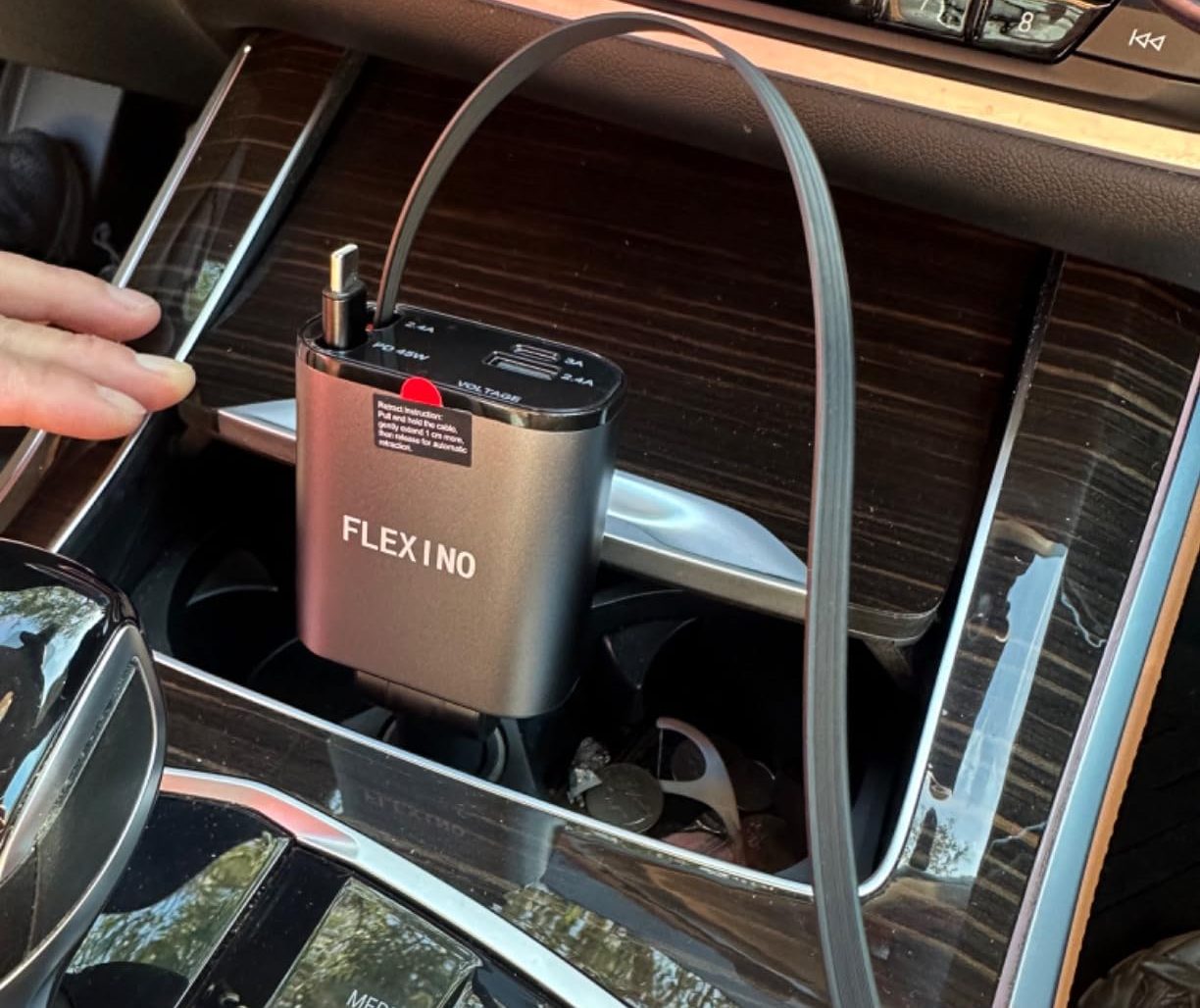
Car charging has become a non-negotiable part of iPhone ownership. Most drivers plug in their phone the moment they enter the vehicle, less out of battery necessity and more out of habit—ensuring the device is always topped up, always ready, always connected. But this routine has carried a persistent annoyance: the cable. It dangles, it tangles, it falls into crevices between seats, and it requires constant adjustment. The retractable car charger solves this with a mechanism so simple it’s striking that it wasn’t standard from the beginning.
The retractable cable retracts flush into the charger body when not in use, eliminating the loose cable that clutters the center console or drapes across the passenger seat. The change is small, but the friction it removes is disproportionately large. Drivers no longer fish for the cable end, untangle knots, or deal with a perpetually messy charging setup. The cable deploys when needed and disappears when it’s not, reducing the charging process to a single deliberate motion rather than a series of small adjustments.

This shift reflects a broader pattern in how people interact with their cars. The vehicle has become an extension of the home workspace—a place where the iPhone is always connected, always charging, and always available for navigation, calls, or music. The cable has been the weakest link in that integration, the one element that still feels improvised rather than designed. The retractable mechanism brings the in-car charging experience closer to the seamless expectation users have for other aspects of their Apple ecosystem.
What’s notable is how the retractable design changes the perception of the car charger itself. Traditional chargers feel like temporary add-ons, devices plugged into the cigarette lighter socket with cables hanging loose. The retractable version feels more permanent, more intentional—a piece of the car’s infrastructure rather than something the driver brought along. This shift in framing matters because it reinforces the sense that the car is a fully integrated part of the iPhone’s daily environment, not a transitional space where compromises are necessary.
SIMILAR
Why iPhone users are carrying standalone noise machines instead of relying on sleep apps
Apple Watch charging became a bedside ritual, here's why the placement matters more than expected
iPhone users are quietly giving up the cable and most dont realize why it happened so gradually over time
The fast charging capability has also become essential. Short trips no longer provide enough time for meaningful charging with slower adapters, and many drivers rely on brief top-ups during errands or commutes. A retractable cable paired with inadequate charging speed would solve one problem while leaving another unaddressed. The combination of cable management and fast charging represents a recognition that in-car charging needs to be both clean and efficient to meet current usage patterns.
The slim profile of these chargers has also reduced another point of friction. Early car chargers protruded awkwardly from the socket, often interfering with gear shifts or cup holders. The ultra-slim design sits flush, taking up minimal space and reducing the sense that the charger is an intrusive foreign object in the vehicle. This matters because car interiors are spatially constrained, and any device that occupies unnecessary space creates low-level annoyance that accumulates over time.
The broader implication is that iPhone users are no longer willing to accept functional but inelegant solutions, even in contexts as transient as car charging. The expectation that Apple ecosystem experiences should be seamless has expanded beyond devices and into every accessory and environment where the iPhone is used. The retractable car charger doesn’t add new functionality—it simply removes friction that users have tolerated long enough to recognize as solvable.
Previously listed near $10, current listings of these retractable models with USB-C and fast charging now appear closer to $8(CODE FATOAKPJ), reflecting both competitive pressure and the expectation that cable management should be a standard feature rather than a premium upgrade.
"Note: Readers like you help support The Apple Tech. We may receive a affiliate commission when you purchase products mentioned on our website."