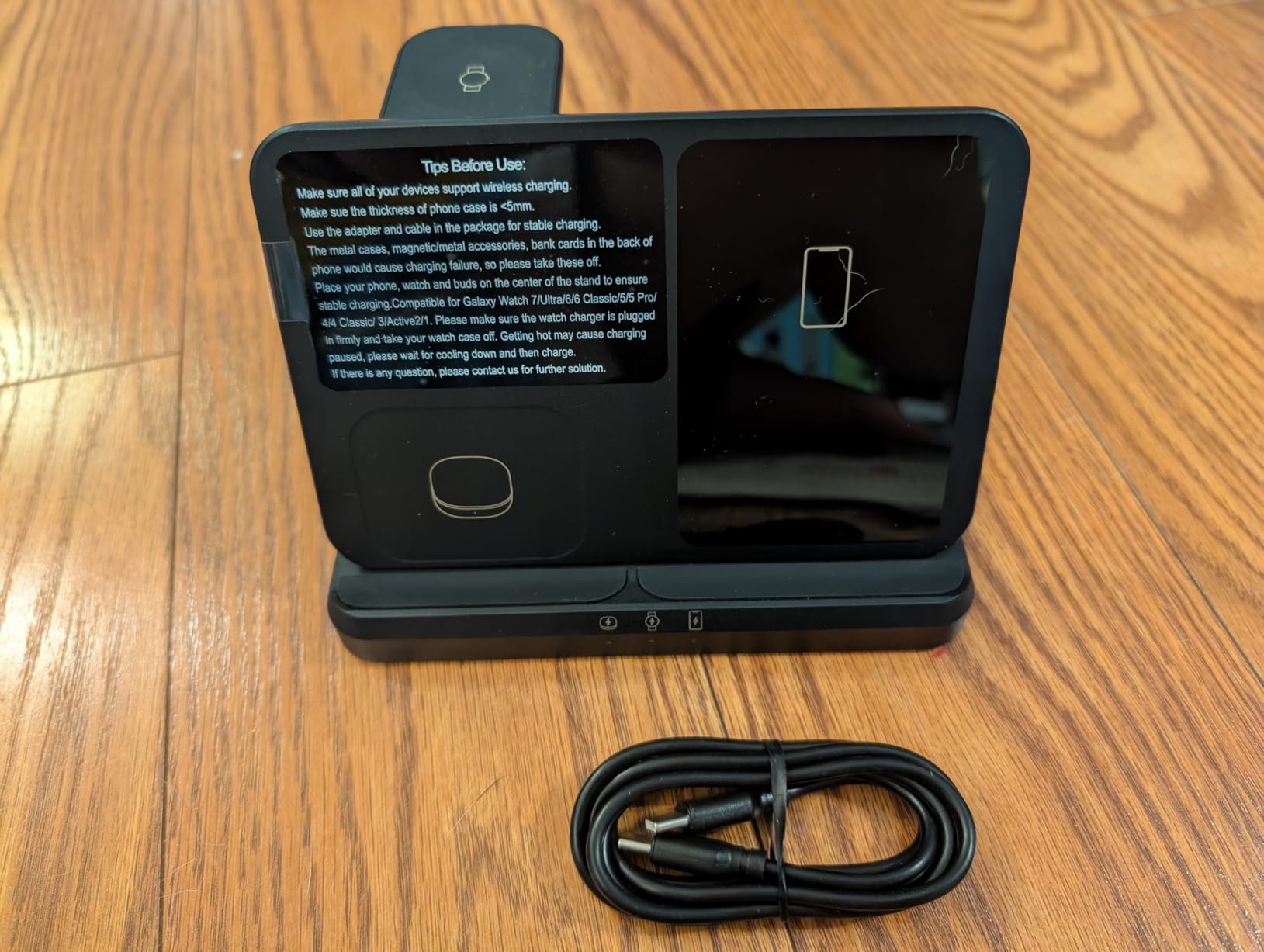
The nightstand charging station looks remarkably similar across ecosystems. An iPhone user has their phone, Apple Watch, and AirPods lined up. A Galaxy user has their phone, Galaxy Watch, and Galaxy Buds in the same configuration. The hardware differs, but the spatial arrangement and nightly routine are nearly identical. The behavior transcended the brand.
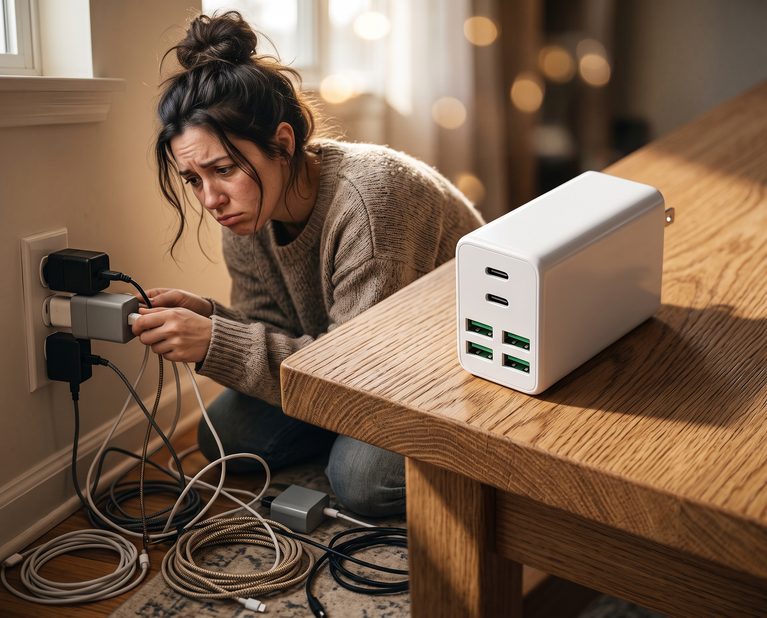
Wireless charging consolidated what used to be a mess of cables. Three devices meant three cables, three wall adapters, and three places to plug them in. A single charging station reduced that to one power connection and one surface. The simplification wasn’t just physical—it was cognitive. There was one place to put devices before bed, and they’d all be ready in the morning.

The detachable watch charger addressed a specific travel problem. At home, the three-in-one station stayed on the nightstand. While traveling, the watch charger could be removed and packed separately, making it easier to fit into a toiletry bag or jacket pocket. The rest of the station could stay behind. That modularity meant the station served both stationary and mobile use cases without requiring a separate travel charger.
Foldable design reflected how people actually used these stations. Some wanted the charger to sit flat on a surface; others wanted the phone propped upright for easier notification viewing. The ability to adjust the angle meant the station worked in different contexts—on a crowded nightstand, on a minimalist desk, on a hotel dresser with limited space. The form adapted to the environment.
SIMILAR
iPhone and MacBook users are compensating for a port problem Apple created
iPhone users are eliminating the tangled cable from every car charging session
iPhone users are transforming nightstands into silent charging infrastructure
Fast charging on a wireless station was always a compromise. Wired charging was faster, more efficient, and more reliable. But wireless charging was tidier, required less physical interaction, and worked even when someone was half-asleep. People tolerated the speed trade-off because the convenience trade-off felt worth it. The station wasn’t about charging as quickly as possible—it was about charging passively, without thought.
The absence of an included adapter was a cost consideration but also an ecosystem assumption. People who owned a Galaxy S25 Ultra almost certainly owned a compatible fast charger already. Including another adapter would have increased the price and added redundant hardware to a drawer full of unused chargers. The station assumed existing infrastructure rather than trying to provide it.
Pricing positioned the station as a mid-tier accessory. Previously listed at $33.99, current listings hover around $25.64. That’s more expensive than individual wireless charging pads but cheaper than buying three separate chargers. The value proposition was consolidation—one purchase, one object, one charging routine.
What’s notable is how little the behavior differed across ecosystems. Apple users and Samsung users both developed the same habit of placing their devices in the same spot every night. The charging station enabled that ritual, turning power management into a passive background process. The devices recharged, but more importantly, they had a designated home, a place they returned to at the end of every day.
"Note: Readers like you help support The Apple Tech. We may receive a affiliate commission when you purchase products mentioned on our website."