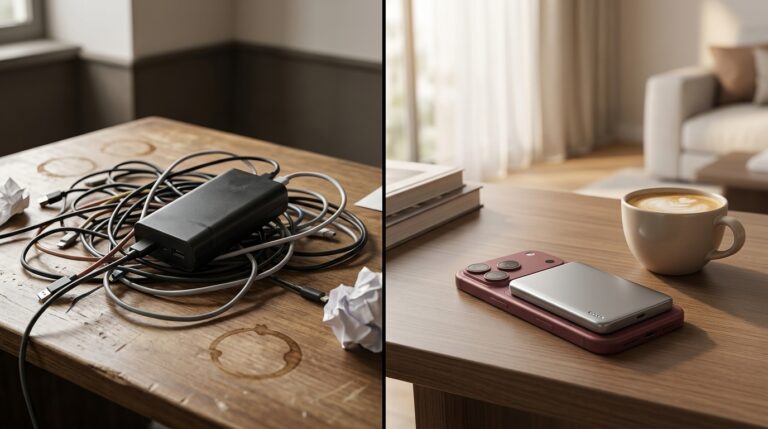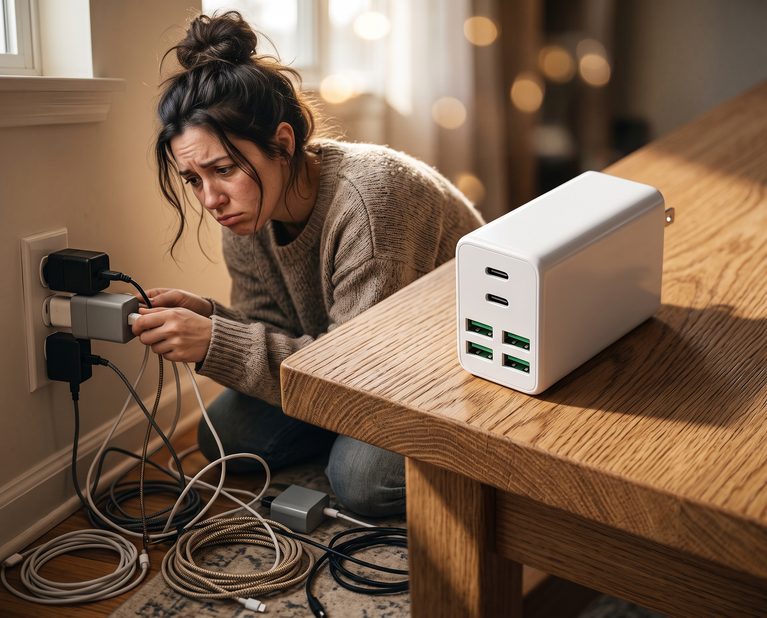


Counting devices in a typical household produced surprising numbers. Two adults and a teenager might have six phones between them—current models plus old ones used as backups or hand-me-downs. Add iPads, Apple Watches, AirPods cases, portable batteries, Kindles, smart home devices, and the count reached fifteen or more. Not all needed charging simultaneously, but they all needed charging eventually, and a ten-port station meant fewer decisions about what to prioritize.
The included cables were both a convenience and a limitation. Four cables meant four devices could charge immediately without searching for compatible cords. But they also meant the station’s flexibility was partially predetermined—the included cables determined which devices could connect easily. Additional devices required bringing their own cables, which undermined the station’s promise of simplification.

GaN technology made two hundred watts of power delivery possible in a reasonably sized unit. Older charging stations with similar wattage would have been much larger and generated concerning amounts of heat. The GaN components ran cooler and packed more densely, making the station practical for desktop placement rather than hiding under a desk or in a closet.
The mix of USB-C and USB-A ports acknowledged the transitional state of device charging. Newer devices used USB-C; older ones still used USB-A. A station with only USB-C ports would have been forward-looking but immediately impractical. The mixed configuration worked with the devices people actually owned, not the devices they might own in the future.
SIMILAR
iPhone and MacBook users are compensating for a port problem Apple created
iPhone users are eliminating the tangled cable from every car charging session
iPhone users are transforming nightstands into silent charging infrastructure
The power strip form factor integrated into existing desk setups. The station replaced a standard power strip, occupying the same footprint while adding USB ports. That substitution meant the station didn’t require finding new desk space—it took over the space the power strip already occupied. The swap was straightforward, which increased the likelihood people would actually set it up.
Wattage distribution across ten ports created a hidden complexity. Two hundred watts total didn’t mean twenty watts per port. The station allocated power dynamically, providing more to devices that could accept it and less to devices that couldn’t. A MacBook might draw sixty-five watts while an Apple Watch drew five. Understanding how the power split wasn’t necessary to use the station, but it affected whether all ten devices would charge at full speed simultaneously.
Pricing positioned the station as household infrastructure. Previously listed at $39.99, current listings hover around $22.79. That’s a substantial purchase for a single accessory, but compared to buying ten individual chargers, it was cost-effective. The station consolidated both cost and physical space.
The station represented an acknowledgment of how device-dense households had become. Ten ports wasn’t future-proofing—it was addressing current reality. The station didn’t encourage buying more devices; it simply accommodated the devices that were already there, spread across family members and use cases. It was infrastructure for a saturation point that had already been reached.
"Note: Readers like you help support The Apple Tech. We may receive a affiliate commission when you purchase products mentioned on our website."