Laptop battery life has improved over the years, but the MacBook Pro’s power demands remain substantial, especially under load. Video editing, 3D rendering, and sustained multitasking all drain the battery faster than casual web browsing, and until recently, running out of power meant finding an outlet. The introduction of high-wattage portable chargers changed that equation, but the trade-off is physical: a battery pack capable of recharging a MacBook is significantly larger and heavier than one designed for an iPhone.
The 165-watt output is the key spec. It’s enough to charge a MacBook Pro at full speed, even while the machine is running demanding tasks. This is a meaningful capability for people who work in environments without reliable power—outdoor shoots, remote locations, long flights. But the battery pack itself is not subtle. At 20,000mAh, it’s a dense brick of lithium cells wrapped in aluminum. It’s TSA-approved, which makes air travel feasible, but it still occupies a non-trivial portion of carry-on space.
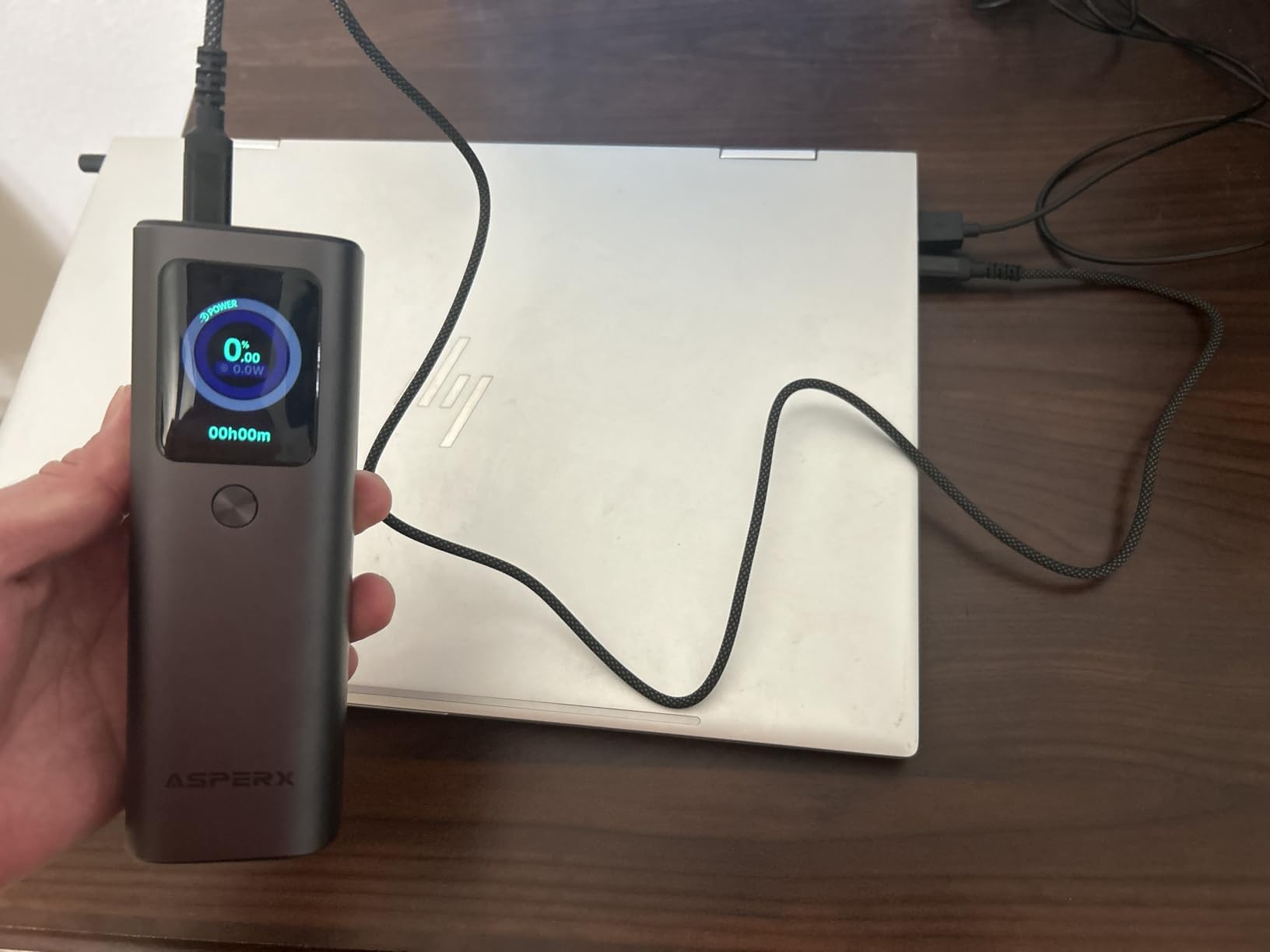
The retractable cable design is an attempt to manage one of the traditional pain points of portable power: cable tangling. A cable that retracts into the body of the charger eliminates the need to carry a separate cord, and it reduces the chance of damage during transit. But retractable mechanisms are inherently complex. Springs, spools, and connectors all introduce potential failure modes. Over time, the retraction may weaken, or the cable may kink. The convenience is real, but so is the risk.
What’s less obvious is the psychological shift that comes with carrying this much power. A phone battery pack is a safety net. A laptop battery pack is infrastructure. It changes the calculus of where you can work. A park bench becomes viable. A train ride becomes productive. But the weight is always present. This isn’t something you slip into a pocket and forget. It’s something you account for when packing a bag, and it’s something you notice when carrying the bag for more than a few minutes.
SIMILAR
iPhone and MacBook users are compensating for a port problem Apple created
iPhone users are eliminating the tangled cable from every car charging session
iPhone users are transforming nightstands into silent charging infrastructure
The multi-device charging capability—iPhone, iPad, MacBook—positions the pack as a universal solution, but in practice, most users charge one device at a time. The ability to charge three simultaneously is useful in edge cases, but those edge cases are rare enough that the feature often goes unused. What matters more is whether the pack can handle the wattage demands of the primary device without overheating or throttling.
Previously listed at $89.99, current listings hover around $56.99, placing this category at the higher end of portable charging solutions but below the cost of a second OEM MacBook charger. The pricing reflects the complexity of delivering high-wattage output in a portable form factor, as well as the niche nature of the use case.
The broader implication is that portability is no longer a binary. There’s “portable enough to carry” and “portable enough to forget.” High-capacity laptop chargers live in the first category but not the second. They enable new workflows, but they also demand compromises in weight, space, and the constant awareness that you’re carrying a small power station in your bag.
"Note: Readers like you help support The Apple Tech. We may receive a affiliate commission when you purchase products mentioned on our website."