
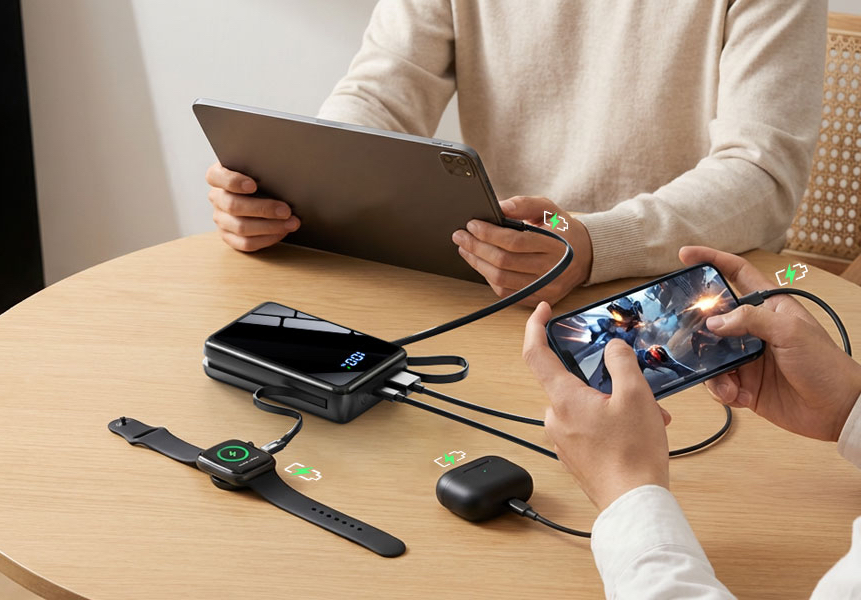
The battery pack weighed more than the iPad it was charging, but that weight was the price of uninterrupted mobility. Digital nomads and remote workers who operate from cafes, co-working spaces, or while traveling face a consistent challenge: electricity is available, but not reliably. Outlets are occupied. Power cuts happen. Some locations simply don’t have charging infrastructure.
A 50,000mAh battery pack addresses this by providing enough capacity for multiple days of device use without wall power. That’s roughly ten full iPhone charges, or three to four iPad charges, or some combination that keeps multiple devices operational through extended periods. The capacity transforms the battery pack from emergency backup into primary power infrastructure.

The built-in cables matter enormously at this capacity level. When you’re carrying enough power to charge a small household’s devices, the last thing you want is to also carry multiple cables that can get lost, tangled, or left behind. Integrated cables mean the battery pack is self-contained—everything needed to charge any device is permanently attached.
But 50,000mAh means significant weight and bulk. These battery packs often weigh two pounds or more, roughly equivalent to a laptop. For travelers trying to minimize carry weight, this creates a genuine dilemma: the battery provides freedom from outlets, but it does so by adding significant load to your bag. The trade-off only makes sense if outlet access is truly unreliable.
The LED display is a practical necessity at this capacity. With smaller battery packs, you can estimate remaining power based on how many times you’ve charged devices. At 50,000mAh, that math becomes impossible. You need precise percentage feedback to plan when you’ll need to recharge the pack itself, especially if you’re in a location where finding power to recharge a massive battery will take hours.
What’s interesting is how this capacity level reflects changing assumptions about connectivity and power access. A decade ago, “off-grid” meant accepting limited device usage. Now it means carrying your own grid with you. The expectation of continuous connectivity hasn’t diminished—it’s just been decoupled from wall power availability.
Previously listed at $99.99, current listings hover around $33.99. The dramatic price drop from original listing reflects both improved battery manufacturing economics and intense competition in the high-capacity portable charger category.
"Note: Readers like you help support The Apple Tech. We may receive a affiliate commission when you purchase products mentioned on our website."