
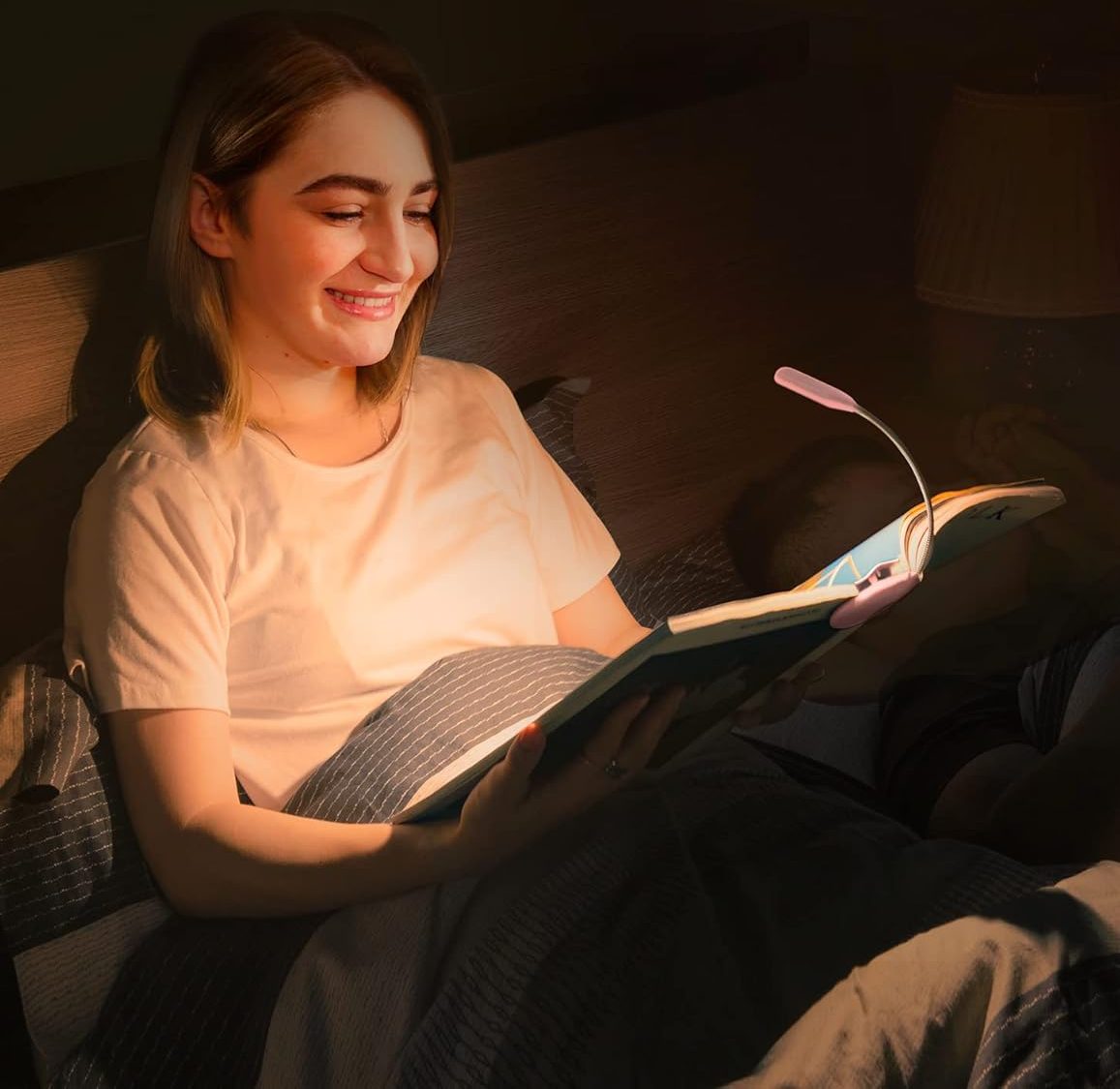
There’s a particular moment in many relationships when reading stops being a solitary activity and becomes a shared environmental experience. It usually happens after moving in together, when bedtimes stop aligning and one person’s wind-down ritual starts bumping against another person’s need for darkness and silence. The iPhone solves this neatly for screen readers—brightness dims to near-nothing, blue light filters activate, and the glow stays contained. But for people who prefer paper, the bedroom becomes a small engineering problem.
The physics are unforgiving. Overhead lights are too bright. Bedside lamps cast pools that bleed across pillows. Phone flashlights create harsh, directional beams that feel like interrogation tools. What’s needed is something narrow, controlled, and forgettable—a light source that illuminates pages without announcing itself to someone trying to sleep eighteen inches away. That this requires a separate device in 2025 feels almost anachronistic, but the market for clip-on reading lights keeps expanding anyway.
Battery life emerged as the unexpected dealbreaker. Not because anyone reads for 80 consecutive hours, but because bedtime devices need to exist in a state of constant readiness without demanding attention. The moment a reading light requires weekly charging, it enters the same mental category as a phone or tablet—something to manage, monitor, and remember. When it holds a charge for weeks, it disappears into the background of a routine. You don’t realize how much noise a page turn makes until someone else is trying to sleep through it.
Color temperature controls sound technical until you use them past 10 PM. Warm light reads as cozy and contained. Cool light feels clinical, and worse, it seems to travel farther across a room than warm tones at the same brightness. The ability to shift between three temperatures isn’t about preference so much as it’s about matching the light to the moment—warmer when someone’s already asleep, cooler when you’re still alone and fully awake. It’s mood control disguised as functional adjustment.
Weight matters in ways that only become apparent after twenty minutes of holding a book. A clip-on light that weighs more than an ounce and a half starts to tip paperbacks forward, changes the balance of hardcovers, and makes your wrist aware that it’s compensating for something. At 1.3 ounces, the presence becomes subliminal. You forget you’ve added hardware to a centuries-old activity, which is exactly the point.
The three-brightness-level standard didn’t exist five years ago. Now it feels mandatory. The logic is obvious once someone explains it: minimum brightness for when someone’s already asleep, medium for shared quiet time, maximum for when you’re alone and want actual illumination. Two settings force compromise. Four feels like overthinking. Three hits the threshold where most situations get covered without requiring a decision tree.
What’s strange is that this entire category exists primarily for people who’ve rejected screens before bed. They’ve made a deliberate choice toward paper, often for sleep quality reasons or because they find screens overstimulating late at night. But that choice creates downstream needs—physical lighting infrastructure, charging routines, something else to pack when traveling. Reading on an iPhone requires nothing beyond the phone. Reading a book in bed after dark now requires accessories, planning, and spatial awareness of another person’s presence.
The 17% discount on these lights matters less than the fact that the baseline price has dropped enough to make them impulse purchases rather than considered investments. At a certain price point, you buy one to see if it solves the problem. If it doesn’t, the cost is forgettable. If it does, you’ve just unlocked an hour of reading time that previously felt socially complicated. That calculation happens quietly, in bedrooms across time zones, whenever someone realizes their reading habit has become someone else’s environmental concern.
"Note: Readers like you help support The Apple Tech. We may receive a affiliate commission when you purchase products mentioned on our website."