
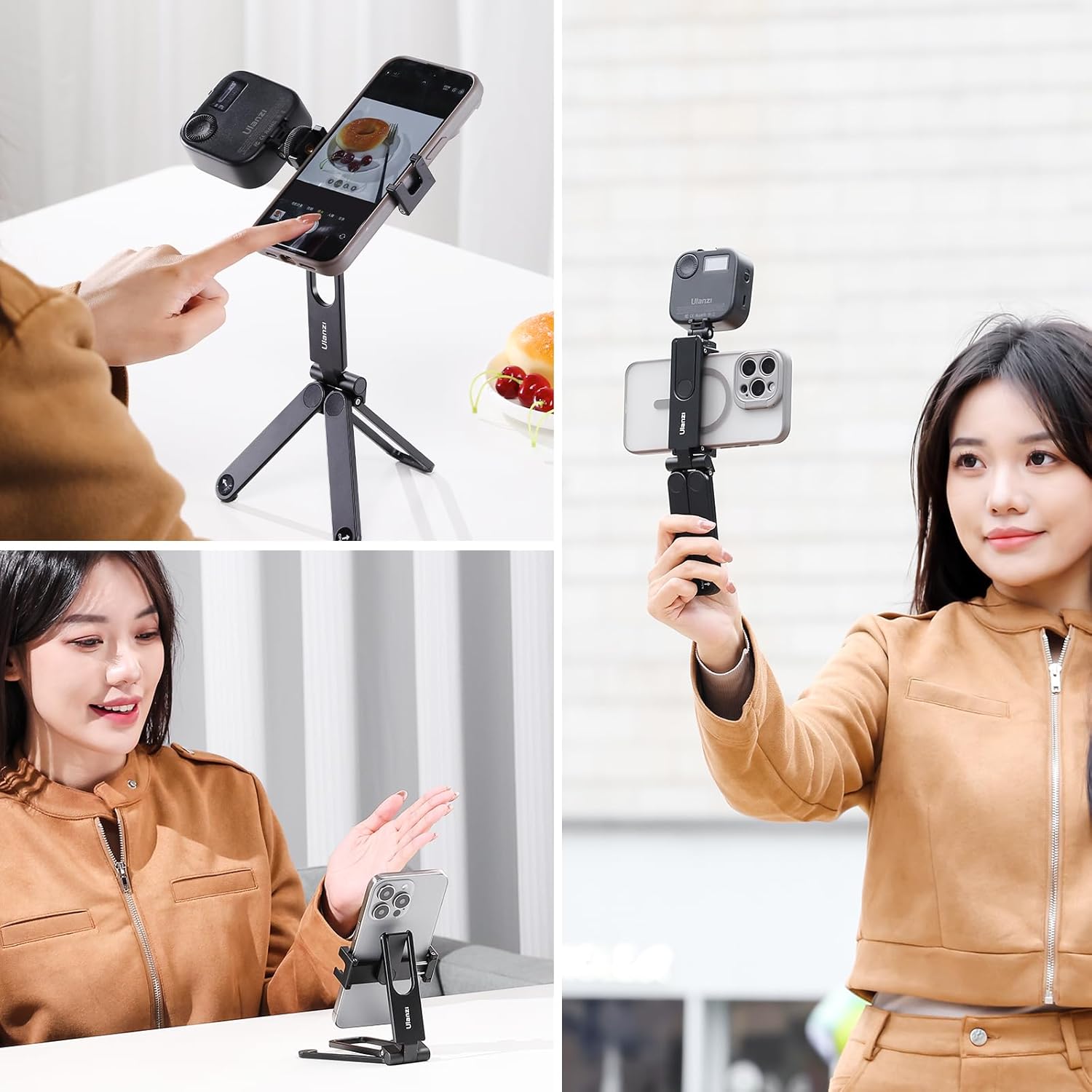
iPhone videography happens in a specific posture. One hand grips the device vertically, thumb hovering near the record button or volume control. The frame wobbles slightly as the user shifts weight or adjusts position. The other hand sometimes reaches across to stabilize, but this blocks the screen or interferes with touch controls. It’s an awkward ergonomic compromise that millions of iPhone users repeat daily without much conscious thought.
This wasn’t always the dominant shooting orientation. Early iPhone video was primarily horizontal, and horizontal filming naturally encourages a two-handed grip with better weight distribution. But social media platforms normalized vertical capture, and vertical filming fundamentally changes how the device sits in the hand. It’s taller, narrower, and more prone to tilt during movement.
The instability isn’t severe enough to ruin footage, but it’s present enough that users developed unconscious compensation strategies—leaning against walls, tucking elbows, or simply accepting a slight waver as normal. Apple introduced stabilization software that smooths some of this movement, and for many users, that felt sufficient. The footage looked stable enough on a phone screen, which is where most of it would be viewed anyway.
What’s notable is how long users managed this friction without seeking alternatives. The iPhone is designed to be held and operated with minimal accessories, and adding a grip or handle feels contrary to the device’s philosophy of simplicity. For years, the default assumption was that good iPhone video meant mastering the one-handed hold, not modifying the hardware.
But the expansion of casual vlogging and selfie video has quietly shifted this expectation. Users who film themselves talking—whether for social posts, family updates, or work documentation—need to maintain eye contact with the lens while keeping the frame steady. This requires a different kind of stability than quickly capturing a moment. The phone needs to stay fixed at arm’s length, which is where the one-handed grip starts to fail.
Compact tripod handles designed specifically for smartphones have become more common. They fold small enough to fit in a jacket pocket, extend to function as a grip, and stabilize into a tripod base when needed. For iPhone users, this doesn’t feel like adopting photography equipment—it’s closer to adding a case or stand, accessories that enhance the phone without fundamentally changing how it’s used.
The behavior shift is gradual. Users don’t announce they’re learning videography. They simply stop bracing their arm against furniture or re-recording shaky clips. Listings for foldable smartphone grips currently reflect a reduction of roughly 20 percent compared with earlier availability.
"Note: Readers like you help support The Apple Tech. We may receive a affiliate commission when you purchase products mentioned on our website."